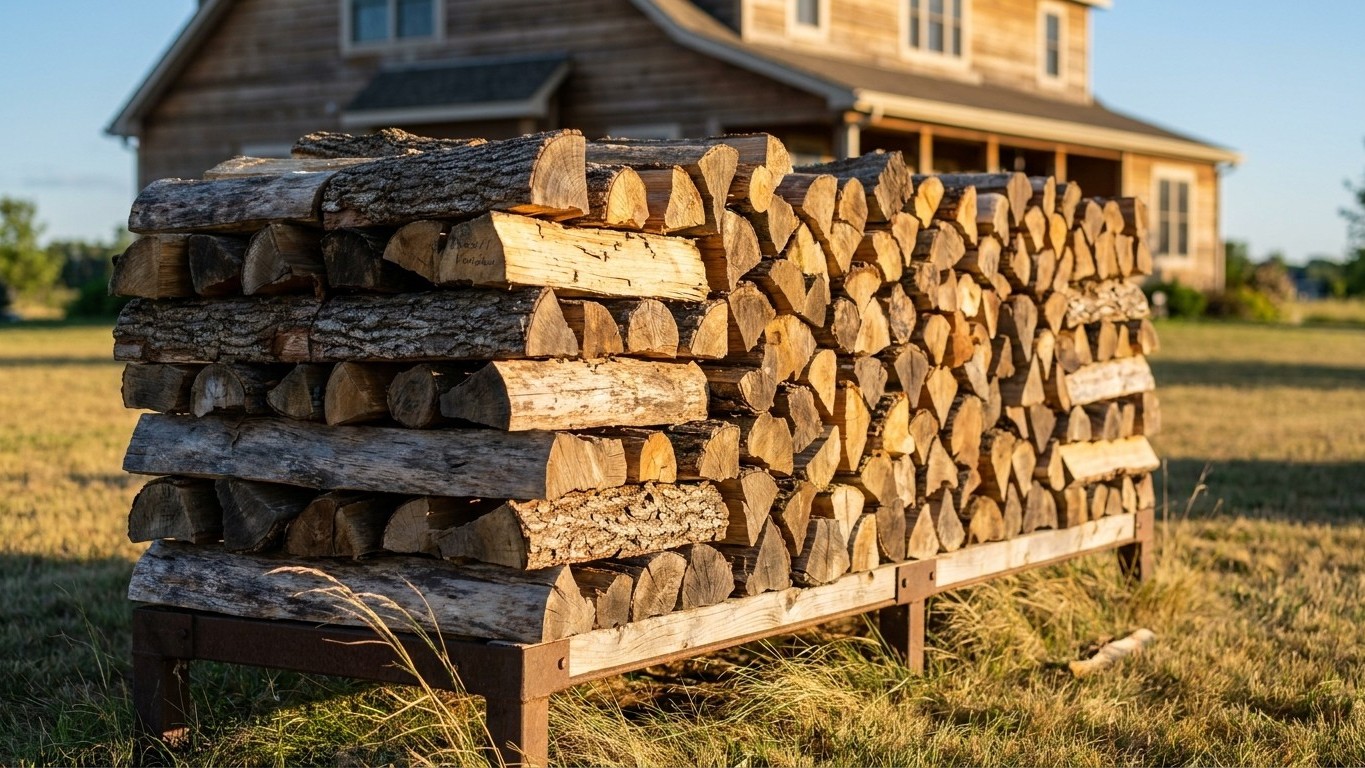

A good firewood stack keeps logs off the ground, exposes them to wind and sun, and sheds rain and snow away from the wood itself. Get those three things right and even green-cut oak will season properly within a year, while a sloppy pile of logs tossed against a fence can stay damp, moldy, and hard to light no matter how long it sits.
The difference between a stack that dries and one that rots usually comes down to airflow, not effort. Homeowners often assume more wood means more work, but the physics are the same whether you’re storing half a cord or five: air needs to move through and around every log, and water needs somewhere to go besides straight down into the pile.
Choosing the Right Spot to Stack Firewood

Location decides more about drying time than almost anything else you’ll do afterward. Wood stacked in a shaded, damp corner of the yard can take two years to season properly, while the same wood stacked in a sunny, breezy spot might be ready to burn in six to twelve months.
Look for a site that gets afternoon sun and catches prevailing wind. South-facing walls work well in most of the country because they pick up extra heat and light through fall and winter. Avoid low spots where water pools after storms, and stay clear of dense tree cover that blocks both sun and airflow.
Distance from the house matters for a different reason. The National Fire Protection Association and most state forestry extensions recommend keeping firewood stacks at least 30 feet from any structure, since woodpiles attract insects, rodents, and occasionally snakes looking for shelter. Termites and carpenter ants in particular can migrate from a woodpile into a home’s siding or foundation if the stack sits too close. A stack near the tree line is convenient for wildlife, not for your house.
Ground Contact Is the Enemy
Never stack firewood directly on soil or grass. Ground moisture wicks upward into the bottom layer of logs, keeping them wet indefinitely and inviting fungal decay. Pallets, pressure-treated 2x4s, or a simple rack made from PVC pipe or metal rail all work to lift the pile 4 to 6 inches off the ground. This single habit probably prevents more spoiled firewood than any other single factor.
How to Stack Firewood So It Actually Dries
Once the base is off the ground, stacking method determines airflow through the pile. Rows should run in the direction of prevailing wind whenever possible, so breezes travel the length of the stack rather than hitting a solid wall of bark.
Split logs dry faster than round ones because splitting exposes the inner wood fibers, where most of the moisture lives. A round, unsplit log with intact bark can take twice as long to season as the same wood split into quarters. Bark acts almost like a raincoat, sealing moisture in even as the exposed ends try to release it.
Leave gaps between individual logs rather than packing them tight. A stack that’s too dense behaves like insulation, trapping humidity inside instead of letting it escape. Aim for loose, somewhat irregular rows rather than a perfectly tight brick-like wall. Height matters too: stacks over 4 feet tall become unstable and harder to access safely, so most extension services recommend keeping rows around waist height.
End-Stacking Methods That Prevent Toppling
Self-supporting stacks (sometimes called “holz hausen” or round stacks) work well in open yards without a wall or post to lean against. Building the ends of a linear row in a crisscross log-cabin pattern, alternating direction every layer, creates a stable interlocking wall that won’t collapse even without external support. This technique is worth learning if the stack sits away from any structure, since a toppled woodpile is both a hazard and a waste of drying time.
Should Firewood Be Covered? What to Use and What to Avoid
Covering firewood protects it from rain and snow, but only the top needs coverage. Wrapping an entire stack in a tarp, sides included, traps moisture and humidity inside, which defeats the purpose of stacking for airflow in the first place. The goal is a cap, not a cocoon.
A rigid roof, whether it’s a lean-to shed, a metal panel, or even sheets of plywood, sheds water more reliably than a tarp and doesn’t flap loose in wind. If a tarp is the only option, cover just the top third to half of the stack and leave the sides completely open. Secure the tarp with rope or bungee cords rather than piling logs on top of the loose edges, since edges weighted down with wood tend to pool water instead of shedding it.
Purpose-built firewood racks with attached roofs solve both the elevation and coverage problems in a single structure, which is why they’re popular with anyone burning wood regularly through a full heating season. For occasional users, a simple pallet base topped with a rigid cover works nearly as well for a fraction of the cost.
How Long Does Firewood Take to Season?
Freshly cut, or “green,” firewood can hold 45 to 50 percent moisture content by weight. Properly seasoned firewood ready to burn should sit closer to 20 percent or below, according to guidance from state forestry and extension programs. That drop doesn’t happen overnight, and it depends heavily on species.
Dense hardwoods like oak and hickory season slowly, often needing a full 12 months or more even under ideal stacking conditions. Softer woods and lighter hardwoods, such as ash, birch, or maple, can be ready in as little as six months if split, stacked correctly, and exposed to good sun and wind. Splitting wood smaller speeds drying time further, since smaller pieces have more exposed surface area relative to their volume.
A simple way to check readiness without a moisture meter: seasoned wood is noticeably lighter than green wood of the same size, has visible cracks radiating from the cut ends, and makes a hollow, sharp knock when two pieces are struck together rather than a dull thud. Bark that’s loose or peeling easily is another sign the wood has dried enough to burn cleanly.
Long-Term and Winter Storage Considerations
Wood that’s fully seasoned still needs protection going into winter, since rain and melting snow can re-wet even dry logs if the stack sits uncovered for months. Moving a smaller working supply, roughly a week’s worth, closer to the house or into a garage or breezeway keeps a dry, easy-access reserve without exposing the entire stockpile to foot traffic and weather every time more wood is needed.
This two-pile system, a large seasoning stack farther from the house and a small “ready” pile near the door, is common practice among people who heat primarily with wood. It also reduces the number of trips tracking snow, bark, and the occasional insect indoors during the coldest months.
Rotating stock matters too. Wood cut and split more than two years ago can begin to lose some of its heat value as it decays past optimal dryness, particularly softer species that are more prone to fungal breakdown once they’ve fully dried and then sat exposed to repeated wetting and drying cycles. Using older wood first, and cutting new supply on a rolling one-to-two-year cycle, keeps the stockpile burning at its best.
One detail often overlooked: firewood purchased or transported from more than 50 miles away can carry invasive insects like the emerald ash borer, which has devastated ash tree populations across dozens of states since its detection in Michigan in 2002. Many states now have quarantine rules restricting how far firewood can be moved, so buying or cutting locally isn’t just about freshness, it’s about protecting the trees already growing nearby. Checking current guidance from the USDA Animal and Plant Health Inspection Service before transporting wood across state lines can prevent an accidental spread that no amount of good stacking technique can fix afterward.