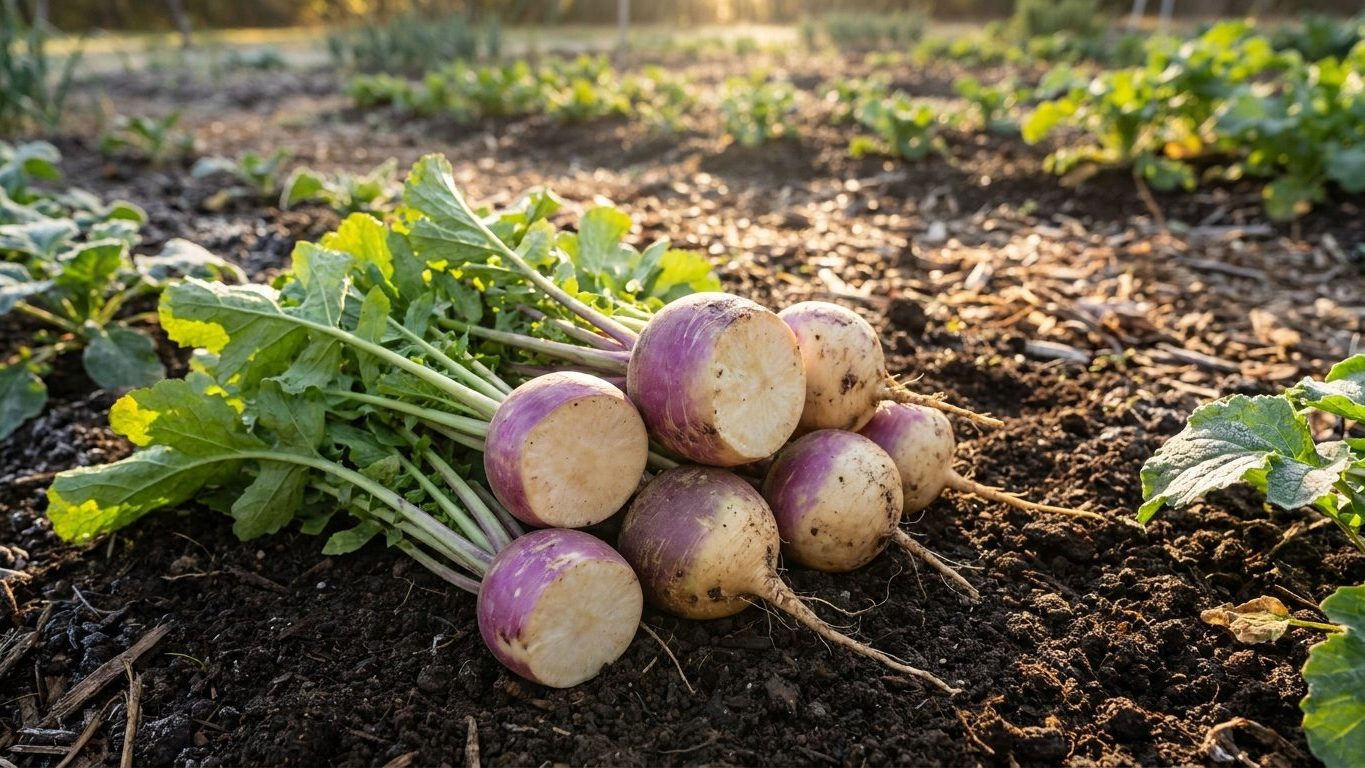

In Indiana, turnips go in twice: once in spring, as soon as the soil has thawed, drained and started to warm, and again in late summer for a fall harvest. Rutabaga belongs mostly to that second round. The Indianapolis frost dates frame both sowings, but they are a proxy for what the crop actually needs, which is soil. The sections below sort out the timing, the season length and the cold.
When the soil is warm enough in Indiana
The date most gardeners want is the last spring frost. At Indianapolis, the NOAA NCEI 1991-2020 Climate Normals (32F freeze probabilities, 30-70% band, station USW00093819) put it between April 9 and April 21. That is a probability, not a promise. Purdue’s own caution is that roughly a 10% chance of a 32F night remains after the published spring date, so anything tender set out at the early edge of the range needs a cover close at hand.
Frost is only a stand-in. Turnips and rutabaga don’t read the calendar or the air temperature. They respond to the soil, and soil lags behind air. A bed that was frozen in March, then soaked by April rain, stays cold and sticky well after the last freeze has passed. Seed sown into that mud sits, rots or comes up ragged. The soil warms after the frost risk ends, not with it, so the useful habit is to check the bed itself. Squeeze a handful. If it crumbles instead of forming a wet ball, and a soil thermometer shows it climbing rather than sitting near its winter floor, it is ready.
Reading the range for your own yard
Indianapolis is the reference point, not the whole state. Southern Indiana runs earlier in spring and later in autumn than the north by a fortnight or more. A gardener near the Ohio River can often work the ground while a gardener near the Michigan line is still waiting for the frost to leave it. Use the Indianapolis range as a midpoint and shift it by your latitude and by how fast your particular bed drains.
Spring sowing is also a race against heat. Turnip roots grown into warm weather tend toward the woody and the sharp. So the spring crop is the one to sow at the first workable moment, while the fall crop is the one that gets the better flavor. Rutabaga, which wants a long stretch of cool growing, is usually planned for the fall side of the calendar. The packet’s days-to-maturity figure, counted backward from the first fall frost, tells you the latest date to sow.
For the types and varieties trialled in your part of the state, go to Purdue Extension. It publishes planting guidance by county and region, and that beats any general chart. For the national picture, the hub guide Growing Turnips and Rutabaga: An Autumn Crop, Sweetened by Frost explains why frost does the sweetening.
How long the season lasts here
Take the latest spring date, April 21, and the earliest fall date, October 21. Between them lie 183 days. Take the earliest spring date, April 9, and the latest fall date, October 30, and the gap grows to 204. So at Indianapolis the frost-free window runs from 183 to 204 days, roughly six months and often a bit more. Both dates come from the same NOAA station, so the subtraction is honest, though the usual caveat applies: a fortnight of difference north to south moves the whole window.
What does that length allow? A second sowing, mainly. A window this long means the spring turnip can be harvested and its bed cleared well before the late-summer sowing needs it. Nothing forces you to choose between a spring crop and a fall crop. A short northern window usually makes the first sowing the only one and turns transplanting into a gamble. Indiana’s window is closer to the generous end of what turnip growers get.
Transplanting is still a poor trade. Turnips and rutabaga form a taproot, and a disturbed root forks, stunts or bolts. With 183 days or more to work with, there is no reason to take that risk, because direct sowing can start late enough that a transplant’s head start buys nothing. If you do start seedlings, set them out while very small and check the roots for kinks before they go in.
Planning a staggered run is easier with a method. The succession sowing guide on this site lays out how to space sowings so the harvest doesn’t arrive all at once. The same idea applies to rutabaga, though it gets fewer slots because of its longer growing period. For a sense of how a different window plays out, compare the pages for Growing Turnips and Rutabaga in Delaware and Growing Turnips and Rutabaga in Pennsylvania.
Heat and water in Indiana
This page has no verified count of days above 90 F and no verified summer rainfall total, and it won’t guess at either. What can be said honestly is qualitative. Indiana summers are warm and humid by Midwestern standards, and that shapes the crop more than any single heat number. Hot stretches push turnips toward bitter, pithy roots, and humid, wet stretches invite fungal trouble such as mildew and root rot. Consistent moisture matters more than volume, because swings between dry and soaked ground split roots.
Turnips and rutabaga are brassicas, so they share their troubles with cabbage, kale and mustard. A damp bed that held cabbage last year carries those pathogens and pests into this year’s turnips. A gardener who rotates turnips into a cabbage bed has rotated nothing. Keep them on a separate rotation from the rest of the brassica family, and use airflow and spacing to keep the foliage dry.
Two cold facts govern this crop more than the hot ones. First, the coldest month. At Indianapolis its mean daily minimum is 20.9 F (NOAA NCEI Climate Normals 1991-2020). That is an average of the lowest temperature of each day, not the record low, so colder nights sit inside it. The USDA Plant Hardiness Zone Map 2023 places the state across zones 5b to 7a, which means northern and central gardens will see colder nights than southern ones. A mean minimum that far under freezing means roots left in the ground are betting on mulch. A thick layer of straw or leaves can hold them through a mild winter stretch, but in the colder north the safer plan is to lift them before the ground locks up.
Second, the winter low sets how much frost sweetening the crop gets. Cold nights after the first fall frost, which falls between October 21 and October 30 at Indianapolis, push the roots to convert starch into sugar. The gain comes between that first frost and the day the ground freezes hard. Once it does, the harvest is over whether the roots are sweet or not. A fall that stays mild gives gentle sweetening, and a fall that plunges quickly gives a short one.
Storage touches food safety, so a few firm rules apply. Inspect every root before it goes into storage and again while it is there. A soft patch, a weeping spot or a moldy crown ends the question, and a root that looks sound from the outside is not proof of anything. Discard anything doubtful instead of trimming around it.
Which turnips and rutabaga suit Indiana
This page names no varieties, on purpose. A variety name means something only if it has been trialled where you garden, and this page does not have those trial results. An invented or half-remembered name would be worse than none. Purdue Extension and its county offices are the place to ask, because their recommendations come from local growing conditions.
What this page can do is reason from Indiana’s facts to the type of plant worth looking for.
| Indiana condition | What it favors |
|---|---|
| A frost-free window of 183 to 204 days at Indianapolis | Room for both a spring and a fall sowing, so earliness matters less than flavor in the fall round |
| Warm, humid summers | Types that tolerate warm weather, given airflow and shade at the root, so the shoulders stay cool |
| Humidity and wet spells | Disease resistance as the first criterion when a type offers it |
| A coldest-month mean minimum of 20.9 F | Sturdy, well-finished roots that hold up in the ground or in storage |
For spring sowing, favor the quick, small-rooted types that finish before summer heat arrives. For fall, shift toward larger or longer-growing types, and treat rutabaga as a fall-only crop. When a seed catalog or packet lists resistance to a disease, take it seriously, since brassica diseases linger in a bed once they arrive.
Take the list to your county Extension office and ask what has performed in your soil. A fortnight of difference between northern and southern Indiana means one gardener’s best sowing date is another’s mistake.
Common questions
When should I sow turnips in Indiana?
Sow the spring crop once the soil has thawed, drained and begun to warm, which usually lands near the April 9 to April 21 last-frost range at Indianapolis. Sow the fall crop in late summer, counting back from the first fall frost (October 21 to October 30 at Indianapolis) using the days-to-maturity on your seed packet.
Can I leave turnips and rutabaga in the ground over winter in Indiana?
Only with care. The mean daily minimum of the coldest month at Indianapolis is 20.9 F, and the north is colder. Thick mulch can protect roots through mild stretches, but in colder areas lifting them before the ground freezes hard is the safer choice. Check them often, and discard any root with a soft patch, a weeping spot or a moldy crown.
Can I plant turnips where cabbage grew last year?
No. Turnips and rutabaga are brassicas and share pests and diseases with cabbage, kale and mustard. Planting them in a former cabbage bed carries those problems forward. Follow a rotation that keeps the whole family out of the bed for a while.
Which variety should I grow?
This page does not name one. The varieties trialled in Indiana conditions are a matter for Purdue Extension, which can point you to what has done well locally. Choose by type: early types for spring, disease resistance for humid conditions, and sturdy roots for fall.