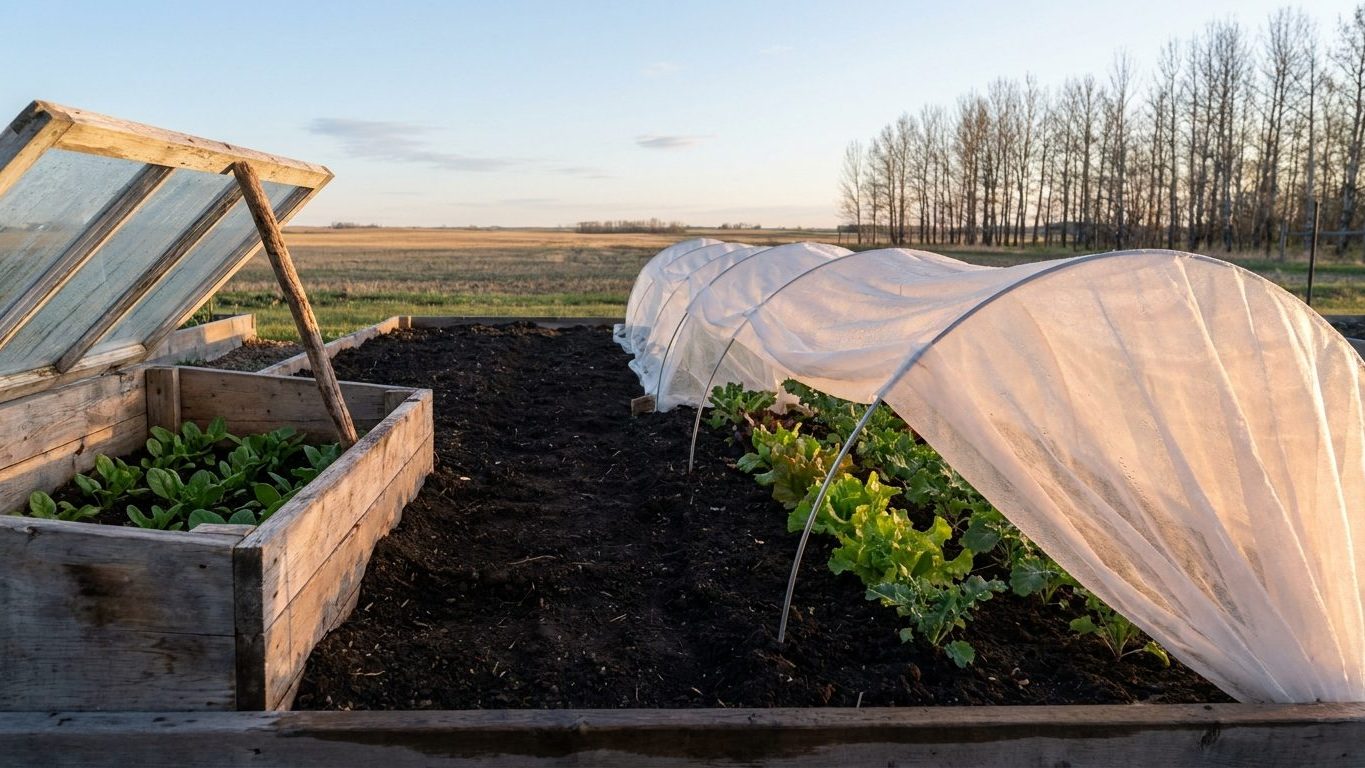

Floating row cover, low tunnels, and cold frames fit Arkansas best. They add a few weeks at each end of a growing season that is already long, and heated greenhouses or heavy structures rarely pay back here. The dates behind that advice come from Little Rock, so they slide earlier or later across a state that runs from the Ozarks to the Delta.
The short answer for Arkansas
Use lightweight covers over hardy crops and a few weeks of protection for tender ones. Row cover and low tunnels do most of the work, and a cold frame handles seedlings and winter greens. That fits the numbers: NOAA’s 1991-2020 Climate Normals for the Little Rock station put the last spring 32°F freeze between March 12 and March 28, and the first fall freeze between November 7 and November 20. Those are probabilities, not promises. They mark the band where the odds of a 32°F freeze run from 30 to 70 percent, so a freeze after the late date in spring, or before the early date in fall, can still happen.
Tender plants live by a different clock. At the 36°F light-frost threshold, NWS Little Rock gives April 3 and October 31. Tomatoes, peppers, and squash start sulking at 36°F, not 32°F, so the useful window for them is tighter than the freeze dates suggest. The gap between those two sets of dates is where covers earn their keep. For more on the overall approach, see Extending the Growing Season in Arkansas.
Mean daily minimum in the coldest month at Little Rock is 30.9°F. Winter nights hover around freezing rather than plunging far below it, which is why a low tunnel can carry spinach, kale, and similar hardy greens through the cold months. The table matches each tool to the job it does best here.
| Extender | Best use in Arkansas | Catch |
|---|---|---|
| Floating row cover | Frost nights in March and early November; cool-season crops | Must be anchored against wind and lifted for pollination |
| Low tunnel (hoops plus cover) | Winter greens; early spring transplants | Needs venting on sunny days |
| Cold frame | Hardening off; starting seedlings; winter salad | Overheats quickly if left closed |
| Water-filled plant protectors | Early tomatoes and peppers around the 36°F date | Cover only one plant each |
| Mulch | Holding soil warmth in fall; protecting roots | Can keep spring soil cold if applied too early |
What will not work here
Planning to grow summer crops through winter will fail. Tomatoes and peppers do not survive a hard freeze, and even a covered bed cannot hold temperatures steady through a long cold snap. The first fall freeze lands between November 7 and November 20, and the tender plants lose ground well before then, because the 36°F date is October 31. A cover that rescues a tomato plant in late October is doing something real. A cover that you expect to keep it fruiting in December is wishful thinking.
Heavy, sealed plastic is a poor match too. Arkansas springs swing from frosty mornings to warm afternoons, and a closed tunnel on a sunny March day can cook seedlings that survived the night. Humidity makes it worse. Warm, damp air trapped under plastic, with plants packed tightly, is a standing invitation to fungal leaf diseases. Venting is not optional, and a structure you cannot open easily from one end to the other will cost you more plants than it saves.
Latitude limits what any cover can do in midwinter. Little Rock sits at 34.73 degrees north, which is far enough south that frost is the main enemy, but still far enough north that winter days are short. Day length, not warmth, controls how fast greens grow in December and January. A covered bed keeps hardy crops alive, yet it does not make them grow quickly. If you expect a January harvest from a September sowing, plant early enough that the crop reaches size before the shortest days arrive.
Finally, trusting the 32°F dates for tender crops is the quiet mistake. Setting out tomatoes right after March 28 because the freeze odds have dropped ignores that the 36°F date is April 3, and cool soil slows them anyway. The reverse holds in fall, where waiting for the first 32°F freeze before covering means the plants have already been nipped. For timing the covering itself, When to Cover Your Garden in Arkansas goes through the triggers.
What changes across Arkansas
Arkansas is not one garden. The USDA Plant Hardiness Zone Map (2023 edition, built on 1991-2020 normals) runs from 6b to 8a across the state. That is a spread of more than one full zone, so no single answer fits everyone, and the Little Rock figures above describe one city, not the territory.
The zone system rests on one variable: the average annual extreme minimum temperature. It tells you what winter will do to a perennial, and it says little about when your last spring frost falls. Two gardens in the same zone can still differ by weeks in frost dates. Treat the zone as a guide to winter survival, and treat frost dates as a separate question.
For readers in the north or at altitude, in the Ozarks and the higher ground around them, the practical shift runs one way. Expect spring to arrive later and fall to end sooner than the Little Rock dates suggest, and lean harder on covers at both ends. Heavier row cover, a second layer on bad nights, and water-filled protectors for early tomatoes pay off more where the margin is thin. How much later is a local question that this page cannot settle.
Readers in the south and the Delta have the opposite problem: a longer season, but the same spring swings. The latitude figure also belongs to Little Rock only. Anyone near the state’s northern or southern edge should check their own latitude, since day length affects things like onion bulbing. To find your hardiness zone, use the USDA map and enter your ZIP code. This page will not guess it for you.
Where to check this for your own county
Your state extension service is the next stop. The University of Arkansas System Division of Agriculture runs Arkansas Cooperative Extension, with an office in every county. Its agents see local conditions season after season, which no statewide page can match.
Look for two things there. First, a planting calendar written for your part of the state, with sowing and transplant dates for each crop. Second, the varieties that have been trialled in your county or nearby, since a tomato that sets fruit in the Delta heat may behave differently on an Ozark hillside. Ask the county office, too, about local frost patterns, because they often know which valleys collect cold air.
A county recommendation beats a state one. This page is the state one: it relies on a single reference station at Little Rock, a probability band, and a hardiness range that covers more than a full zone. It is a starting frame for choosing tools, not a substitute for advice from people who work your soil and weather. When the two disagree, go with the county.
Checking this against your own garden
Your own observations outrank every date above. Three are worth watching, and none needs equipment beyond your hands and eyes.
- Soil warmth by feel. Push your hand a few inches into a bed in early spring. If it feels distinctly cold, warm-season seed will sit and rot, whatever the calendar says. A bed that feels warm sooner than your neighbor’s tells you it has a sheltered, sunny microclimate.
- First true leaves. The leaves after the seed leaves show a seedling is established and growing. If cool-season seedlings reach that stage under cover well ahead of the uncovered ones, your site gains real warmth from the cover.
- First male flowers. Squash and cucumbers open male flowers before female ones. Their arrival tells you the plants have settled in. Earlier flowers in one bed than another point to the warmer spot.
Add one more habit: note where frost shows on the grass on a cold morning. Low spots usually frost first, and that pattern marks where covers matter most.
Common questions
Is row cover enough for Arkansas winters?
For hardy greens, usually yes, since the coldest month’s mean daily minimum at Little Rock is 30.9°F. During a sharp cold snap, add a second layer or a hoop frame.
Which frost date should I use for tomatoes?
The 36°F dates, not the 32°F ones. NWS Little Rock gives April 3 and October 31 for that threshold.
Do the Little Rock dates apply to the whole state?
No. They come from one station, and the USDA zone range of 6b to 8a shows how much the state varies. The north and higher ground should expect a shorter season.
Can I use plastic instead of fabric row cover?
Yes, but only if you can vent it. A closed plastic tunnel overheats on sunny days and traps humidity, which invites disease.