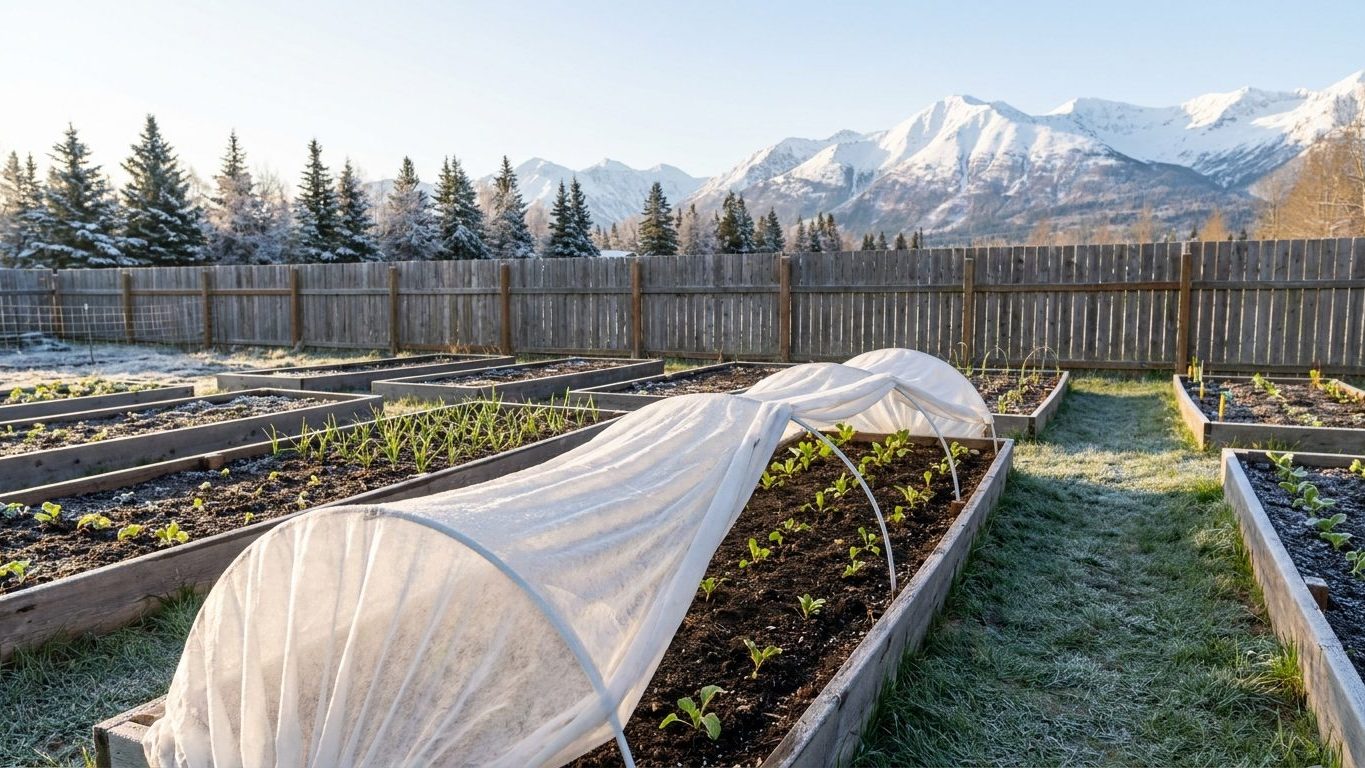

Cover tender plants in Arkansas on any night the forecast low falls to about 36°F, not only at 32°F. Cold air pools near the ground and can frost leaves while the porch thermometer still reads above freezing. For Little Rock, the light-frost dates that matter are April 3 in spring and October 31 in fall. Hardy greens run on a different, earlier clock.
The short answer for Arkansas
Put covers on tomatoes, peppers, squash, cucumbers and basil whenever the forecast low reaches 36°F, and keep them within reach from mid-March through early April and again from late October on. At that threshold, NWS Little Rock gives April 3 and October 31 as the light-frost dates. Tender plants need those dates, not the freeze dates.
Two thresholds, four dates
The freeze figures come from NOAA’s 1991-2020 Climate Normals for the Little Rock station. They show a 30 to 70 percent probability band of a 32°F freeze, which means the dates mark when frost is a toss-up, not when it is over. Nobody should read them as a promise.
| Threshold | Spring | Fall |
|---|---|---|
| 32°F freeze (30-70% probability band) | March 12 to March 28 | November 7 to November 20 |
| 36°F light frost (NWS Little Rock) | April 3 | October 31 |
The 36°F line squeezes the usable season by about a week at each end. March 28 is the late edge of the spring freeze band, yet April 3 is the light-frost date, so a gardener who plants on the first date is six days early by the tender-plant standard. In fall the gap runs the other way, with October 31 arriving a week before the earliest freeze date of November 7. The NOAA station data is public if you want to see the source.
Why 36°F, and why at dusk
Clear, calm nights let the ground radiate its heat straight up. Leaves lose warmth faster than the air around them does, so a plant can freeze while the forecast says 35°F. Clouds and wind blunt this, which is why a breezy overcast night at 34°F is often safer than a still, starry one at 37°F.
Cover in late afternoon, while the soil still holds the day’s warmth, and let the fabric reach the ground so that heat stays put. Take it off the next morning once temperatures climb. The coldest month at Little Rock has a mean daily minimum of 30.9°F, just under freezing, so winter protection here is mostly a matter of nightly chores, not a permanent shelter. If you want to match the cover to the crop, Which Season Extenders Work in Arkansas sorts the options, and Extending the Growing Season in Arkansas covers the larger picture.
What will not work here
Planting on the 32°F date fails first. A gardener who sees March 28 as the end of the spring freeze band and sets out tomatoes that weekend has ignored the tender-plant date of April 3. The plants usually survive the transplant, then meet a cold night with nothing on hand to cover them. Pick the threshold for the crop, not the date that looks friendliest.
Waiting for November also fails in fall. The 32°F fall band starts November 7, but NWS Little Rock puts the light-frost date at October 31. Tomato and pepper plants still carrying fruit can take damage a week before most gardeners think of covers. If the plants are loaded, check the forecast in the last days of October.
Sealed plastic is the third trap. Arkansas is humid, and a tunnel closed tight through a mild, damp spell holds moisture against the leaves, which invites fungal disease. A sunny afternoon in March can also cook seedlings under clear film long before the next cold night arrives. Vent the ends every sunny day, or use breathable fabric where you only need a few degrees of protection.
A light sheet will not carry you through a hard freeze. The 30.9°F figure is an average, so individual nights in the coldest month run both above and below it. A cover that handles a night at 34°F is a different tool from one that handles a deep freeze, and in the colder parts of the state, where the USDA hardiness system reaches zone 6b, the extremes bite harder. Plan a heavier layer or a second one for the nights that fall well below 32°F.
Leaving covers on squash and cucumbers once they flower works against you. Pollinators cannot reach blossoms under fabric, so a cover that stays down for days costs you fruit. Take it off by mid-morning whenever the weather allows.
The last failure is treating any date, including the ones in the table, as settled. They are averages over 1991-2020. A warm March can tempt you early, and a cold snap in the second week of April has caught gardeners who trusted a number printed on a seed packet. The forecast on the day outranks the calendar.
What changes across Arkansas
Arkansas does not have one hardiness zone. The USDA Plant Hardiness Zone Map (2023 edition, built on 1991-2020 normals) places the state in zones 6b to 8a. That system rests on one variable, the average annual extreme minimum temperature. It tells you whether a perennial survives the winter and says little about when to cover a tomato in April. There is no single answer for the whole state, only a spread.
Every figure in this article belongs to Little Rock, at 34.73 degrees north. If you garden near the Missouri line, shift your expectations toward later spring dates and earlier fall ones, and plan on more cover nights at each end of the season. A gardener close to the Louisiana border has the opposite adjustment. How far to shift is a local call, which the next section covers.
Latitude affects more than frost. Onions decide when to stop making leaves and start making bulbs by day length, not by warmth, so a northern Arkansas garden and a southern one run on slightly different schedules even in the same spring. If you live near the edge of the state, look up your own latitude before copying a Little Rock planting date.
Elevation and terrain matter too. Higher ground in the hills of the north and west tends to run cooler than the river valleys, while a low spot in your own yard can collect cold air and frost earlier than the slope above it. Two beds forty feet apart can sit on different calendars.
Which zone applies to you is not something this page can answer. The USDA Plant Hardiness Zone Map lets you look up your ZIP code, and that is the right starting point for deciding how far your own garden sits from the Little Rock numbers.
Where to check this for your own county
The University of Arkansas Cooperative Extension Service is the place to confirm any of this. Every county has an office, and the staff there know the local frost pockets, soils and the surprises of recent seasons. A county recommendation beats a state one, and this page is the state one, built from a single reference station.
Look for two things on the extension site. First, the local planting calendar, which gives sowing and transplanting windows for your part of the state and tells you whether the Little Rock dates are a good fit or need a shift. Second, the vegetable varieties trialed in your county. A variety that does well in a test garden near you has already handled your heat, your humidity and your disease pressure, which no national seed catalog can promise.
If you cannot find a calendar for your county, call or visit the county office. Ask what the last light-frost date has looked like over the past few springs and which crops they would cover first. Agents answer these questions all the time, and a five-minute conversation can settle what a dozen web searches leave open.
Bring your own notes if you have them: the dates your garden frosted last year, what you covered, what survived. Extension staff can place your observations against county patterns, and that is when a state calendar turns into a local one.
Checking this against your own garden
Your own observations outrank every date on this page. Three signs are worth watching, and none needs more than your hands and your eyes.
- Soil warmth by feel. Push your hand a few inches into the bed on a spring morning. If the soil feels cold and clammy, warm-season seeds will sulk. A bed that warms sooner than the one next to it has better sun or drainage, so plant there first.
- The first male flowers. Squash and cucumbers send out male blossoms before female ones. When yours appear, the plants have settled in. If they arrive weeks later than a neighbor’s, your garden runs cooler.
- The first true leaves. The first pair a seedling shows are seed leaves, and the second pair are true leaves. How fast seedlings reach them tells you whether a bed is warm enough for steady growth or stalling on cold nights.
Write the dates down. NOAA’s normals average thirty years, so a notebook needs a few seasons before it can rival them, but after three or four springs your yard’s own record will tell you more than Little Rock’s. Put a note beside the first frost you spot on the grass each fall, and which corners frosted first, and you will know exactly where to place the covers.
Common questions
Do I cover at 32°F or 36°F?
For tender plants, 36°F. That is the light-frost threshold, and frost can form on leaves before the air reaches 32°F. Hardy crops such as kale and spinach can wait until the forecast approaches freezing.
Can I plant tomatoes before April 3 if I plan to cover them?
You can, but you are betting on the forecast. April 3 is the NWS Little Rock light-frost date, so earlier plantings need covers ready on cold nights, and the nights may arrive in clusters. Gardeners in the north of the state should be more cautious.
Should covers stay on during the day?
Not in most cases. Remove or vent them once the morning warms, since sun under a sealed cover can overheat plants and trapped humidity favors disease. Flowering crops need uncovering so pollinators can reach them.
Do I need winter covers in January?
For hardy greens, only on the coldest nights. The mean daily minimum of the coldest month at Little Rock is 30.9°F, just under freezing, so many nights call for nothing. Check the forecast before a hard freeze and cover then.