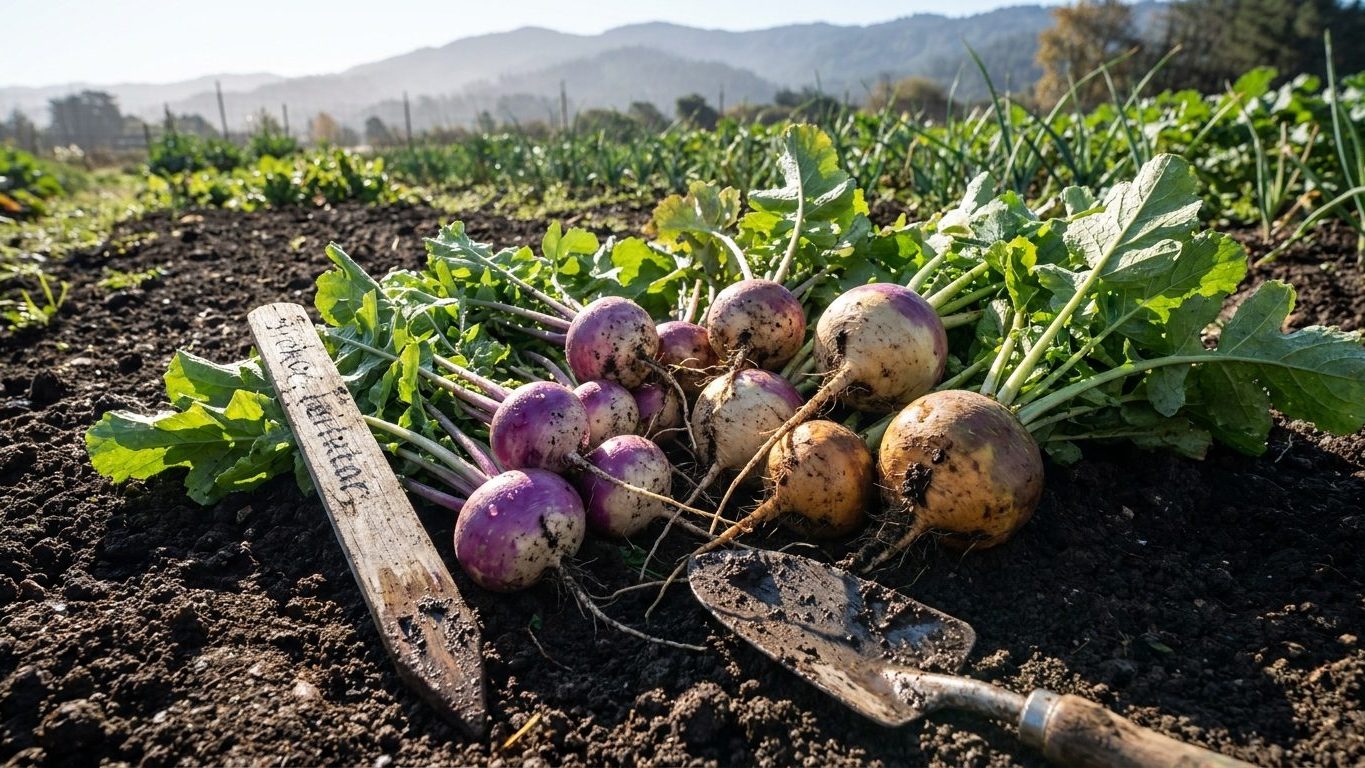

In Ohio, grow quick-maturing turnips twice a year and treat rutabaga as a fall crop that has to beat the first frost. Type matters more than the name on the seed packet: fast and tender beats big and slow. The sections below cover how that plays out in Ohio’s season, what tends to fail, and how far the answer shifts from Lake Erie to the Ohio River.
The short answer for Ohio
The frost dates set the choice. For zone 6a, Ohio State University Extension’s Ohio Gardening Calendar gives a last spring frost of May 5 to May 15 and a first fall frost of October 5 to October 15. Both are probabilities of frost, not promises. The spring range marks when a killing frost becomes unlikely, and the fall range marks when one becomes likely. Neither is the day it stops or starts. Turnips shrug off light frost, so the dates guide your sowing but don’t forbid it. For specific sowing windows, see When to Sow Turnips in Ohio.
That gives a decision by type, not by brand:
| Type | Where it fits in Ohio | Main risk |
|---|---|---|
| Small, fast salad turnips (Hakurei is a well-known example) | Spring and fall, the most forgiving choice | Going woody or bolting if spring warms quickly |
| Standard globe turnips (Purple Top White Globe is the classic) | Fall crop, with greens for the table along the way | Sowing too late to size up before hard freezes |
| Rutabaga (American Purple Top is a common type) | Fall crop only, sown early enough to use the long cool stretch | Running out of season before the root fills |
The reason for the split is simple. A turnip is a cool-season root that can be eaten young, which means it forgives a late start. Rutabaga is the slowest root in the garden, and it wants the longest unbroken run of cool weather. Ohio’s autumn provides that run, and its spring usually does not.
If you only plant one thing, make it a fall globe turnip. It gives you two harvests, greens first and roots after, and it sits comfortably inside the October frost window. Variety names above are examples of types, not a trial result. Which specific cultivar performs best in your county is a question for local trials (more on that below).
What will not work here
Rutabaga sown in a rush at the end of the season fails first. With the first fall frost averaging October 5 to October 15 in zone 6a, a late sowing leaves a plant with leaves and almost no root. Rutabaga cannot be rescued by a mild November, because growth slows as the days shorten whatever the thermometer says.
Counting on winter to be a storage cellar fails too. Columbus, the NOAA reference station (1991-2020 normals), has a mean daily minimum of 22.0°F in its coldest month. That is an average night, not a record low, so roots left in the ground through January face nights at or below that figure again and again. Mulch can buy you some weeks, but it is not a plan. Pull roots before deep winter and store them.
Spring sowing that assumes a long cool season
A spring sowing of big storage turnips is a bet on the weather staying cool. Ohio springs do not always cooperate. After a last frost in the May 5 to May 15 range, warmth can build fast, and a root that sizes up slowly meets summer heat in the field. Heat pushes turnips toward bolting, sending up a flower stalk, and roots left to ride it out turn tough and pithy. That is why the quick salad types suit spring, and why the big globes belong in fall.
Close spacing in a humid summer
Ohio summers are humid, and that punishes tight rows. Leaves that crowd each other stay wet longer after rain or dew, and wet foliage invites disease. Crowded roots also compete and come out small and misshapen. Thin seedlings to the spacing on the seed packet, even if it feels wasteful, and sow fall crops when the worst of the humid heat has passed rather than into it.
The common thread is a mismatch between the plant’s clock and the state’s calendar. Anything that needs a long, steady cool season in spring, or an unusually late fall, will disappoint in most of Ohio.
What changes across Ohio
Ohio is not one garden. The USDA Plant Hardiness Zone Map 2023 (built on 1991-2020 normals) places the state in zones 5b to 6b, so there is no single answer for the whole state. That zone is built on one variable only, the average annual extreme minimum temperature. It tells you about winter cold, not about when to sow. Frost dates and your own spring do that job.
The frost dates quoted on this page are for zone 6a. Gardeners in the colder parts of the range, generally the north and higher, hillier ground, should expect those dates to run later in spring and earlier in fall. That narrows the window for rutabaga more than for anything else. If you are in a colder spot, favor the quick turnip types, push your rutabaga sowing to the early edge of its window, and have a plan for cold snaps. Gardeners toward the warmer 6b end get a little more room at both ends, though not enough to change the type decision.
This page does not have county-level frost dates, so it cannot say exactly how far your garden sits from the 6a figures. Do not guess your own zone from a neighbor’s advice or from a plant tag. Look it up on the USDA Plant Hardiness Zone Map by ZIP code, then read the frost dates as a starting range, not a fixed rule.
For the broader growing picture, including soil prep and care through the season, see Growing Turnips and Rutabaga in Ohio.
Where to check this for your own county
Your state extension service is the right next stop, and in Ohio that is Ohio State University Extension. County offices there know local soils, local weather quirks and which varieties have done well nearby. Two things are worth looking for: the local planting calendar for your county, and any vegetable varieties trialled or recommended in your area.
A county recommendation beats a state one, and this page is the state one. It averages a range of zones and a wide spread of weather into a single sensible answer. That is useful for planning, but a county office can tell you whether your area runs cold in April, whether fall frost tends to arrive early, and which cultivars have been grown there rather than in some other part of the country.
When you call or search, ask specific questions. What is the usual last frost date in my county, and how reliable is it? Which turnip and rutabaga varieties do you recommend for fall sowing? Is there a local planting guide I can download? Staff and Master Gardener volunteers get these questions all the time and usually answer quickly.
Keep your expectations realistic. Extension materials may cover turnips in a general vegetable guide without a dedicated rutabaga calendar, and varieties named there may not match what a local garden center stocks. If so, ask for the closest equivalent by type.
Checking this against your own garden
Your own observations outrank every date on this page. Three are worth watching, and none needs equipment.
- Soil warmth by feel. Press your hand flat into bare soil in the morning. If it is cold and clings in a wet clump, wait. If it crumbles and feels cool rather than chilly, it is workable. A bed that warms earlier than your neighbor’s tells you your spring window opens sooner.
- The first true leaves. Seedlings first show rounded seed leaves, then the rougher, lobed true leaves. When those appear, thin to the spacing on the packet. If they show up quickly, your bed is warm and your crop is moving. If they stall, the spot is cool or shaded.
- Where frost lands first. On the first cold mornings of fall, check which parts of your yard are white and which stay green. Low spots collect cold air. Beds near a wall or pavement usually hold heat longer. That pattern shows you where fall roots will keep growing and where they will stop.
Write down what you see for a season or two. A short notebook of dates will tell you more about your own plot than a state average ever can, and it makes next year’s sowing a matter of reading your own notes.
Common questions
Can I grow rutabaga in Ohio?
Yes, as a fall crop. It needs a long cool stretch, and the first fall frost averages October 5 to October 15 in zone 6a, so sow early enough for roots to fill before then.
Which turnip type is the safest choice for a beginner?
A small, fast salad type. It matures quickly and works in spring or fall, so one mistimed sowing does not cost you the whole crop.
Do I need to know my hardiness zone to pick varieties?
Not for sowing dates. Ohio spans USDA zones 5b to 6b, a measure of winter cold. Your frost dates and county extension advice matter more for choosing when to plant.
Can I leave turnips in the ground all winter?
It is not a reliable plan. The mean daily minimum in Columbus’s coldest month is 22.0°F, and roots left in the ground face that cold repeatedly. Harvest and store them before deep winter.