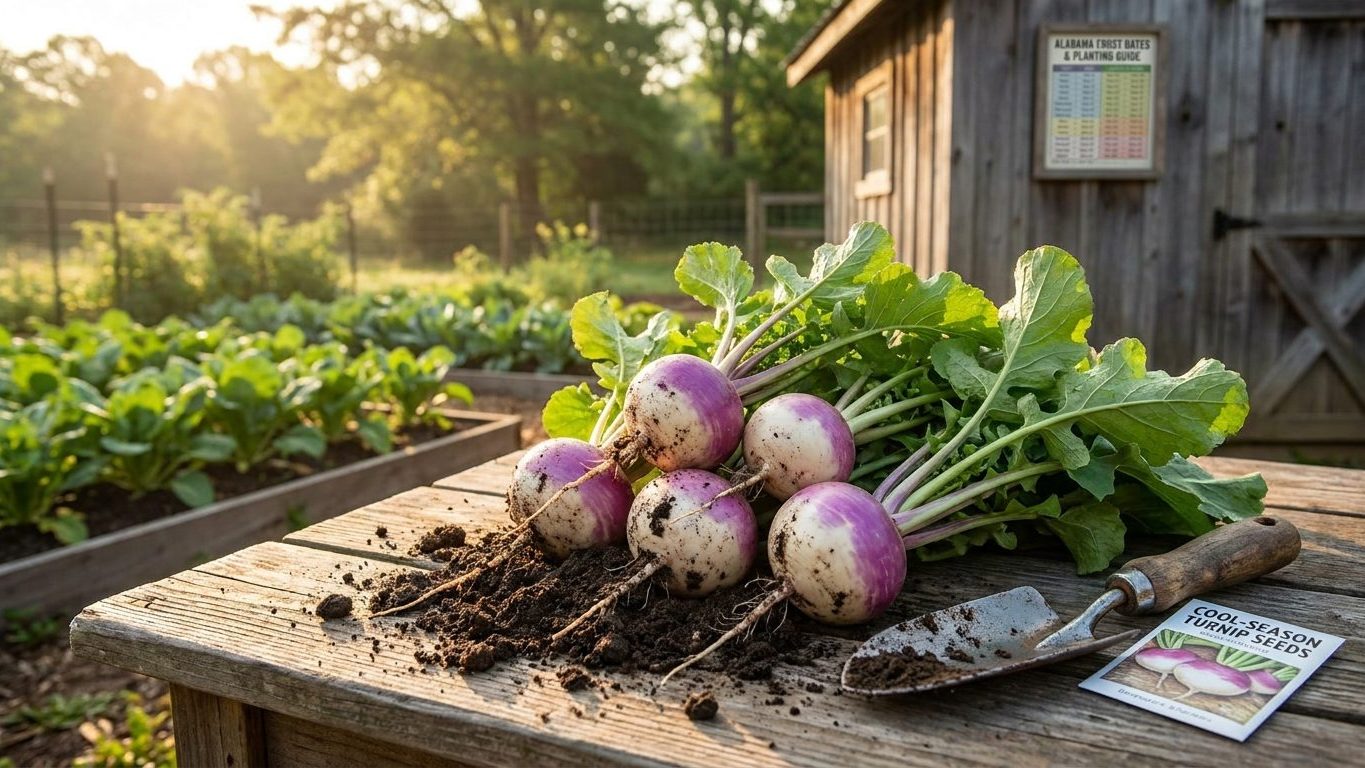

Sow turnips in Ohio twice: in early spring, as soon as the soil can be worked, and again in late summer so the roots finish before fall frost. For USDA zone 6a, Ohio State University Extension’s Ohio Gardening Calendar puts the last spring frost at May 5 to May 15 and the first fall frost at October 5 to October 15. Rutabaga wants the longer, cooler back half of the season.
The short answer for Ohio
Those two frost windows are probabilities of a freezing night, not dates on which anything happens. “May 5 to May 15” describes when a frost after that point becomes unlikely, and a late cold snap is still possible. “October 5 to October 15” works the same way in reverse: it is when a first freeze becomes likely, and some years it arrives sooner. Treat them as the edges of a gamble, not a schedule.
Turnips are a cool-season crop, which changes how you read them. A light frost does not end the season, so the spring window opens before the last-frost range, once the ground is workable. In fall, the October range is the finish line you count backward from. Check the seed packet for days to maturity, subtract that from the first-fall-frost range, and you have your latest sensible sowing date. This page does not carry a verified soil-temperature threshold or a week-by-week sowing date, so those anchors are the most it can give you.
| Sowing | Anchor from the frost dates (zone 6a) | How to use it |
|---|---|---|
| Spring turnips | Last spring frost: May 5 to May 15 | Sow once soil is workable, ahead of and around this range |
| Fall turnips | First fall frost: October 5 to October 15 | Count back from this range using the packet’s days to maturity |
| Rutabaga | First fall frost: October 5 to October 15 | Same backward count, with the longer maturity on its packet |
The coldest-month minimum at the Columbus reference station, a mean daily low of 22.0°F (NOAA NCEI Climate Normals, 1991-2020), is the other number worth keeping in mind. It describes an average night in the coldest month, not a record. Nights like that kill turnip tops, so the plan here is to harvest in fall, not to count on roots surviving winter in the open ground.
For the full growing picture, see Growing Turnips and Rutabaga in Ohio. Choosing between types and cultivars is covered in The Best Turnips and Rutabaga for Ohio.
What will not work here
Sowing rutabaga on the same early-spring schedule as turnips tends to disappoint. Rutabaga is the slower root, and between the spring frost range of May 5 to May 15 and the fall range of October 5 to October 15, the frost-free stretch is finite. A spring-sown rutabaga has to bulk up through the warmest part of that stretch, which is the wrong weather for a cool-season root. Aim it at the cooler back half of the season, working backward from October.
Late sowings that run out of calendar
The most common failure is the fall sowing made too late. A packet’s days to maturity assume growing weather, and growth slows as autumn nights cool. If your count backward from October 5 to October 15 lands in the past, skip that variety and choose a faster one, or grow the crop for greens instead of roots. Turnip tops are edible long before the root is full size, which gives a late sowing a use.
Sowing turnips in late spring to harvest in early summer is the other trap. Cool-season roots sown after the cool weather has gone tend toward woody, sharp-flavored, or bolting plants. Ohio’s last frost does not arrive until May 5 to May 15 in zone 6a, so a gardener who waits for “safe” frost-free weather before sowing has often already moved into the season turnips dislike. For this crop, waiting for the last frost is the wrong signal.
Overwintering is not a plan either. With a mean daily minimum of 22.0°F in the coldest month at Columbus, tops will not carry through the winter, and treating the garden as cold storage invites a mushy, frozen harvest. Pull roots after the first hard freezes, or mulch heavily and expect partial losses.
This page does not have rainfall or humidity figures for Ohio, so it will not hand you a watering schedule. What holds anywhere humid in summer is that crowded rows keep foliage damp, which favors leaf disease. Thin to the spacing on the seed packet instead of letting seedlings stay tight, particularly for a late-summer sowing that germinates in warm, muggy weather.
What changes across Ohio
Ohio is not one garden. The USDA Plant Hardiness Zone Map (2023, built on 1991-2020 normals) spans zones 5b to 6b across the state, so there is no single answer to when a given gardener should sow. The frost dates above belong to zone 6a, and gardeners in cooler or warmer parts of the state will sit on either side of them.
A reader in the colder, zone 5b parts of the state, such as the north, should shift in a predictable direction without any exact days promised here. Expect the last spring frost to come later than May 5 to May 15 and the first fall frost to come earlier than October 5 to October 15. Spring sowing starts later, and the fall deadline arrives sooner, so the backward count from the packet’s days to maturity matters more. A zone 6b garden gets a longer stretch on both ends, with the same logic reversed.
The hardiness zone is built on one variable, the average annual extreme minimum temperature, so it describes cold survival, not sowing dates. Two gardens in the same zone can still differ in frost timing because of hills, cold-air pockets, and nearby water. Use the zone as a rough guide, not a sowing date.
Do not take a zone from this page. Look yours up on the USDA Plant Hardiness Zone Map by ZIP code, then treat 6a dates as a starting point and shift them toward your own conditions.
Where to check this for your own county
Ohio State University Extension is the place to go next. It runs offices across the state, and the staff there know which varieties have been grown and trialled near you and when local gardeners actually sow. It also published the Ohio Gardening Calendar behind the frost dates on this page.
When you get there, look for two things. The first is a local planting calendar, which should list spring and fall sowing windows for root crops. The second is any variety trial or recommended-variety list for your county, which will tell you which turnips and rutabagas have done well in your soil and weather.
A county recommendation beats a state one. This page is the state one: it takes a single zone’s frost dates and offers the logic around them. A county extension office has local knowledge of frost pockets, soil types, and pest pressure that no state-level page can carry. If the two disagree, go with the county.
Checking this against your own garden
Your own observation outranks every date on this page. Three things are worth watching, and none needs an instrument.
- Soil feel. Squeeze a handful. If it crumbles, it is workable, and if it smears or forms a wet ball, wait. Soil that warms and dries early tells you the spot is a quick one for spring sowing.
- First true leaves. After the seed leaves come the first true leaves. Their arrival tells you the sowing took, and it is the cue to thin. A slow arrival in a cold spring or fall tells you your site runs cool.
- First frost location. Note which part of the yard shows frost first in fall. The low corner that whitens early is a cold pocket, and the sheltered wall that stays clear is your warm microclimate. Sow fall crops in the second and treat the first as your earliest deadline.
Keep notes for a season or two, and your own dates will outperform any calendar.
If you follow the almanac, here is when to plant turnips by the moon. It is a tradition, not a proven method.
Common questions
Can I sow turnips in Ohio before the last frost?
Yes. Turnips tolerate light frost, so spring sowing starts once the soil is workable, ahead of the May 5 to May 15 last-frost range for zone 6a. A hard freeze can still damage young seedlings.
When is the latest I can sow turnips in fall?
The deadline comes from your variety. Take the days to maturity on the packet and count backward from the October 5 to October 15 first-frost range for zone 6a. If you land in the past, choose a faster variety or grow for greens.
Do these dates apply to all of Ohio?
No. They are zone 6a dates, and the USDA map shows Ohio running from zone 5b to 6b. Colder parts of the state should expect a later spring start and an earlier fall deadline.
Do rutabagas follow the same calendar?
They use the same frost anchors, but rutabaga is slower, so its backward count from October is longer. Check the days to maturity on the packet, and note that zone and frost dates will not tell you how well a variety performs in your county, which the county extension office can.