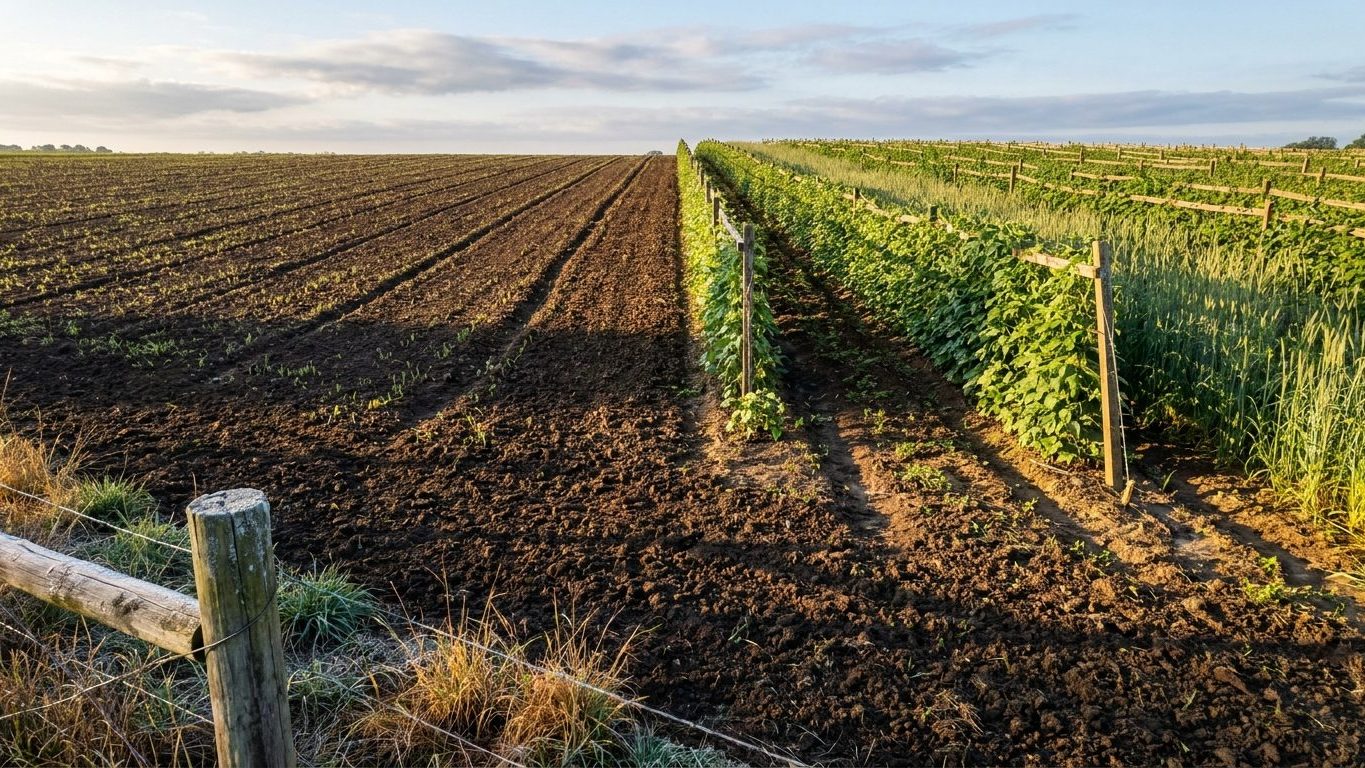

In Illinois, fall cover crops go in before the first fall frost, which at the Chicago reference station lands between October 24 and November 3. Spring and summer covers wait for the last frost, between April 11 and April 22. Those are reference-city dates. Most suburban and rural gardens run later in spring and earlier in fall, so treat them as a starting point.
The short answer for Illinois
Those dates are probabilities, not deadlines. The figures come from NOAA’s 1991-2020 Climate Normals for 32°F freezes, and they mark the stretch where the chance of a freeze sits between 30 and 70 percent. A frost can still arrive before or after the window in any given year. The window tells you when the odds are shifting, nothing more.
Fall sowing
The fall target is simple: get seed in the ground early enough that it sprouts and puts on leaf before October 24 to November 3, the band when a first freeze becomes a coin flip or better. Oats, which die over winter, need the most growing time to be worth the trouble. Cereal rye is the forgiving one, and it will germinate in cool soil well after the others have given up. For a full comparison of species, see The Best Cover Crops for Illinois.
Spring and summer sowing
Spring is the mirror image. Tender, fast covers such as buckwheat should wait until the April 11 to April 22 band has passed, because a single freeze kills them outright. Hardy species can go in earlier, but only if the bed isn’t waterlogged. Illinois soil is often too wet to work in early April, and sowing into mud wastes seed.
One caution matters more than the rest. These dates come from an airport weather station, and gardens away from it typically see the last spring frost later and the first fall frost earlier, often by one to two weeks, and more at elevation. Move your calendar accordingly: sow fall covers sooner and hold spring ones back.
For the bigger picture of why and how, the parent guide, Cover Crops for Illinois Gardens, covers the fundamentals.
What will not work here
Winter here is cold enough to sort cover crops quickly. The mean daily minimum of the coldest month at the Chicago reference station is 18.8°F. That is an average night low, not a record, which means a typical January night sits well below freezing for weeks. Anything marginally hardy is living on borrowed time.
Sowing a slow crop late
The most common failure is seed that goes in after the frost window has already opened. A late-sown oat or clover planting may sprout and then stall as a handful of tiny seedlings, too small to shade out weeds or hold soil. With the first fall frost arriving as early as October 24 at the reference station, and earlier in many rural yards, the calendar leaves less slack than it feels like on a warm October afternoon. If you are past the window, switch to cereal rye, which tolerates the lateness, rather than forcing a species that needs more time.
Planting tender crops too early
The opposite mistake happens in spring. A warm week in early April tempts people to sow buckwheat, and then a freeze inside the April 11 to April 22 band wipes it out. Because those dates only mark where the freeze odds fall between 30 and 70 percent, an early sowing is a gamble at best. Buckwheat sown just before a freeze is dead seed money.
The table below sums up how the common types behave against the frost dates.
| Type | Sow against | What winter does |
|---|---|---|
| Cereal rye | Fall, up to and a bit past the first frost window | Survives; resumes growth in spring |
| Oats | Fall, well before the first frost window | Winter-kills, leaving a mulch |
| Buckwheat | After the last spring frost window | Killed by the first freeze |
| Crimson clover | Early fall | Less reliable in the colder parts of the state |
One more thing fails: assuming a single date for the whole state. Illinois is long enough that a sowing date that works near Chicago can be wrong by weeks at the other end, which the next section explains.
What changes across Illinois
Illinois does not sit in one hardiness zone. The USDA Plant Hardiness Zone Map (2023 edition, built on 1991-2020 normals) places the state anywhere from 5a to 7b. That spread is based on one variable, the average annual extreme minimum temperature, so it describes how cold the worst nights get rather than when frost arrives. There is no single answer for the state, and nobody should pretend there is.
The practical consequence is straightforward. Chicago’s reference figures describe the north. A gardener in the colder zones should lean toward cereal rye and treat crimson clover as a gamble, and should expect the first fall frost near the early edge of the October 24 to November 3 band or before it. Someone in the milder zones to the south has more room: later fall sowings stand a better chance, and tender species in spring can be tried a bit earlier with less risk, though never with certainty.
Local terrain complicates the pattern further. Low spots collect cold air and frost earlier. A bed against a south-facing wall behaves like a different zone altogether. Elevation also pushes frost dates earlier in fall and later in spring.
Which zone you are in is not something this page can tell you. Look up your location on the USDA Plant Hardiness Zone Map and read your own zone there. Then use the Chicago figures as an anchor and adjust from them, not as a prescription.
Where to check this for your own county
The best next stop is University of Illinois Extension, the state’s land-grant extension service. It has county offices staffed by people who know what actually grows in your soil and what the local frost pattern looks like.
When you get there, look for two things. First, a local planting calendar, ideally one written for your county or region instead of the whole state. Second, the cover crop varieties that have been trialled near you, with notes on how they overwintered and how they performed when sown at different times. A species that does well in one county’s trials can do poorly two hours away.
Be plain with yourself about the hierarchy. A county recommendation beats a state one, and this page is the state one. It rests on a single reference station, and it cannot see your soil, your slope, or your windbreak.
One limit to flag: this page does not have an Illinois calendar by species to quote. Extension calendars tend to be written for one crop or species at a time, so when you find one, check that it matches what you intend to grow instead of borrowing a calendar built for something else. If your county office has nothing on cover crops specifically, a phone call or email to the office will usually get you a pointer.
Checking this against your own garden
Dates on a page come second to what your own soil is doing. Three observations will serve you better than any calendar, and none needs equipment.
First, soil warmth by feel. Push your hand into the top few inches of a bed on a spring morning. If the soil still feels cold and clammy, it is too early for tender seed, whatever the date says. Beds that warm sooner than your neighbor’s are telling you about drainage and sun exposure.
Second, watch for the first flush of male flowers on squash or sweet corn tassels, if you grow them. When they appear, summer heat has settled in, and you know your garden has moved past the risk of spring frost. Compare the timing year to year and you will learn how your yard runs against the airport’s numbers.
Third, notice when the first true leaves appear on a spring sowing or on volunteer weeds. Those are the second set of leaves, shaped like the mature plant. A bed where they come up fast is a warmer microclimate. One where they lag is cooler and later, and your sowing dates should lag with it.
Keep a simple note each year of the date of the first frost you actually see in your yard. After two or three seasons, that note will beat the reference-city window.
Some gardeners also time this by the Moon: when to plant cover crops by the moon, as almanac tradition rather than fact.
Common questions
Can I sow cover crops after the first frost in Illinois?
Sometimes, but the choices narrow. Cereal rye still germinates in cool soil, so it is the usual late pick. Oats and clovers need more growing time and tend to give a thin stand if they go in after the October 24 to November 3 window at the Chicago reference station.
When is it safe to sow buckwheat in spring?
After the last spring frost. The reference figure is April 11 to April 22, but rural and suburban gardens often see it a week or two later, so check your own county before sowing.
Do the frost dates on this page apply to my whole state?
No. They come from one airport reference station in Chicago and give the stretch where the chance of a 32°F freeze is between 30 and 70 percent. Illinois spans USDA zones 5a to 7b, so dates elsewhere will differ.
Where can I find a calendar for my own county?
Start with University of Illinois Extension and look for your county’s planting calendar and any cover crop trial results. Both beat a state-level page like this one.