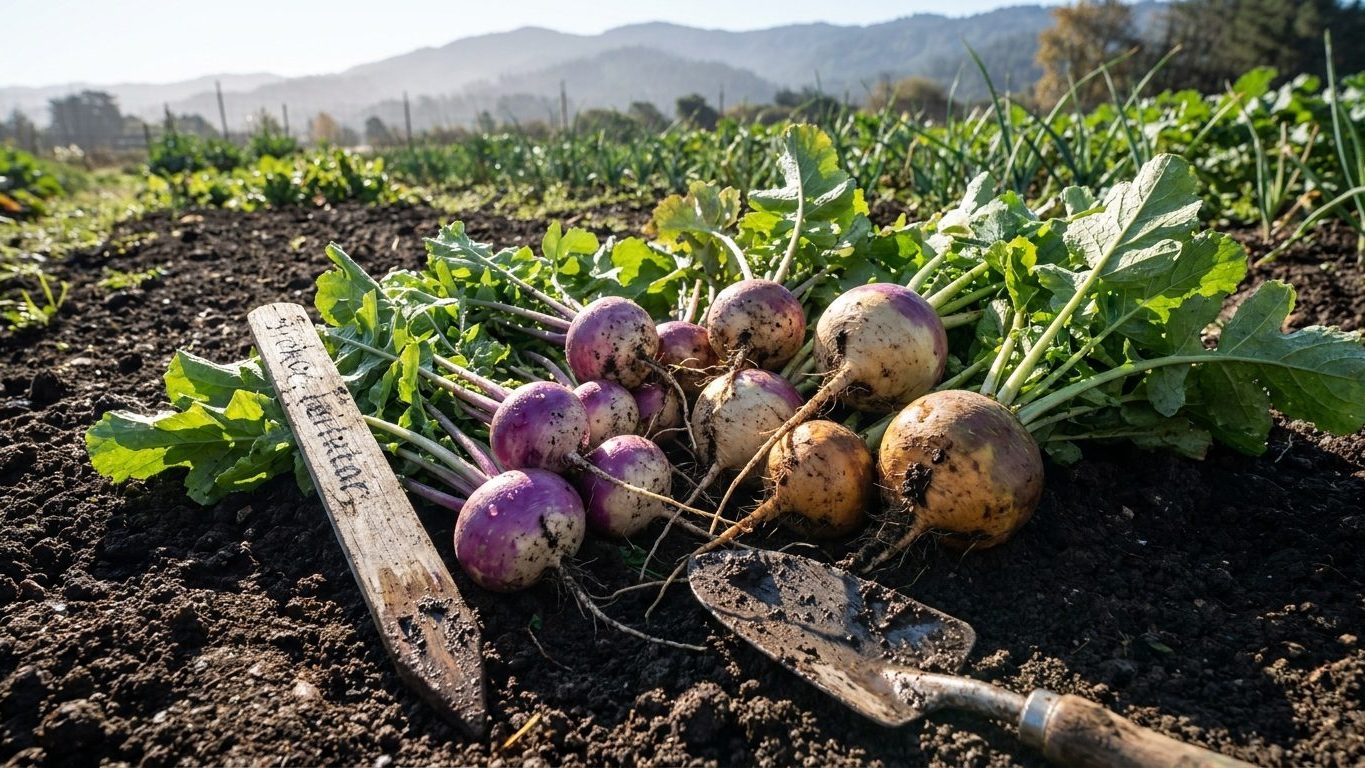

For most Ontario gardens, the best turnips are quick, small-rooted types such as Hakurei or Tokyo Cross. The best rutabaga is a dependable 90-day type such as Laurentian, sown early enough to finish before fall frost. Toronto’s frost-free stretch, April 30 to October 16 on average, has room for both. It does not have room for slow varieties sown late. The full crop guide is in Growing Turnips and Rutabaga in Ontario.
The short answer for Ontario
Grow fast white turnips for spring and fall eating, a classic purple-top globe turnip when you want roots for storage, and a Canadian-bred rutabaga such as Laurentian as your main-season crop. The season supports all three, provided the rutabaga goes in early and you treat frost dates as midpoints rather than promises.
What the frost dates actually say
Environment and Climate Change Canada’s 1981-2010 normals for the Toronto Pearson station put the last spring frost on average on April 30 and the first fall frost on average on October 16. Count the days between them and you get about 169, or roughly 24 weeks. These are mean dates, not probability bands. In one year out of two, the last spring frost lands after April 30, and in one year out of two the first fall frost arrives before October 16. A gardener who sows on the average date is gambling on a coin flip.
Rutabaga is where that coin flip matters. Seed packets typically list around 90 days to maturity, so it eats more than half of the average frost-free window. A typical small white turnip needs about 35 to 55 days, which leaves slack for a second sowing. Both crops tolerate light frost, so the dates are less a deadline than a guide to how much growing time you have.
The decision by type
| Type | Examples | Best use in Ontario |
|---|---|---|
| Quick white salad turnip | Hakurei, Tokyo Cross | Spring and fall sowings, eaten young and tender |
| Purple-top globe turnip | Purple Top White Globe | Fall crop, harvested after cool weather sweetens it |
| Rutabaga | Laurentian, American Purple Top | One early sowing, harvested late in the season |
Exact sowing dates depend on where you live, and they are laid out in When to Sow Turnips in Ontario. This page covers which variety to put in the row, not which week.
If you can only plant one thing, choose the quick white turnip. It forgives a late start, a cool spring and a missed week of thinning, and a row sown in late summer is often ready before you have thought about the fall. Rutabaga rewards patience but punishes procrastination.
What will not work here
Rutabaga sown in midsummer is the classic Ontario mistake. At about 90 days to maturity, a July sowing is racing an October 16 average frost with almost no margin, and since that date is a midpoint, roughly half of all years bring the frost sooner. The plant will not die. It will sit in the ground with a root the size of a golf ball and a lot of leaf. Rutabaga also sizes up best in cool weather, so a root that spends its swelling weeks in late-summer heat tends to come out smaller and tougher.
Large storage turnips sown in spring run into the opposite problem. Warm weather and long days push turnips toward bolting and woody roots, and the globe types take long enough that they spend their best weeks in the heat of an Ontario July. Save them for a late-summer sowing that matures in the cooler weeks of fall, and use the fast white types for spring. The page does not carry a summer temperature or humidity figure for Ontario, so it cannot say how many hot days to expect. But a hot spell on a turnip bed is a familiar way to lose a crop.
Uneven watering is a related failure. Turnips and rutabaga that swing between dry soil and a sudden soaking tend to crack and turn bitter. A grower who waters once a week during a dry spell is giving the crop exactly that swing. A layer of mulch and a steadier schedule matter more than any variety choice.
Close spacing fails in humid weather. Crowded leaves stay wet, which invites disease, and crowded roots simply do not swell. Thin turnips to a few inches apart and give rutabaga more room than the packet’s minimum if your beds hold moisture. Spring sowings also face cabbage root maggot and flea beetles, which hit these crops in Ontario gardens. Row cover from the day of sowing is the cheapest defence.
Then there is winter. The mean daily minimum of the coldest month at the Toronto reference station is -10.2 °C. That is an average night, not a record low, so colder nights do happen. Turnips and rutabaga are not overwintering crops here. Roots left in unprotected soil past hard freezes turn to mush, so plan to harvest or heavily mulch before the ground freezes.
One more trap is statistical. The Canadian frost normals cover 1981-2010, while the hardiness zones discussed below use 1991-2020 data. Comparing the two directly, or comparing either with the US figures on this site, mixes two different periods. Treat the frost dates as a starting estimate and no more.
What changes across Ontario
Ontario is not one garden. The frost dates above come from a single airport station near Toronto, and the province stretches far to the north and covers upland districts well away from the lakes. Natural Resources Canada lists Toronto, the reference city for this page, in Canadian hardiness zone 7a (1991-2020 normals). That is a Canadian zone, built from seven climate variables, and it does not convert to a USDA zone. It describes the reference city, not the province. The page does not hold the full zone range for Ontario, and since the province spans several zones, there is no single answer for it.
What can be said is the direction of the shift. Northern and upland gardens run weeks behind the Pearson dates, with a later last spring frost and an earlier first fall frost. That shortens the window available to a 90-day rutabaga. If you garden in those places, give rutabaga the earliest sowing the soil allows, choose the faster of the two rutabaga varieties you can find, and lean on quick white turnips rather than globe types. A fall turnip crop also has to be sown earlier, since the cold arrives sooner.
Near the lakes, and in the milder southern districts, the Pearson numbers are a closer match, though still not a guarantee. Open ground, shelter and slope all move the dates a little. To see where your own municipality sits, use Natural Resources Canada’s plant hardiness map rather than guessing from a neighbour’s garden or a seed catalogue.
Where to check this for your own county
The next stop is the provincial source. The Government of Ontario’s agriculture and food pages are the official starting point for provincial guidance. Look there for two things: a planting calendar for your part of the province, and any varieties that have been trialled in your county or a neighbouring one. A trial result in your own region tells you more than any national seed-catalogue description of a variety.
Be realistic about what you will find. Ontario does not run the kind of county-by-county gardening extension office that many US states do, so local guidance may be thinner, scattered across a few pages or held by regional growers and garden clubs. Ask at a nearby independent garden centre or farm-supply store as well, since they see which varieties actually sell and which come back for a second year. If a local source gives you a different sowing window or a different variety, trust it over this page.
This page is a provincial summary. It rests on one Toronto-area station and one reference-city zone, so it cannot reflect the differences between Windsor, Ottawa, Sudbury or Thunder Bay. A county recommendation beats a provincial one every time, because it is built on conditions nearer to your own soil and your own frost pocket.
Checking this against your own garden
Your own observations outrank every date on this page. Three are worth watching, and none needs a gadget.
- Soil warmth by feel. In spring, push your hand into the bed. If the soil feels cold and sticky and clumps in your fist, wait. Soil that crumbles and feels merely cool is ready for turnips. A bed that reaches that point a week before the rest of your yard is a warm pocket, usually south-facing or sheltered. A bed that lags is shaded or low and wet.
- The first true leaves. After the two seed leaves, the first rough, true leaves show how fast the crop is moving. Note the number of days from sowing. If they take much longer than a packet suggests, your soil or air is running cool and a rutabaga there needs an earlier start next year.
- The first frost night. Check frost on the grass, a car roof and your beds on the same morning. If your beds frost while the neighbourhood does not, you are in a cold hollow. If they stay clear well after others have frosted, you have a longer season than the Pearson average suggests.
Write the dates down for a season or two. A few lines in a notebook will give you a better calendar than any provincial average.
Common questions
Which turnip is the easiest for a first Ontario garden?
A quick white salad type such as Hakurei or Tokyo Cross. They mature in roughly 35 to 55 days (check the packet), leave room for a second sowing, and tolerate the cool weather of spring and fall.
Can I still sow rutabaga in July?
It is risky. Rutabaga typically needs about 90 days, and the average first fall frost at the Toronto reference station is October 16, which half of all years beat. Farther north, the margin shrinks. Early sowing is the safer plan.
Will fall turnips survive a frost?
Light frosts are fine for both crops, and cool nights tend to sweeten the roots. A hard freeze is another matter. Harvest or mulch heavily before the ground freezes, since the Toronto reference station’s coldest-month mean daily minimum is -10.2 °C.
Is zone 7a my hardiness zone?
Not necessarily. Zone 7a is the Canadian zone for Toronto, the reference city used here, not for the province. Find your own municipality on Natural Resources Canada’s map, and remember that the Canadian system is not interchangeable with USDA zones.