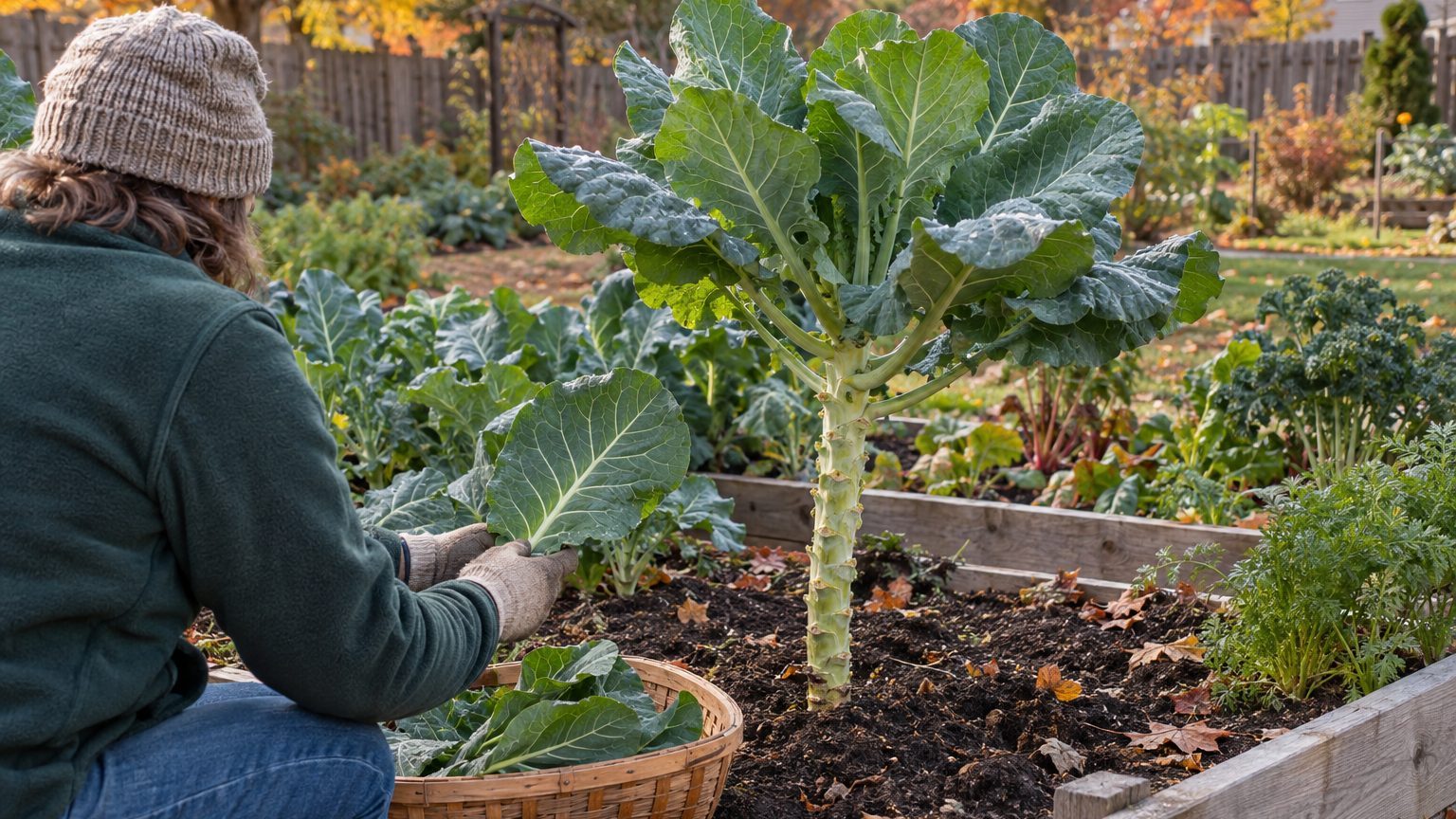

Collards give you more than one meal per plant. Pick the lower leaves, leave the top intact, and one planting keeps producing for months. Plant them so the leaves mature in cool weather, and they get sweeter as the nights get colder. How long the harvest lasts depends mostly on how cold your winter gets.
One plant, harvested for months

Most vegetables end the day you harvest them. A head of lettuce, a carrot and an ear of corn each get one cut, and the plant is finished. A collard works differently, and the difference is the whole economy of the crop. The plant grows from a single point at the very top of its stem, a cluster of tiny folded leaves called the terminal bud. Everything above the soil is built from that point, one leaf after another, pushed out from the center while the older leaves at the bottom get pushed down and outward.
The rule that follows from the mechanism
Because the growing point sits at the top, you can take leaves from the bottom without touching it. That gives you the rule: harvest from the bottom up, take mature lower leaves, and never cut the crown. Snap or cut each leaf close to the main stem and leave the cluster of young leaves at the top untouched. The plant answers by making more leaves from that same bud. Over a season the stem stretches upward, bare below and leafy on top, and gardeners often compare it to a small palm tree.
A gardener who cuts the entire plant at ground level has turned a six-month vegetable into a one-meal one. The plant might resprout from the stump in some conditions, but those shoots are small and scattered, nothing like a crown that keeps pushing out full-size leaves. Treat the top of the plant as the engine and the bottom leaves as the output.
How a single autumn planting can reach spring
Plant in late summer or early fall in a region with mild winters, and you can pick through the cool months. Each picking takes the oldest leaves first, and those are also the ones most likely to be chewed on, yellowing, or splattered with soil. Taking them is a kind of housekeeping. The plant has no reason to hold onto them, and removing them lets air move through the canopy.
The run ends when the plant decides it does. Collards are biennial, so after cold weather followed by lengthening, warming days, the plant sends up a flower stalk. Once that starts, leaves turn tougher and stronger-tasting, and the harvest is effectively over. Pull the plants at that point and use the bed for something else.
Where that bed goes next matters. Collards are brassicas, in the same family as cabbage, kale, broccoli and mustard. Turnips and rutabagas are brassicas too, so a bed that held turnips last year is not a fresh start for collards. They share the same insects and soil-borne diseases. Check your rotation page before choosing the spot, and give the whole family a break from the bed.
Pests follow the family too. Cabbage worms, aphids and flea beetles all find collards. The practical defenses are floating row covers installed early, hand-picking Caterpillars, and keeping weeds down around the plants. As for which collard types suit your area, such as open-leaf or heading, and which have been trialled locally, ask your state cooperative extension service. They test types in your actual soil and climate.
One food-safety habit to build in: inspect every leaf before it goes in the kitchen. Wash off grit, and discard anything slimy, foul-smelling or visibly moldy rather than trimming around it.
Frost makes them better
Southern gardeners have a saying that collards are not worth eating until after frost. It is a simple observation about what cold does to the plant. Like turnips, collards respond to falling temperatures by converting starch stored in their leaves into sugars. Sugar dissolved in the cell sap lowers the temperature at which the sap freezes, so it works partly as a defense for the plant. The side effect, for you, is a milder, sweeter, less harsh leaf.
That is a response to cold, not ripening. A collard does not mature toward some sweet peak the way a tomato does. Leaves picked in warm weather taste stronger and more bitter, and leaves of the same plant picked after cold nights taste noticeably different. Time on the stalk does not make the difference. Temperature does. A leaf that has been through several chilly nights is the goal, though a single frost is not magic.
What this does to planting dates
The practical consequence is that you plant backward from the cold. Southern gardeners aim for a harvest that starts after the first frosts, so they plant in late summer or early fall, long enough ahead for the plants to reach good size before the cold arrives. A young, small plant going into winter has little to give you. A well-established one starts producing right as the flavor improves.
Start by finding your average first fall frost date, then count backward to leave the plants a full stretch of growing weather. Your extension service publishes planting calendars for your area, and these give you a date range instead of a guess. Seed packets list days to maturity for a given variety, so use that figure rather than a rule of thumb from another region.
A spring planting is possible but harder. Leaves that mature in rising heat come out tougher and stronger, and insect pressure builds as the weather warms. Gardeners in cold-winter areas sometimes plant in spring and again in midsummer for a fall crop, which gets the sweetening effect before the plants are done.
How much frost collards can take, and whether they live through the whole winter, is a local fact. A plant that sails through January in one state will be dead by December in another. Your extension service will give figures that match your zone.
Collards, mustard, kale and chard
These four get lumped together as cooking greens, and they overlap in the garden and on the plate. They are not interchangeable, though. The table lays out the differences that affect what you plant, where you plant it, and how you pick it.
| Crop | Brassica? | Frost | Heat and bolting | How it is harvested |
|---|---|---|---|---|
| Collards | Yes (same species as cabbage and kale) | Flavor improves in the cold, hardiness varies by region | Holds up in heat better than most greens, flowers eventually | Lower leaves picked repeatedly, crown left in place |
| Mustard greens | Yes (a separate species) | Takes cool weather well, sweeter after cold | Bolts quickly in heat and long days | Young leaves cut repeatedly, or the whole plant taken |
| Kale | Yes (same species as collards) | Among the most cold-tolerant greens | Gets bitter and tough in sustained heat | Lower leaves picked repeatedly, like collards |
| Swiss chard | No (beet family) | Tolerates light frost, hard freezes vary by region | Handles summer heat better than the brassicas | Outer leaves picked, center left to regrow |
Mustard is the sprinter of the group. It grows fast, bolts fast, and suits gardeners who want greens within weeks and are happy to sow again. Collards are the marathon runner. If you want to compare collards with kale in more detail, the kale page on this site covers its growing habits, and the Swiss chard page does the same for chard.
The brassica column is the one to pay attention to. Collards, mustard and kale all share cabbage-family pests and diseases, so they count as one group when you plan where things go. Chard is not a brassica. It belongs to the beet family, alongside beets and spinach, and that is the practical reason the distinction matters. A bed that held chard can host collards the next year without carrying over brassica trouble, and a bed that held mustard cannot. Rotate by plant family, never by how similar the leaves look.
Gardeners also ask which type to choose within each crop. Extension services run variety trials, and their lists are specific to your region. Check theirs before ordering seed.
Why the answer changes with where you garden
Collards live two completely different lives depending on the map. In a mild-winter region, they are a standing crop. You plant in late summer or early fall, and the garden holds fresh leaves from about November through March, with the plants staying in the ground through the whole cold season. They are effectively winter vegetables, and the harvest happens while most other gardens sit empty.
In a cold-winter region, the story is shorter. Collards there are an autumn crop. They grow through the cooler end of the year, get sweeter with each frost, and end with the hard freeze. You get a good run, but not a winter one. A few gardeners stretch it with row covers or low tunnels, and whether that works depends on how low your temperatures actually go.
The two lives need different decisions. The mild-winter gardener plants for the long haul and picks conservatively so the plant lasts. The cold-winter gardener plants early enough for the leaves to be at full size before the cold arrives, and can pick more heavily since the freeze will end things anyway. Both follow the same bottom-up rule, but the stakes differ.
Go to the state pages in this silo for the specifics of your area, including planting windows and how collards behave through the winter where you live. Then check with your state cooperative extension service, which is usually run through your land-grant university and has local offices in most counties. They can tell you which collard types have been trialled in your region, what pests are active, and what your frost dates are. That is the information that decides between a harvest that ends in November and one that carries into March.
Common questions
Can I cut the whole collard plant at once?
You can, but you give up the months of harvest. Cutting at ground level removes the growing point, and the plant will not return to producing full leaves the way an intact crown does. Take the lower leaves and leave the top.
Why do my collards taste bitter?
Heat is the usual cause. Leaves that mature in warm weather taste harsher, and older leaves can be tougher than young ones. Time your planting so the harvest falls after cold nights, and pick leaves while they are mature but not oversize.
Can I plant collards where turnips or cabbage grew last year?
Not if you want a real rotation. Turnips, rutabagas, cabbage, kale and mustard are all brassicas, and they share pests and diseases with collards. Choose a bed that held a non-brassica crop, and check your rotation page for the sequence.
Do collards come back the next year?
Collards are biennial, so a plant that survives winter will flower in its second season and then decline. In mild-winter areas, plants can carry on into spring before they bolt. Once the flower stalk rises, the leaves turn tough, and it is time to pull the plant and replant for the next fall.
Sources : aces.edu | nicksgardencenter.com | seedsavers.org