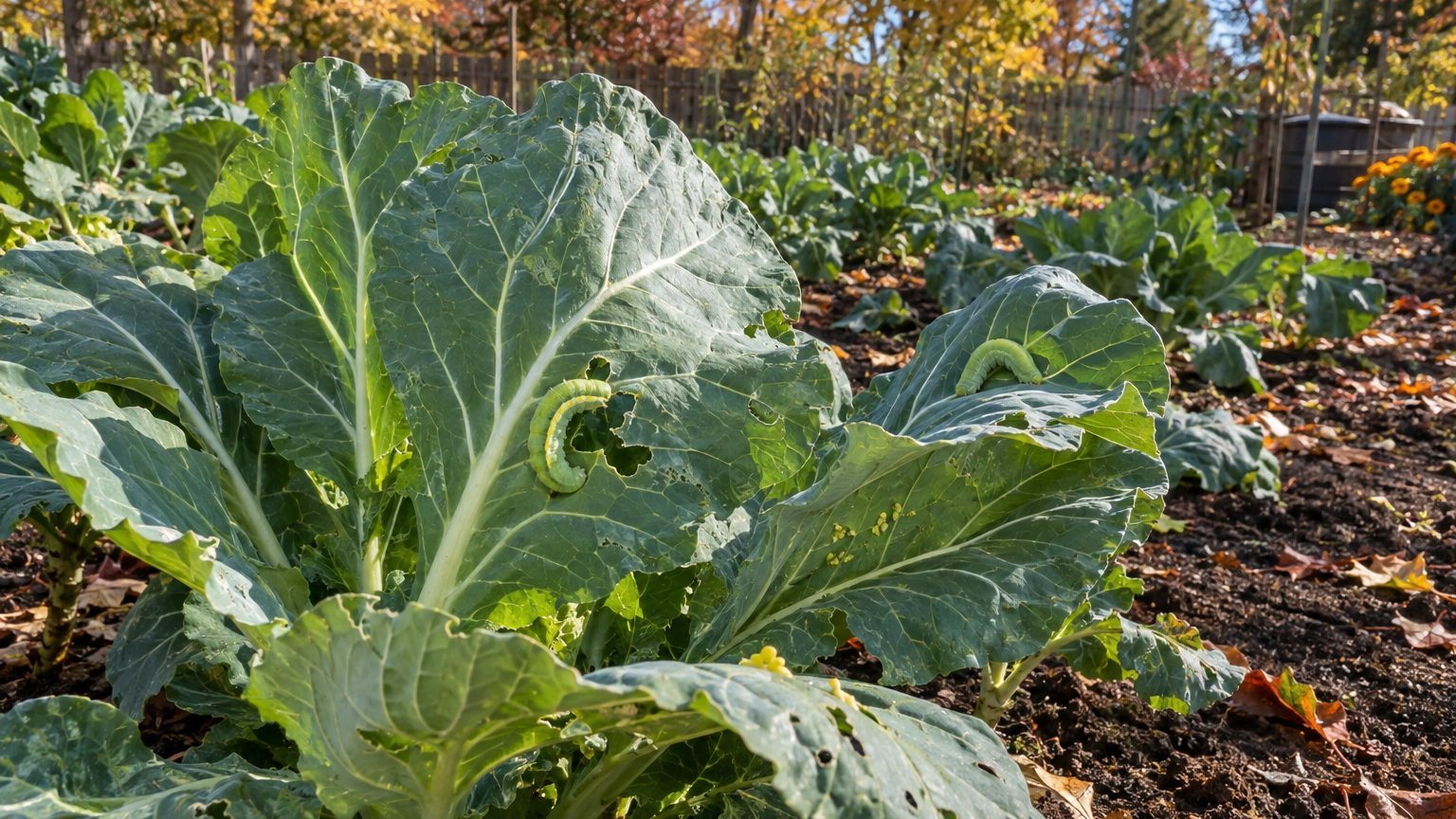

Green caterpillars chewing ragged holes in collard leaves are almost always one of three species: the imported cabbageworm, the cabbage looper, or the diamondback moth larva. All three are the young of small butterflies or moths that lay eggs on anything in the cabbage family. A weekly check of leaf undersides, handpicking, a Bt spray (Bacillus thuringiensis var. kurstaki) when numbers climb, and a row cover installed before the egg-laying starts will handle nearly every infestation. Knowing which caterpillar you have helps you time those steps.
Three caterpillars, three ways to tell them apart
The imported cabbageworm is the most common. It is velvety green, up to about an inch long, with a faint yellow stripe down the middle of its back. It crawls slowly and steadily, and it tends to bore toward the center of the plant as it grows. Its parent is the familiar white butterfly with one or two dark smudges on each forewing, the one you see fluttering over the garden on sunny mornings. Each female scatters single, pale yellow, bullet-shaped eggs across the undersides of leaves, and a single butterfly can lay a few hundred over her short life.
The cabbage looper looks similar at first glance but moves differently. It is pale green with thin white stripes along each side, and it travels by arching its middle into a hoop and stretching forward, like an inchworm. That gait comes from having only a couple of pairs of fleshy legs near the rear of its body. Mature loopers reach roughly an inch and a half, which makes them the largest of the three, and they eat more than their size suggests. The adults are mottled brown moths that fly at night, so you rarely connect them with the damage.
The diamondback moth larva is the small one. It stays around a third of an inch, tapers at both ends, and wriggles hard when touched, often dropping off the leaf on a silk thread. Its feeding leaves translucent “windowpane” patches where it scraped the lower leaf surface and left the upper skin intact. Larger holes follow as it grows. The adult moth folds its wings to show a row of pale diamond shapes along its back, which is where the name comes from. This species has a reputation among commercial growers for developing resistance to insecticides, which is one reason gardeners should lean on timing and barriers rather than reaching for stronger sprays.
Mixed populations are normal. A single collard plant in September can host all three at once, along with the occasional armyworm or corn earworm that wandered in from a neighboring crop.
Reading the damage and picking your moment
Start with the droppings. Caterpillar frass looks like tiny dark green to black pellets, and it collects in the leaf folds and on the lower leaves beneath the feeding site. If you see holes with no pellets, suspect something else. Flea beetles leave dozens of pinpoint shot holes. Slugs leave slime trails and ragged edges, usually near the soil. Harlequin bugs, the black-and-orange shield bugs common across the South, suck sap and leave pale stippled blotches rather than chewed tissue. And if the new growth at the center is curled and sticky instead of eaten, you are looking at a different problem: see Grey Aphids Packed Into the Growing Point.
Season matters more in the South than it does up north. Cabbage butterflies and moths are active from early spring through late fall, and in the Deep South, mild winters let some of them keep going. Where northern gardeners may see two or three generations, a Gulf Coast or Florida garden can see more, with the heaviest pressure usually in early fall, when the collards you just transplanted are small and the adult populations are at their summer peak. Eggs hatch in a few days in warm weather, and the larvae feed for roughly two to three weeks before pupating. That quick turnover is why a patch that looked clean on Saturday can look chewed by the following weekend.
Collards are more forgiving than most crops in this family. Because you harvest leaves rather than a head, and the plant keeps pushing up new growth from the crown for months, a few holes in lower leaves are cosmetic. Young transplants are the exception. A seedling with six leaves can be stripped to stems by a handful of larvae, so the first four to six weeks after planting deserve the closest watch. On established plants, I would act when you find caterpillars on most plants in the bed or when the newest leaves near the center start getting eaten, since those are the ones you’ll harvest next.
Scouting takes about five minutes. Walk the row, flip over a few leaves per plant, and look along the midribs, where the green caterpillars blend in best. Check the crown too, because cabbageworms often retreat there. Early morning or late evening works well, since the larvae are easier to see when leaves are cool and upright. Crushed yellow eggs and clusters of tiny, pale larvae tell you a new generation has started.
Control that works, in order of effort
Handpicking comes first, and it works better than most people expect in a home-sized planting. Drop the caterpillars into a bucket of soapy water or step on them. Twenty feet of collards can be cleared in a few minutes if you start early, and removing a half-dozen large loopers matters, since the last growth stage does most of the eating. Squashing the yellow eggs on leaf undersides while you’re at it keeps the next wave from hatching.
When numbers outrun your patience, Bt is the standard tool. It is a naturally occurring soil bacterium that produces a protein toxic to caterpillars (moth and butterfly larvae) once they eat it. They stop feeding within hours and die over the next few days. It does not harm people, pets, bees, or ladybugs, and it breaks down quickly in sunlight, which is both its strength and its weakness. Coverage has to be thorough, with the spray reaching the leaf undersides where the caterpillars hide, and it needs reapplying every five to seven days during heavy pressure and after rain. Spray in the evening so the sun doesn’t degrade it before the caterpillars feed overnight. Products with spinosad, which is also approved for organic production, work on a similar caterpillar-targeting basis but have a broader effect on other insects, so read the label.
Most home-garden Bt labels allow harvest the same day, but check the one on your bottle, because intervals differ by product and by state. Alternating between Bt and spinosad also reduces the chance of resistance building in the local population, which matters for diamondback moths in particular.
Barriers prevent the problem rather than treat it. Lightweight row cover laid over hoops at transplanting keeps the adults from laying eggs at all, as long as the edges are buried or pinned down tight. Two cautions apply. Don’t cover a bed where last season’s cabbage-family crops were growing and the pupae could be overwintering in the soil, because you would be sealing the next generation inside. And pick a cover weight suited to your climate, since thicker fabrics can overheat plants in a Georgia or Texas September. The details of weights, hoops, and when to take the cover off are covered in Row Covers Over Greens: Two Jobs at Once. For the bigger picture on spacing, timing, and keeping plants productive, the main guide to Growing Collards: One Planting, Months of Harvest is the place to start.
Natural enemies do real work if you let them. Small parasitic wasps in the genus Cotesia lay eggs inside cabbageworm caterpillars. If you see a dying caterpillar surrounded by a cluster of tiny yellow cocoons that look like grains of rice, leave it alone, because the wasps that emerge will go after more. Paper wasps, lacewings, and ground beetles also take their share. Broad-spectrum pyrethroid sprays wipe out these allies along with the pests, and the caterpillars often rebound faster than their predators do. This is the main reason I would rank those products last for a collard patch.
Two small habits cut the odds further. Pull wild mustards and shepherd’s purse from the edges of the garden, since they host the same insects and feed the next generation. And rotate: planting collards where cabbage, broccoli, or kale grew last year puts the new transplants right next to any overwintering pupae.
Getting them out of the kitchen
Even a well-managed patch can send a stowaway to the sink. Cabbageworms tuck into leaf folds and the curled center of the plant, where their green color matches the foliage almost perfectly. Soaking cut leaves for ten to fifteen minutes in a sink of cold water with a tablespoon or two of salt or a splash of vinegar encourages stragglers to let go and float or sink to the bottom. Then rinse each leaf under running water and run a thumb along the midrib, the spot where frass tends to collect. Collards are usually cooked low and slow, so a rinsed, de-stemmed leaf is in good shape by the time it hits the pot.
One last point about spraying near other plantings: Bt kills any caterpillar that eats treated leaves, and that includes the larvae of black swallowtail butterflies, which feed on parsley, dill, and fennel. If those grow beside your collards, spray carefully on a calm day so the drift doesn’t reach them, or let the row cover do the job instead.