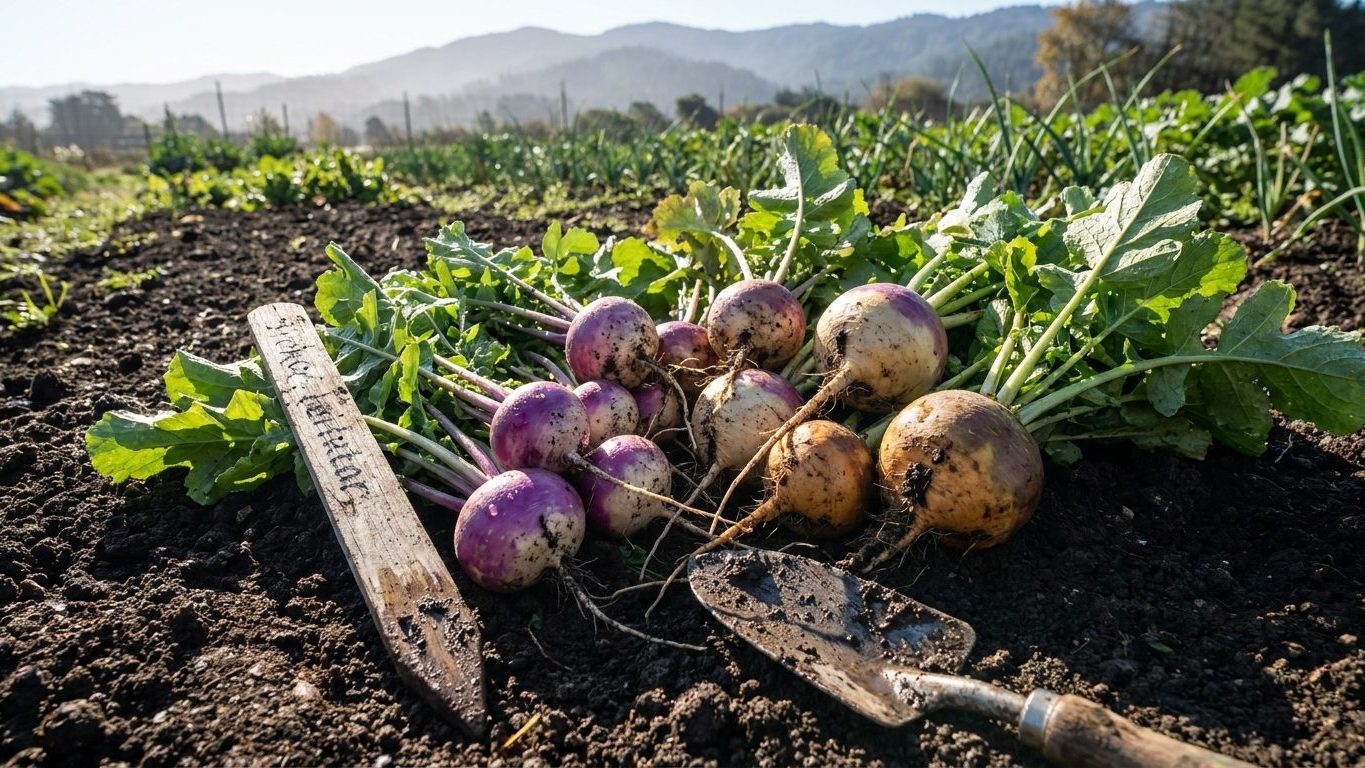

Choose fast white salad turnips for spring and fall, a classic purple-top globe turnip for fall storage, and a rutabaga sown early enough to bulk up before October. Wisconsin offers a cool-season window that is generous in the south and short in the north. A variety’s name matters less than how fast it matures, and the frost dates decide that.
The short answer for Wisconsin
The best turnip for Wisconsin is whichever one finishes before a hard freeze, and the best rutabaga is the one you give the longest runway. Both crops are cool-season roots, so the choice comes down to days to maturity rather than flavor claims on a seed packet.
What the frost dates actually measure
NOAA’s 1991-2020 Climate Normals put the last spring freeze at April 16 to April 29 and the first fall freeze at October 17 to October 29. Those are not guarantees. Each range is the band where the odds of a 32°F freeze run between 30 and 70 percent. A date inside it is closer to a coin flip than a promise.
Count the days between the two bands and you get roughly 171 days (April 29 to October 17) at the short end and 196 (April 16 to October 29) at the long end. That is a bit under six months to a bit over. For tomatoes, that window is tight. For turnips and rutabaga, which tolerate light frost, it is more than enough, because they can start before the spring band closes and keep growing after the fall band opens.
One caution comes with these numbers. Lake Michigan delays the first fall freeze at the lakeshore, while inland southern Wisconsin typically freezes in early October and the north far earlier. The ranges above describe one reference point, not the whole state.
Choosing by type
Sorting by type works better than hunting for a single “best” variety. The table below sets out the decision.
| Type | Wisconsin role | Reason |
|---|---|---|
| Quick white or Japanese-type salad turnips | Spring crop and a second fall sowing | Fast roots that finish before summer heat or the first hard freeze |
| Purple-top globe turnips | Main fall crop, good for storage | Larger roots that size up in cooling weather |
| Rutabaga | Fall harvest only | Slowest of the three, so it needs the earliest start and the longest runway |
Seed catalogs sell dozens of named selections within each of those types. This page does not have Wisconsin trial results for specific cultivars, so it sticks to the types. For the full growing picture, see Growing Turnips and Rutabaga in Wisconsin.
What will not work here
Rutabaga sown late in the north is the first casualty. Rutabaga is the slowest crop in this family, and the north’s first fall freeze arrives far earlier than the October 17 to October 29 band quoted above. A rutabaga seeded on a southern Wisconsin schedule in a northern garden will meet a hard freeze while the roots are still small. Slow types belong where the season is longest, or they need the earliest sowing that soil conditions allow.
Waiting for the last frost to pass is the opposite mistake. Many gardeners treat April 29 as a green light, the way they would for tomatoes. Turnips do not need that caution. Holding back until the end of the April 16 to April 29 band burns the cool weeks that spring roots depend on. By the time warm weather arrives, a late spring planting is racing heat it cannot beat. The exact sowing window is laid out in When to Sow Turnips in Wisconsin.
Heat is the second enemy of a late start. Turnips that mature in warm soil tend toward tough, woody, sharp-tasting roots, and they bolt. This page does not carry summer temperature or rainfall figures for Wisconsin, so treat that as general crop behavior and not a statewide number. The practical lesson stands, though: the spring sowing should be finished and harvested before midsummer, and the main crop should be timed to mature in cool autumn weather.
Humidity punishes tight spacing. Crowded turnip tops stay wet after rain, hold disease, and give pests like root maggots a sheltered place to work. A seed packet’s spacing is a minimum, and in a damp Wisconsin summer or fall it is worth erring wider. Thinning seedlings early is tedious, but it is cheaper than losing a row.
Finally, do not count on the soil as a winter cellar. The coldest month here has a mean daily minimum of 17.2°F (NOAA 1991-2020 normals, Milwaukee reference), and that is an average, not the extreme. Roots left in the ground into that cold are a gamble. Harvest them after the first hard freeze and store them, rather than assuming the row will hold them until January.
What changes across Wisconsin
Wisconsin is not one garden. The USDA Plant Hardiness Zone Map (2023, built on 1991-2020 normals) places the state in zones 3b to 6a, which is six half-zone steps from the cold north to the warmer southeast. There is no single answer for the state, and any page that gives one is averaging away real differences.
Zones are built on one variable, the average annual extreme minimum temperature. That tells you about winter survival of perennials, not how long your turnip season is. Still, the same cold that sorts the north into the low zones also shortens its growing season, so the zone is a decent shorthand for which way to shift.
A reader in the north should lean toward speed. Choose the quick salad types, sow the fall crop earlier than the state-level dates suggest, and treat rutabaga as a stretch unless local experience says it works. The frost dates quoted above are not yours if you garden far north, since the first fall freeze there comes well before the October 17 to October 29 band.
A reader on the Lake Michigan shore has the opposite situation. The lake delays the first fall freeze, which gives the fall crop extra days and makes rutabaga more realistic. Inland southern Wisconsin sits in between, with its first freeze typically in early October.
For your own zone, use the USDA map and look up your location. This page will not tell you which zone you are in, because a ZIP code or a county lookup is the only reliable way to find out. Use the map’s result as a guide to how far to push the state-level advice, not as a calendar.
Where to check this for your own county
Start with University of Wisconsin Extension, the state’s land-grant extension service. Its horticulture staff work at the county level, and their recommendations are built from local conditions rather than a statewide average.
Two things are worth looking for there. The first is a local planting calendar, which will show spring and fall sowing dates for your area in place of the broad frost bands used here. The second is a list of varieties trialed or recommended for your county. A cultivar that performs well in a university trial in your region is a better bet than one that simply looks good in a catalog. It is also worth checking any pest alerts for root crops, since local conditions change what is most likely to damage a planting.
A county recommendation beats a state one. This page is the state one. It is built from NOAA normals and a statewide hardiness range, and it cannot account for your lake effect, your hillside, or the frost pocket at the bottom of your yard. Treat it as the starting frame, then let the extension office narrow it down.
This page does not have county-level variety trial results, and it does not claim any. If a local trial says a specific rutabaga outperformed the rest in your county, believe it over anything written here.
Checking this against your own garden
Your own observations outrank every date on this page. Three are worth watching, and none need an instrument.
First, feel the soil. Push your hand into a bed in early spring. If the soil crumbles instead of clumping into a wet ball, and it feels cool but not frozen, it is workable, and turnips can go in. A bed that stays cold and soggy long after your neighbor’s has told you something about drainage and sun exposure.
Second, watch the first true leaves. After the seed leaves, the first true leaves show how fast your spot really grows. If they appear quickly, your bed is warm and well drained. If they lag behind what the packet suggests, your microclimate is cooler, and you should favor the faster types or sow earlier.
Third, find where frost lands first. On a clear, cold night in autumn, check which parts of the yard are white at dawn. Low spots collect cold air and frost early. Beds near the house or a wall hold warmth longer. Noting that pattern one fall tells you where the fall crop will last longest, and which bed should hold the slow rutabaga.
Write the dates down for a season or two. A simple notebook of when the soil crumbled, when leaves appeared, and when the first frost hit will soon beat any calendar, including this one.
Common questions
What is the best turnip type for Wisconsin?
Fast salad turnips suit spring and a second fall sowing, and purple-top globe types suit the main fall crop. The right pick depends on how long your season is, so shorter seasons favor the quicker types.
Can I grow rutabaga in northern Wisconsin?
It is a stretch. Rutabaga is the slowest of these crops, and the north’s first fall freeze comes far earlier than the October 17 to October 29 band for the reference point. This page does not have a northern sowing date, so check with your county extension office before committing garden space.
When should I sow turnips in Wisconsin?
Spring sowing can begin when the soil is workable, since turnips tolerate light frost, and the fall crop is timed to mature before a hard freeze. The detailed windows are in When to Sow Turnips in Wisconsin.
Can turnips stay in the ground over winter in Wisconsin?
Not reliably. The coldest month averages a daily minimum of 17.2°F at the Milwaukee reference, and the ground freezes. Harvest after the first hard freeze and store the roots instead of leaving them in the row.