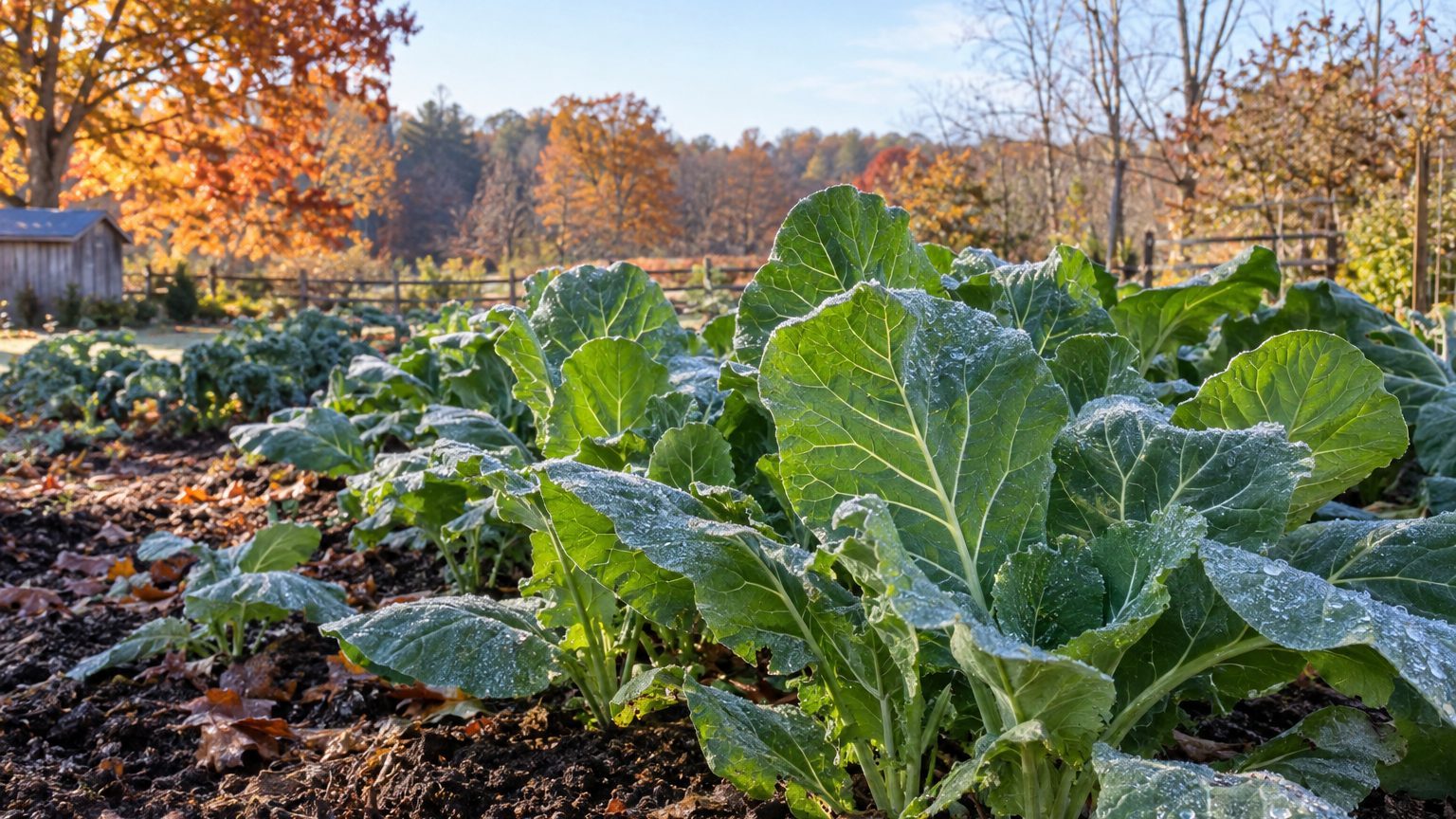

Start collards indoors from mid-February to early March for a spring crop, then sow again from late June through mid-July for the fall crop that tastes best. Both windows hang on the Providence reference dates: last spring frost April 7 to April 17, first fall frost October 24 to November 3. Gardens inland and away from the water usually run a week or two later in spring and earlier in fall.
The short answer for Rhode Island
Those frost dates are odds, not promises. They come from NOAA’s 1991-2020 climate normals for the Providence airport station, and each one is the 30 to 70 percent probability band for a 32°F freeze. On April 7 the chance of another freeze is still real. By April 17 it has dropped to a minority of years, but a late freeze still shows up occasionally. In fall the logic runs backward: October 24 is when a first freeze becomes possible, and by November 3 it is more likely than not. The airport sits in a warm, built-up spot near the bay, so a backyard in the country will often freeze later in spring and earlier in fall.
Collards are forgiving about the spring dates. Established plants shrug off a light freeze, which is why they can go out before the tomato crowd. Here is how the calendar breaks down against the reference-city dates:
| Crop | Task | Window |
|---|---|---|
| Spring | Sow seed indoors | Mid-February to early March |
| Spring | Set hardened-off transplants outside | Late March to mid-April |
| Spring | Sow seed directly in the garden | Early April to early May |
| Fall | Sow seed in flats, a seedbed or the row | Late June to mid-July |
| Fall | Set transplants in the garden | Mid-July to mid-August |
Spring crop
Counting back from the April 7 to April 17 window puts indoor sowing in late winter. Seedlings that size toughen up over a week outdoors and go in the ground in the weeks around the last frost date. Seed sown straight into the soil in April works too, though the plants come in later and have less time before summer heat arrives.
Fall crop
The fall crop is the one worth planning around. Plants that mature in cooling weather build sugar in the leaf as nights approach freezing, and the flavor shows it. Working back from October 24 puts the last sensible transplant date in late summer, which is why seed goes in the ground earlier. For the full growing picture, see Growing Collards in Rhode Island.
What will not work here
Winter harvests are the first casualty. The mean daily minimum in the coldest month at Providence is 22.1°F, which means plenty of nights fall well below that. Collards grown in the Deep South stand in the garden through January. Here, plants that come through December are a bonus, not a plan, and a sustained cold snap finishes them even under a row cover. Treat the fall crop as one that runs from October into early winter and eat it with that in mind.
Sowing in August fails for a related reason. Seed started in the first half of August makes small plants by the time the first freeze arrives, and small collards stall instead of sizing up when days get short and soil cools. Anything that goes in after mid-August will give you baby leaves at best. The July start is what turns into a full harvest.
Late spring sowing is another trap. A direct seeding in late May or June runs the plant into July and August, when hot stretches push growth, leaves toughen, and cabbage worms and aphids build up on a crop that has no time to outgrow them. A spring crop earns its place by being in the ground and growing in April, harvested before midsummer. If it is not planted by early May, wait for the fall window.
Humidity punishes crowding. Rhode Island summers are damp, especially near Narragansett Bay and the southern shore, and tight spacing keeps leaves wet after dew and rain, which invites leaf spots and gives caterpillars a hiding place. Plants set farther apart dry out faster and are easier to inspect. A row planted too close looks productive in June and becomes a disease problem by September.
The last mistake is assuming the Providence dates are your dates. A garden in a low hollow, on a north slope or in the northwestern part of the state can see its last spring freeze after April 17 and its first fall freeze before October 24. Plant to those dates blindly and a spring crop gets caught by frost, or a fall crop is not big enough by the time cold arrives.
What changes across Rhode Island
The state is small, but it is not one garden. The USDA Plant Hardiness Zone Map (2023 edition, built on 1991-2020 normals) places Rhode Island across zones 6a to 7b. There is no single zone for the state and no single sowing date. Zone numbers rest on one variable only, the average annual extreme minimum temperature, so they say how cold the worst nights get, not how many frost-free weeks you have. Collards care about both, which is why the zone is a rough guide and local frost timing is the better tool.
In general, the warmer end of that spread follows the shore and islands, where ocean air takes the edge off winter, and the cooler end runs through the interior and northwest. A gardener near the coast can lean toward the early side of each window. One inland or at higher elevation should shift later in spring and earlier in fall: push indoor sowing and transplanting back by a week or two, and start the fall crop in late June so transplants are in the ground by mid-July instead of August.
Variety matters more as the season shortens. Gardeners on the cold side of the state do better with faster-maturing types, and those near the water have more room to grow larger-framed ones. The comparison is in The Best Collards and Greens for Rhode Island. To find your own zone, use the USDA Plant Hardiness Zone Map and search by ZIP code. Do not guess it from a neighbor’s garden a few towns over.
Where to check this for your own county
University of Rhode Island Cooperative Extension is the place to confirm everything above against your own ground. The land-grant extension network exists to translate research into local advice, and Rhode Island’s is part of that national system. It is a better source for a specific planting date than any statewide article, this one included.
Look for two things when you get there. The first is a vegetable planting calendar for the region, ideally with spring and fall dates listed for cool-season crops such as brassicas and leafy greens. The second is any information on the varieties that have been trialed locally, because a collard that performs in a test plot in your part of the state is a safer pick than one that has only done well elsewhere. If the site does not list collards specifically, the cabbage and kale entries are close enough to guide timing, and the staff can answer questions directly.
A county recommendation beats a state one every time. A statewide calendar has to cover coastal towns and hill country alike, and the Providence dates are a reference point, not a rule. Local frost dates, soil types and variety results are what an extension office can give you, and they are what should override any date you read here.
Checking this against your own garden
Your own observations outrank every date in this article. Three are worth watching, and none needs equipment beyond your hands and your eyes.
- Soil warmth by feel. In spring, push a hand into the bed. If the soil crumbles instead of clumping and does not chill your fingers after a few seconds, direct sowing is reasonable. A bed that stays cold and sticky well after a neighbor’s has dried tells you your garden runs late, so shift your windows later.
- First true leaves. Seedlings first show a pair of rounded seed leaves, then the first true leaves, which look like small collard leaves. Once those have appeared and the plant has a few of them, it is ready to harden off. If indoor seedlings stretch and flop before that point, they need more light or a cooler spot.
- Frost on the grass. In late October, check which corners of the yard turn white first on a clear, still morning. Low spots and open ground freeze earlier than ground near the house or a stone wall. The pattern shows you how far your garden sits from the reference dates.
Keep notes from year to year. After two seasons you will have your own dates for transplanting, first harvest and first hard freeze, and those will serve you better than any published calendar.
The Moon calendar is a separate, older custom: see when to plant collard greens by the moon, written as tradition rather than fact.
Common questions
Can I sow collards directly in the garden in April?
Yes, and many gardeners do. Sowing in early April to early May works when the soil has warmed enough to crumble. Plants will mature later than transplants started indoors, so expect a harvest closer to early summer.
Will collards survive a Rhode Island winter?
Not reliably. Light frosts and a few cold nights are fine and improve flavor, but the coldest month at Providence has a mean daily minimum of 22.1°F, and sustained hard cold kills the plants. Count on a harvest from fall into early winter, not through to spring.
How late can I plant collards for fall?
Transplants set out through late summer can still size up before the first freeze, which arrives October 24 to November 3 in Providence and sooner inland. Seed should go in a month or so before that. After mid-August, plants stay small.
Should I start collard seed indoors or outdoors?
Both can work. Indoor starts in mid-February to early March give the earliest spring crop. For fall, many gardeners sow seed in flats or a protected seedbed in late June to mid-July, then transplant when the plants have several true leaves.