
Sweet potatoes do well in New Jersey if the slips go out late rather than early. At the Newark reference station the last spring frost falls between March 29 and April 6. The plants wait for warm soil, though, which usually means late May into early June. Summer then supplies enough heat for most gardens and plenty of rain. The real hazards are cold ground, soggy beds, and rot.
When the soil is warm enough in New Jersey

Start with the date everyone asks about. In NOAA’s 1991-2020 U.S. Climate Normals for the Newark airport station, the last spring 32 F freeze falls between March 29 and April 6 (the 30 to 70 percent probability band). Suburban and rural gardens typically see the last spring frost one to two weeks later, and more at elevation, so check your own county before marking a calendar. A frost date is a probability, not a promise, and a late cold snap can still show up after it.
Frost is only a proxy
Treat that date as a starting line you do not cross yet. Sweet potatoes are tropical in origin and wait for warm soil, not merely for air that has stopped freezing. Soil lags behind the air by weeks. A bed can stay cold and wet long after the last freeze, and slips set into it stall, sulk, and sometimes rot at the stem.
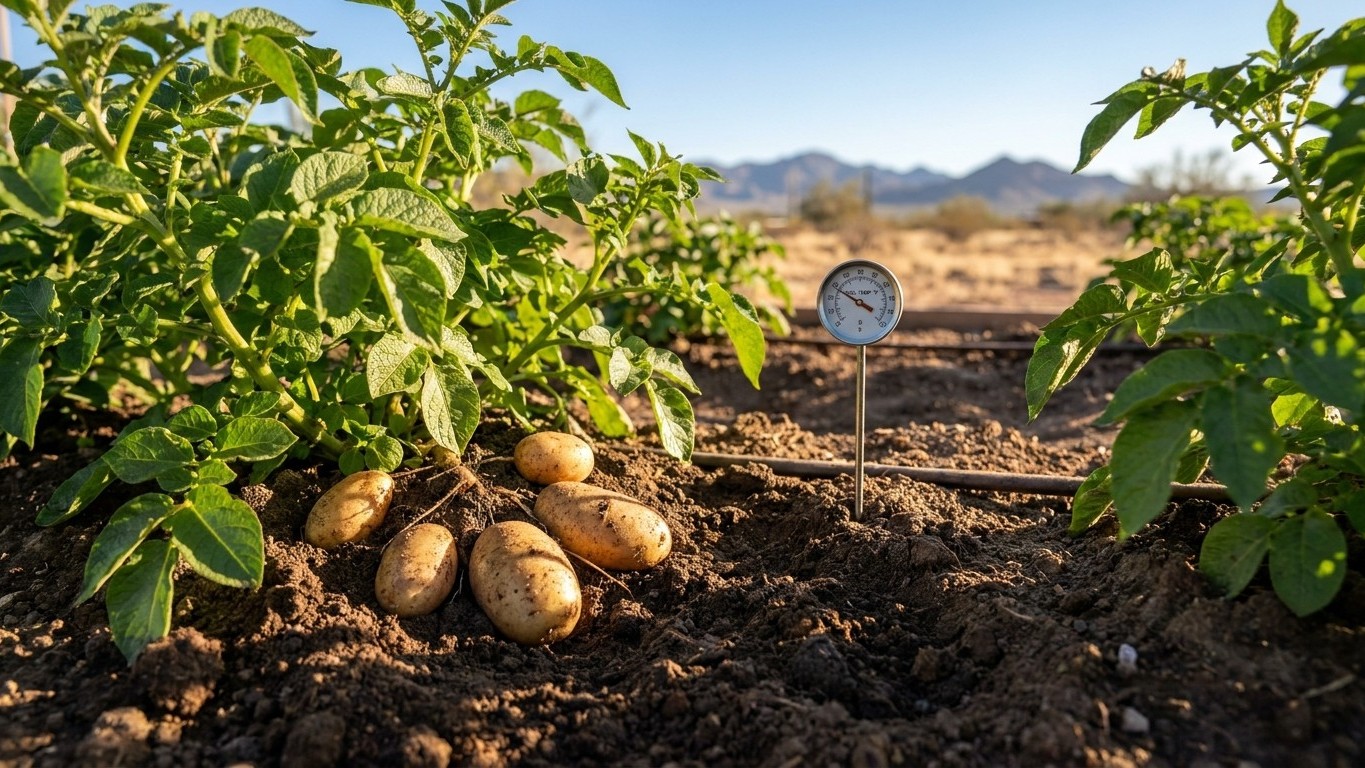
A soil thermometer settles the question. Take the reading in the morning, when the ground is at its coolest, and wait until it holds steady. In most New Jersey gardens that lands between late May and early June. Cool springs, shade, and heavy clay push it later. A sheet of black plastic laid over the bed ahead of planting speeds things up.
A relative of morning glories, not of potatoes
The supermarket label muddles this plant. Sweet potato is not a yam (true yams are an unrelated tropical crop) and it is not a potato. It does not share a rotation with potatoes, tomatoes, or peppers. A bed that grew potatoes last year is not disqualified, but moving sweet potatoes to fresh ground each season still keeps soil-borne rot in check. The crop starts from slips, which are rooted shoots sprouted from a mature root.
The USDA Plant Hardiness Zone Map spans zones 6a to 7b across the state. That system rests on winter minimum temperatures, so for a summer annual killed by the first frost it matters far less than the warmth of the soil in June.
How long the season lasts here
The arithmetic
The Newark reference station puts the first fall frost between November 4 and November 16. Counting from the latest spring date (April 6) to the earliest fall one (November 4) gives 212 days. Counting from the earliest spring date (March 29) to the latest fall one (November 16) gives 232. So the frost-free stretch at the reference station runs from 212 to 232 days. Gardens outside the city, with a later spring frost and an earlier fall one, should expect to lose a couple of weeks or more from each end.
Frost-free days are not sweet-potato days, either. The useful window opens when the soil warms in late May or early June and closes when cold nights arrive in the fall. Frost blackens the vines, and cold soil injures roots still in the ground. Even after that trimming, the window comfortably holds one full planting.
What a window this long allows
A long window buys options that a short one does not. It makes room for a second round of slips set out a few weeks after the first, which staggers the harvest and gives insurance if an early planting gets hit by a cold, wet spell. It also allows time to do the root check properly, so that white roots show before planting. Where the season is tight, that pause costs too much.
The second round has a limit. Roots need warm soil to bulk up, so a planting that goes in late has fewer weeks to do it and tends to give smaller roots. The Growing Sweet Potatoes: Slips, Heat, and a Careful Cure guide covers slip handling in detail, and the succession sowing guide on this site explains how to space plantings through the summer. Gardeners farther north, where the window is tighter, will find a different set of trade-offs in Growing Sweet Potatoes in New York, and in Growing Sweet Potatoes in Alberta, where the crop becomes a project from the first day.
Heat and water in New Jersey

Warm days, and the nights that go with them
Sweet potatoes want accumulated warmth, with warm nights as well as hot afternoons. At the Newark reference station, the mean number of days reaching 90 F or more is 20.8 a year (NOAA NCEI Climate Normals, 1991-2020). That is a handful of hot spells, not a long scorching summer. Newark is a city station, so a rural garden may run cooler after dark, and your own plot will differ from the airport reading.
Taken at face value, the figure puts New Jersey in the middle. It is not the Deep South, where the crop is routine and heat stress is the main worry. It is not a cold-summer region either, where the crop turns into a project of plastic, ridges, and early types. In a normal year bare ground works. In a cool, damp summer, the usual penalties are slow ripening, mildew on the foliage, and soil rots. A mulch of black plastic and raised ridges are the insurance, and they pay off most in cool springs.
Rain: 13.2 inches in three months
Rainfall across June, July, and August at the same station averages about 13.2 inches (June 4.34, July 4.66, August 4.15), out of 46.6 inches over the year. That is generous. Steady moisture lets roots swell evenly. A long dry stretch followed by a drenching storm is what splits them.
The inch of rain behaves differently depending on the ground. A sandy bed lets water through within the day, so even a wet summer can mean watering every couple of days. Clay holds the same rain for a week and invites rot, which is where ridges and good drainage earn their keep. Heat adds a wrinkle: much of a summer’s rain arrives as thunderstorms, and a downpour on hard, dry soil mostly runs off instead of soaking in.
Eventually the wet-summer reputation has to meet your own plot. These are normals, not forecasts. A rain gauge staked at the bed, checked after storms, tells you what the soil actually received. Ease off the watering before digging, since soaked roots are prone to split and spoil.
Which sweet potatoes suit New Jersey
Choose by type, matched to what the climate throws at the crop.
| Condition | Type to look for |
|---|---|
| A shorter window, such as a suburban or higher-elevation garden | The earliest-maturing types |
| Hot spells with 20.8 days a year at 90 F or more at Newark | Vigorous vining types that shade the root zone, grown on ridges with airflow |
| Humid summers with about 13.2 inches of rain from June through August | Types sold with disease resistance, such as to soil rot, wilt, and scurf |
In a humid climate, resistance comes first, ahead of flavor and flesh color. A tidy-looking vine that rots in the ground does nothing for the kitchen.
A variety recommendation means something only if it was grown in trial plots near you, in your soil, and a name copied from a national catalog tells you nothing about how it behaves in South Jersey sand or northern clay. Rutgers NJAES and its county extension offices know which varieties have been trialled in the state, and which slip suppliers they trust. A phone call there is worth more than any list.
Common questions
Can I plant slips right after the last frost?
No. Frost risk ending does not mean the soil is warm. Wait until a thermometer in the soil holds steady in the morning. Slips set into cold ground stall, and cold wet soil invites rot.
Do I need black plastic in New Jersey?
Not every year, but it helps in a cool spring, on clay, or in a shaded bed, where it warms the soil sooner. Pair it with raised ridges so water drains. On warm sandy ground in a hot spring, bare soil usually does fine.
How should I handle the harvest and storage?
Dig before frost blackens the vines and before the soil turns cold, and handle the roots gently, since bruises invite rot. Curing comes next, in a warm, humid spot, and the main sweet potato guide walks through it. Never store sweet potatoes in a refrigerator. Cold injury below the storage range is the most common way a good home crop is ruined. Inspect every root. A soft patch or a weeping spot ends the question, and a root that looks sound is not proof that it is safe.
How do I find my county’s frost dates?
Rutgers NJAES county offices can give frost timing for your own area, and a cheap minimum-thermometer left in the garden shows you the local pattern over a season or two.