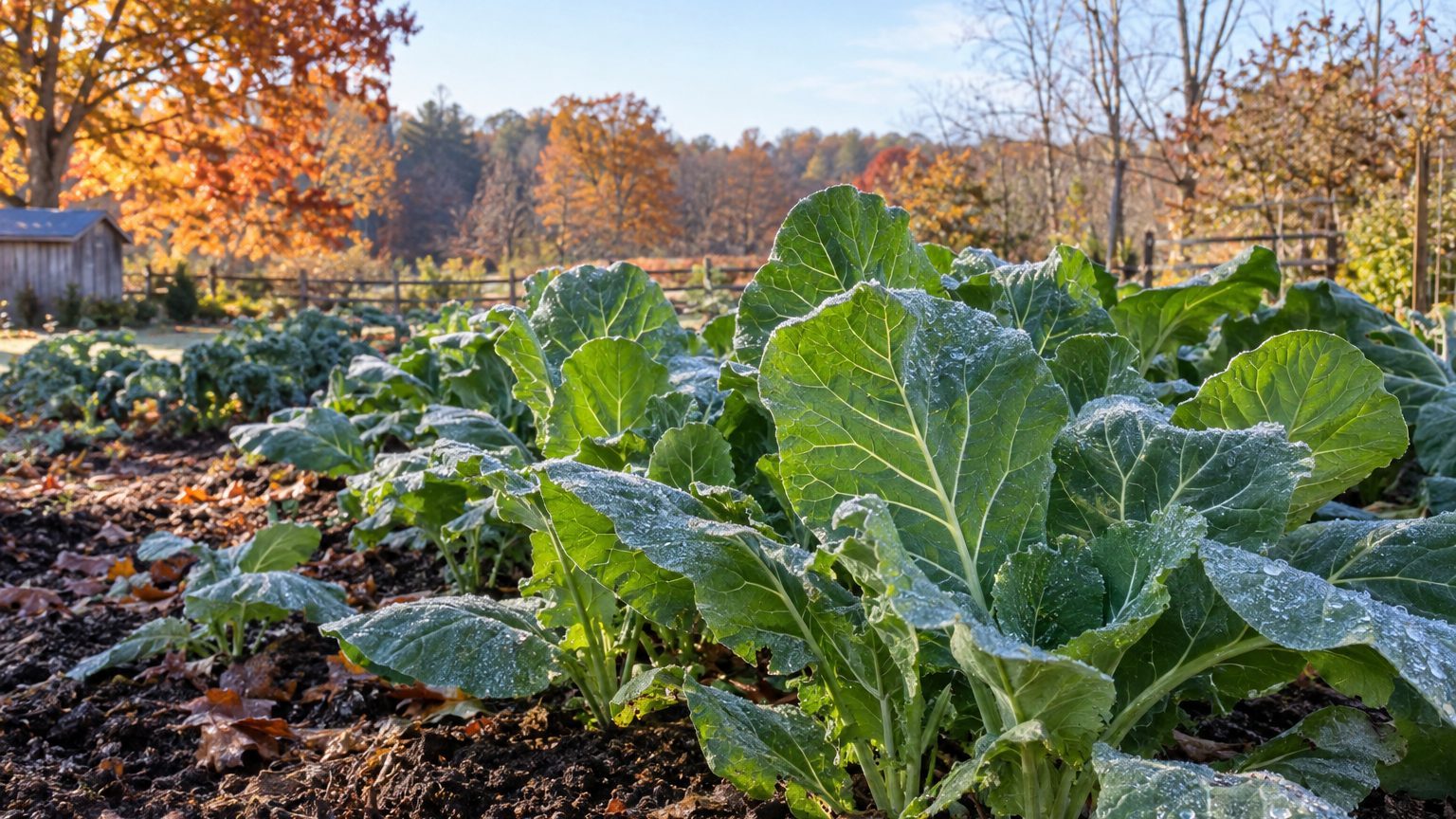

Collards in the Northwest Territories are a transplant crop. Start seed indoors in mid to late April, then move sturdy seedlings outside from late May into early June, with a cover ready for cold nights. Seeding straight into cold northern soil burns the first weeks of a short season. The dates below are built on Yellowknife, so gardens farther north should add time.
The short answer for Northwest Territories
Environment and Climate Change Canada’s 1981-2010 normals for the Yellowknife A station put the last spring frost on average on May 25 and the first fall frost on average on September 18. Each date is a probability statement: in one year out of two, the last frost falls later than May 25, and in one year out of two, the first fall frost arrives earlier than September 18. Roughly 116 days separate the two averages.
Neither date is a safe one. Treat May 25 as the middle of the spring window, not the day the risk ends. Half of all springs still hold a frost after it, so tender transplants set out that day need a cloche, row cover, or a bucket on hand for a few nights. Collards cope with a light frost better than most garden crops, which is why the fall end of the season is more forgiving than the spring end.
| Task | Timing | Reasoning |
|---|---|---|
| Sow seed indoors | Mid to late April | Four to six weeks of indoor growth before the May 25 average |
| Harden off seedlings | Last week of May | A week of gradual exposure to wind and sun |
| Transplant outdoors | Late May to early June | Around the average last frost, with cover for the later-frost half of years |
| Begin harvesting leaves | Late July onward | Collards are usually listed at about 60 to 80 days from transplant |
| Final harvest | After the first fall frosts | Average first frost is September 18; light frost sweetens the leaves |
Harvest leaves from the bottom up, taking a few from each plant, and the crop keeps producing well into fall. The full picture of growing the crop, from bed preparation to feeding, is in Growing Collards in Northwest Territories. This article stays with the calendar.
Count backward from your own transplant date rather than forward from a seed packet. If a cold May pushes transplanting to June 5, the seeds should have gone in around late April, not mid-April, or the seedlings will be leggy and root-bound by the time they reach the ground.
What will not work here
Sowing seed outdoors in April or early May fails first. Northern garden soil is often still frozen or sitting just above freezing then, and brassica seed in cold, wet ground rots or sits idle. By the time the soil is workable, the best weeks of the season are gone. Starting indoors turns those weeks into leaf.
The slowest, largest collard types fare poorly too. With about 116 days between the average frost dates, and no sensible transplanting before late May, a variety that needs the long end of 80 days from transplant leaves very little cushion. Half of all years bring the first frost before September 18. Southern heirloom collards bred for long, warm seasons are the usual casualties, and the choice of faster, hardier types is covered in The Best Collards and Greens for Northwest Territories.
Overwintering is off the table. The mean daily minimum of the coldest month at Yellowknife is -29.5 °C (-21.1 °F), and the Canadian hardiness zone for the city is 1b. That is the Canadian system, built on seven climate variables, and it does not translate into a USDA zone. Collards are tough in a fall frost, but they are not built to survive a winter like this. Plants left standing in October will not return in spring, so plan on a fresh crop every year.
Planting on the average date as if it were a deadline also backfires. A gardener who sets out tender transplants on May 25 with no cover is betting on a coin flip. A better habit is to look at the ten-day forecast, harden the plants off, and keep a cover on the bed through the first week.
Oversized, root-bound transplants held indoors too long are another quiet failure. Seedlings kept in small cells past their prime, then hit with a run of cold nights after planting, can be pushed toward flowering instead of leafing. Bolted collards turn bitter and stop producing useful leaves. Long daylight pushes growth fast once the plants are settled, but it cannot rescue a stunted start.
Finally, thin soil over rock dries quickly under those long days. A weekly deep soak may not be enough in a shallow bed, so raised beds with deeper soil and a mulch layer are a more dependable base.
What changes across Northwest Territories
The territory runs from the 60th parallel at the Alberta border up to the Arctic Ocean coast, so no single sowing date covers it. The hardiness zone of 1b applies to the reference city of Yellowknife under the Canadian system, using 1991-2020 normals. It is not the zone of the whole territory, and the zones shift with latitude, with distance from Great Slave Lake, and with exposure to the wind. For where your own community falls, check Natural Resources Canada’s Plant Hardiness Site, which maps the zone by municipality.
The frost dates also come from one station. The Yellowknife A averages describe the airport area, and northern or upland districts run weeks behind them. A reader in the far north should push the whole calendar later, with indoor sowing later and transplanting later, and should treat any garden without protection as a gamble. Southern communities nearer the 60th parallel are likely to run somewhat earlier than Yellowknife, though a cold, windy site can erase that advantage.
Within one community, the differences can be nearly as large. A south-facing wall, a raised bed, and a spot sheltered from wind each add warmth. A low pocket where cold air settles takes it away, and frost lingers there on mornings when the rest of the yard is clear.
For gardeners in the north or in exposed sites, the practical shifts are the same:
- Use raised beds, which thaw and warm sooner than native ground.
- Add row cover or a low tunnel after transplanting.
- Choose faster-maturing varieties over large, slow ones.
- Consider a greenhouse or cold frame to start and harden off seedlings.
The Yellowknife dates are a starting point for those further afield, not a promise. Shift them according to what your own spring does.
Where to check this for your own county
The Northwest Territories has no county system, so the useful local layer is your community and region. The territorial government’s agriculture services, run through the Department of Industry, Tourism and Investment, are the right place to start. Look for the planting guidance for northern gardens, any lists of vegetables and varieties that have been grown successfully in your region, and contact details for agriculture staff who can answer questions about your area.
Two things matter most when you get there. The first is a local planting calendar, ideally one tied to your community’s own spring conditions instead of Yellowknife’s. The second is any record of which cabbage-family varieties have actually done well nearby, since a variety that matures reliably in one community may not in another. If a collard variety is not listed, kale and other hardy greens with similar growing needs are a reasonable guide to what a local trial would show.
A community or regional recommendation will always beat a territory-wide one. A calendar built on a single weather station averages across a very large area, and your own spring may start a month earlier or later. Use the territorial calendar to plan, and let the local advice and your own observations overrule it where they disagree.
Local gardening groups are worth a call too. People who have gardened in your town for years know which beds thaw first and what year-to-year swings look like, which no average can show.
Checking this against your own garden
Your own observations outrank every date above. Three are worth watching.
Soil warmth by feel. Push your hand into the bed, a few inches down. If it feels cold and clammy, hold off. Soil that feels cool but not numbing is workable for hardened-off collards. A bed that reaches that point days before the neighbor’s tells you it has good sun and drainage, so you can plant earlier there.
Leaf-out of local trees. When the birch and willows near you begin to open their buds, the worst of spring is typically behind you. If they leaf out late in a particular year, your transplanting should wait too. Compare the year’s leaf-out with last year’s, and you will have a personal calendar that tracks the real spring.
True leaves on your seedlings. The first leaves are seed leaves. The true leaves come next, and a seedling with true leaves is ready for hardening off. If seedlings are stalling, or stretching tall and thin, the window is closing or the light is poor, and you may need to adjust the sowing date next year.
Keep a simple note of each one every year. After a few seasons, your notes will tell you more about your own microclimate than any regional average can.
The Moon calendar is a separate, older custom: see when to plant collard greens by the moon, written as tradition rather than fact.
Common questions
Can I sow collard seed directly in the garden in the Northwest Territories?
It is possible in early June in a warm, sheltered bed, but it leaves little time. Starting seed indoors in mid to late April and transplanting in late May or early June is the more dependable approach.
Is May 25 a safe date to plant outside?
No. May 25 is the average last spring frost at the Yellowknife A station, and in one year out of two the last frost falls later. Harden off seedlings first and keep a cover ready.
Will collards survive winter outdoors?
No. The mean daily minimum in the coldest month at Yellowknife is -29.5 °C (-21.1 °F), and the city sits in Canadian hardiness zone 1b. Collards are managed as an annual crop here.
When does the growing season end for collards?
The first fall frost averages September 18 at the Yellowknife A station, and in one year out of two it arrives earlier. Collards tolerate a light frost, and the leaves often taste sweeter afterward, so harvesting can continue after the first frosts.