
Open-ground sweet potatoes do not finish in Nunavut. At Rankin Inlet A, the reference station for the climate normals, the average gap between the last spring frost and the first fall frost is 86 days, and the thermometer reaches 30 °C about 0.03 days a year. A heated greenhouse, a sunroom or large containers kept indoors can work. A garden bed cannot. The method itself is covered in Growing Sweet Potatoes: Slips, Heat, and a Careful Cure.
When the soil is warm enough in Nunavut

The last spring frost at Rankin Inlet A falls, on average, on June 19 (Environment and Climate Change Canada, Canadian Climate Normals 1981-2010, station climate ID 2303401). That is a mean date, and a frost date is a probability, not a promise: in one year out of two the last frost comes later. Read it as the middle of a window. Communities farther north run weeks behind this Hudson Bay station.
Frost is only a proxy
Sweet potatoes do not wait for the frost to end. They wait for warm soil, and soil warms after the frost risk ends, not with it. Where snow lingers into spring and the ground thaws from the top down, cold soil holds on long after the air turns mild. A slip set into that soil sits, stalls and starts to rot at the base.
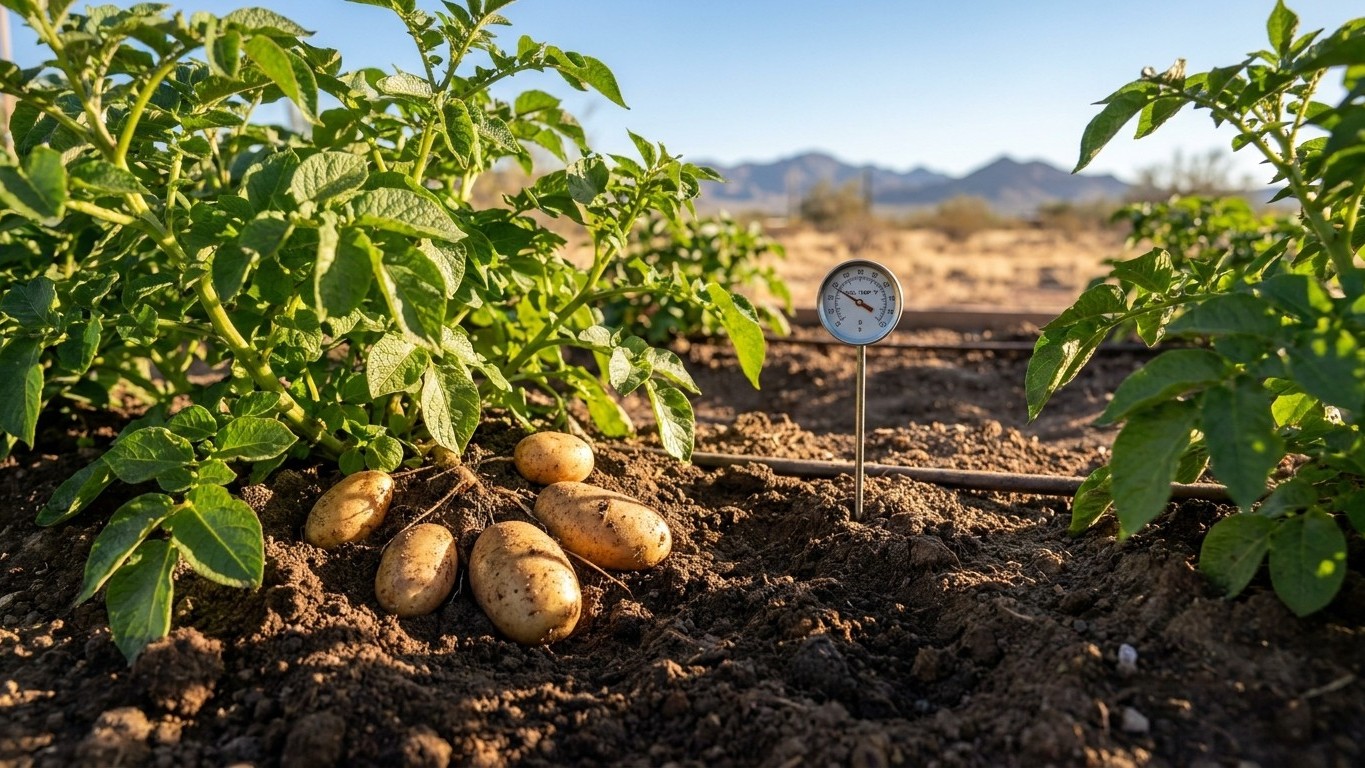
The test is a soil thermometer pushed four inches down and read in the morning, when the bed is at its coolest. A steady reading across several mornings is the signal. One warm afternoon is not. Dark mulch film laid over the bed a couple of weeks ahead nudges that day earlier, but it only moves heat that is already in the air into the soil. It cannot make any.
Slips raised indoors should be timed to that reading, not to the calendar. A slip that outgrows its pot while waiting turns leggy and weak, and a weak slip handles the shock of transplanting badly.
A tender crop that is not a potato
Sweet potato belongs to the morning glory family. It is not a yam (the supermarket label is wrong, and true yams are an unrelated tropical tuber) and it is not a potato. It is not a nightshade either, so potato rotation rules and potato blight advice do not apply to it. What does apply is its sensitivity to cold: one frosty night blackens the vines, and roots sitting in chilled soil are damaged even when the foliage looks fine.
How long the season lasts here
Count from June 19 to September 13, the average last and first frosts at Rankin Inlet A, and you get 86 days. Both are mean dates, so in half of all years the fall frost arrives sooner than September 13. And 86 days is a frost-free span, not a warm-soil span. The ground needs days after June 19 to reach the mid-teens, and in late summer growth slows with the cool nights well before the frost itself arrives. The usable window is shorter than 86 days.
What that length allows is a single planting. A long season can fit a second sowing, with the first batch harvested while the next one is still filling out. The succession sowing guide on this site is written for windows like that. Here the first planting is the only planting, so everything rides on it.
That changes whether transplanting is worth a root check. Sweet potatoes are grown from slips, and listed days to maturity count from the day the slip goes into the ground, not from any sowing date. With so little room, a slip that arrives without roots can lose weeks just establishing itself. Before moving one out, look for a few white roots at the base and a firm, green stem with no black at the cut end. A rooted slip starts growing within days. A bare cutting may not.
Three decisions follow from a window this short:
- Start slips indoors early enough that they are rooted and ready when the soil thermometer says go.
- Grow under cover (a heated greenhouse, a sunroom, or containers that can move indoors) instead of trusting open ground.
- Plan the harvest ahead of the first fall frost, because frost-chilled roots do not keep.
For comparison, the neighbouring territory’s window is laid out in Growing Sweet Potatoes in Northwest Territories. Neither territory gives a gardener room to waste.
Heat and water in Nunavut

At Rankin Inlet A, the average number of days a year reaching 32 °C is 0.0. At 30 °C, the more familiar threshold in Canada, the count is 0.03 days a year. Heat of this order simply does not occur at that airport station. Other communities will read differently, and a greenhouse changes the picture, but the station gives a clear idea of what an open bed gets.
That matters because sweet potatoes want accumulated warmth, and warm nights as much as warm days. Where many days pass 32 °C, as in the mid-Atlantic, the crop is routine (see Growing Sweet Potatoes in Delaware). Where the count is a handful, it becomes a project of black plastic, ridged beds and an early type. Where it is zero, even that toolkit falls short, because plastic holds heat but cannot supply it. Cool nights stall growth, and the roots stay thin.
What the rain does
Summer rainfall at the station totals about 127 mm (5.0 inches) across June, July and August, out of 310 mm (12.2 inches) over the year. June is the driest month at 27 mm (1.05 inches). July brings about 42 mm (1.65 inches) and August about 57 mm (2.26 inches). These are 1981-2010 normals, a guide to what the region can usually expect, not a forecast. A rain gauge on the plot itself settles what your own garden gets.
Rain never works alone. Sandy ground lets an inch drain through within the day, while clay holds it for a week. With cool air, evaporation is low, so a clay bed can stay soggy and a sandy one can still dry out between showers. Sweet potatoes want steady moisture while the roots swell, because a long dry spell followed by a heavy soaking is what splits them. In a greenhouse or container you control that rhythm. In a bed, you do not.
Cool and damp is the real risk in a short northern summer. Powdery mildew, slow ripening and root and stem diseases all follow, especially in a closed greenhouse where humid air sits among the vines. Water the soil rather than the leaves, and keep air moving. Natural Resources Canada places Rankin Inlet in zone 0a on the Canadian plant hardiness scale, which says something about winters but little about a tender annual, and it cannot be converted to a USDA zone.
Which sweet potatoes suit Nunavut
The choice comes down to type, and a short, cool, humid season sets the criteria in order. Earliest-maturing types come first, because every day saved from transplanting to harvest counts. Disease resistance comes second, since damp air and enclosed growing favour mildew and rot. Growth habit comes third.
| Type | Why it fits a short, cool summer | What to check |
|---|---|---|
| Earliest-maturing types | Shortest wait between transplanting and harvest | Compare the listed days from transplanting with the real window, not with the calendar |
| Compact, short-vine (“bush”) types | Fit containers and low structures, and are easier to move indoors | Still need warm soil and warm nights |
| Disease-resistant types | Cope better with damp, enclosed conditions | Resistance should be stated in the slip supplier’s description |
A name means something only when it has been grown under conditions like yours, and a type that thrives where nights stay warm tells you little about a summer on Hudson Bay. Agriculture and Agri-Food Canada is the place to start (Agriculture and Agri-Food Canada), and the territory’s own agriculture contacts can tell you what has actually been tried in northern greenhouses.
If a crop does come in, the harvest is where it can still be lost. Cure the roots in a warm, humid place. Never put sweet potatoes in a refrigerator or a cold cellar. Cold injury below their storage range is irreversible, and it is the most common way a home crop is ruined after a good harvest. Inspect every root before you eat it. A soft patch or a weeping spot ends the question, and a root that merely looks sound is not proof that it is safe.
Common questions
Can sweet potatoes grow outdoors in Nunavut?
Not reliably. With 86 days between the average frosts at Rankin Inlet A and essentially no days at 30 °C, open ground does not supply the warmth the crop needs. Heated greenhouses, sunrooms and containers kept indoors are the realistic options.
When should slips go into the ground?
When the soil says so, not the calendar. Wait for the morning soil temperature to sit steady for several mornings. June 19 is only the average last frost, and the soil trails behind it.
Can I store the roots over winter?
Cure them warm first, then keep them in a place that is cool but not cold. Never use a refrigerator or a cold cellar, since chilling damage cannot be undone. Check each root before use, and discard any with a soft patch or a weeping spot.
Does the Canadian hardiness zone help?
Barely. Natural Resources Canada gives Rankin Inlet zone 0a, a rating built on seven climate variables that mainly speaks to perennials surviving winter. A sweet potato is a tender annual that dies at frost anyway, and the Canadian zones cannot be converted into USDA zones.