
Sweet potatoes go into Virginia ground once the soil is warm. That usually means May on the coast and late May or early June in the mountains. The state runs from Virginia Beach to the southwest highlands, and planting dates shift by weeks along the way. Slips set into cold soil sit still. Slips set into warm soil take off, and everything else in the season follows from that start.
When the soil is warm enough in Virginia

Start with the frost calendar. At NAS Oceana in Virginia Beach, the NOAA NCEI 1991-2020 Climate Normals put the last spring frost at March 20 to April 3. That is the band where the odds of a 32F freeze run between 30 and 70 percent, so a freeze after those dates still happens in some years.
Sweet potatoes do not plant by the frost date. They plant by soil temperature, and soil warms later than the air stops freezing. A bed that thawed in March can still be cold and wet well into April. The crop is tropical in origin, and chilled roots and slips stall and then rot. Wait until the soil has warmed at planting depth and nights are no longer cold.
How do you check soil temperature before planting?
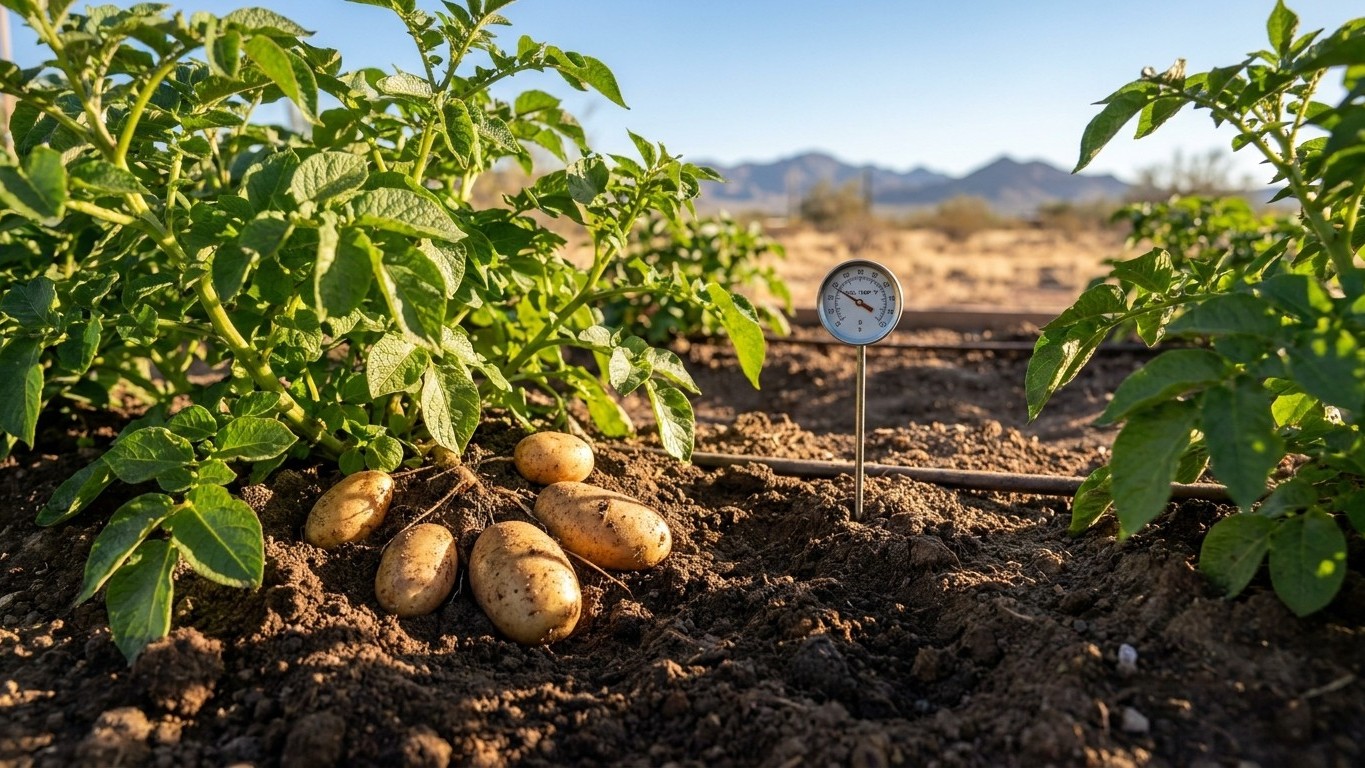
Push a soil thermometer 4 inches down in the morning, when the ground is at its coolest. Take readings for several days in a row. One warm afternoon proves nothing. If the numbers hold at or above the floor, plant. If a cold snap is in the forecast, wait. Slips are cheap compared with a month lost to a stunted start.
Black plastic laid over the bed for a couple of weeks ahead of planting raises soil temperature and gives you a few extra days of margin. It does not replace the thermometer.
Does the planting date change across Virginia?
Yes, and by a lot. Virginia Beach sits at the mild end of the state. The Blue Ridge and southwest Virginia run weeks later in spring and earlier in fall. The USDA Plant Hardiness Zone Map (2023) shows zones 5a to 8b across the state, built on average annual extreme minimum temperature. A gardener in the mountains should treat the coastal dates as the earliest possible, not the target.
One more point that matters in the garden. The sweet potato belongs to the morning glory family. It is not a potato and not a nightshade, so it does not rotate with potatoes or tomatoes. The grocery label “yam” is also wrong, because true yams are a different tropical crop. For a Virginia gardener, the practical result is that the usual potato calendar, which plants in cool March soil, does not apply here.
How long the season lasts here
The first fall frost at the same station falls between November 10 and November 24, using the same NOAA 30-70 percent band. Between the mean last spring frost and the mean first fall frost, the coast has more than seven months of frost-free ground. That is a generous window, and it is the mild end of the state.
A long window gives you room to correct mistakes. If a late cold snap kills the first slips, replanting still leaves a full season. You can also stagger plantings over two or three weeks, which spreads the harvest and protects against one bad week of weather. The succession sowing guide on this site covers how to space plantings like that.
Inland, the arithmetic tightens. The same frost data warn that the Blue Ridge and southwest Virginia lose weeks at both ends. There, the first planting is usually the only one, and it has to go in on time with healthy slips. Before planting, check each slip: the stem should be firm, the leaves green, and the base free of dark, soft spots. A weak slip that costs two weeks in a short season costs the crop.
Roots need time to bulk up, and cold ends that. Vines blackened by frost are a sign to dig promptly. Roots left in cold, wet soil can be injured, and the damage shows up later in storage. In a long-season area you can wait for cool, dry days. In a short one, plan to dig as the first cold nights approach.
For a sense of range, growing sweet potatoes in Tennessee shows a state with a similar spread between warm lowlands and cooler uplands. At the far end, growing sweet potatoes in Minnesota shows what a short season does to the whole method. For the full crop cycle from slips to curing, the main guide on growing sweet potatoes: slips, heat, and a careful cure covers it.
Heat and water in Virginia

Sweet potatoes build roots on accumulated warmth, and warm nights count as much as hot days. At the Virginia Beach reference station, the 1991-2020 normals show 26.0 days a year at or above 90F. That is a count at one coastal station, not a description of the whole state. Mountain valleys and the southwest see fewer hot days. The Piedmont and Southside interior often see more.
For lowland gardens, 26 hot days with humid summer nights makes sweet potatoes a routine crop. Where hot days are scarcer, in higher elevations, the crop turns into a project. Black plastic, raised ridges that drain and warm quickly, and an early-maturing type all earn their keep. A cool, damp summer brings slow root growth, foliage disease and later ripening, and vines can run long and leafy while roots stay small.
How much rain do Virginia sweet potatoes get?
At the same station, June through August brings about 15.0 inches of rain (46.6 inches over the full year). June is the driest of the three at 4.15 inches, then July at 5.76 and August at 5.09. Those are normals for 1991-2020 at one site. A rain shadow, a slope or a town can change the picture, so a rain gauge on your own plot is what settles it.
The total is generous, so the issue is how it arrives. Summer storms often drop an inch or more in an hour, and much of that runs off hard ground. Sweet potatoes handle dry spells well once established, but a long dry stretch followed by a soaking can split the roots as they swell. Steady moisture is the goal, with water in dry weeks rather than waiting for storms.
Soil changes the answer. Sandy ground, common on the coast, lets rain through within the day, so even a wet summer can call for watering every few days. Clay, common in the Piedmont, holds water for a week or more and can leave roots sitting wet, which invites rot. Ridges help clay drain. In the last few weeks before digging, ease off the watering so the roots firm up.
Which sweet potatoes suit Virginia
Choose by type, matched to your part of the state. A cultivar name from a catalog says little about how it handles a Blue Ridge September or a humid Tidewater August. The varieties trialled locally by Virginia Cooperative Extension are the ones with real local results behind them, and your county extension office can tell you which ones do well in your soil. Start there for names, and use the table below to decide what to ask about.
| Your situation | Type to favor | Reason |
|---|---|---|
| Mountains and southwest, shorter season | Earliest-maturing types | Roots need to size up before cold nights arrive |
| Hot, humid lowlands | Types with open vines that allow airflow and shade the roots | Dense, wet foliage holds disease; shaded soil stays cooler at the root |
| Wet or clay ground | Types listed as disease-resistant | Humid summers make rot and foliar disease the main threat |
| Small beds | Compact, short-vine types | Less sprawl, easier to space and ridge |
In humid country, disease resistance comes first. Ask extension which types resist soil rot and the common root diseases, and buy certified disease-free slips rather than sprouting roots from the grocery store. Store-bought roots may carry disease and are often treated to prevent sprouting.
Flesh type is a matter of taste: moist, sweet orange types and firmer, drier types cook differently. Pick by how you plan to eat them, after the disease and season questions are settled.
Common questions
Can I plant slips on the average last frost date?
No. On the coast that date is late March or early April, when the soil is still cold. Wait until the soil at 4 inches holds around 65 F and nights stay above 50 F, which usually means May.
Should sweet potatoes follow potatoes in rotation?
Potatoes and sweet potatoes are unrelated. A sweet potato is not a nightshade, so it does not share the potato family’s rotation rules or its pests. Rotate sweet potatoes away from their own bed in later years to limit soil disease.
Do I need black plastic in Virginia?
On the warm coast, usually not. In the Blue Ridge and southwest, where nights run cooler and the season is shorter, plastic and raised ridges can make the difference.
How should I store sweet potatoes after digging?
Cure them first in a warm, humid spot, following the steps in the main sweet potato guide. Then keep them in a cool but not cold place. Never put sweet potatoes in a refrigerator or a cold cellar. Cold injury is irreversible and is the most common way a good harvest is ruined. Check roots often. A soft patch or a weeping spot ends the question, so discard that root, because a sound look on the outside does not make a root safe.