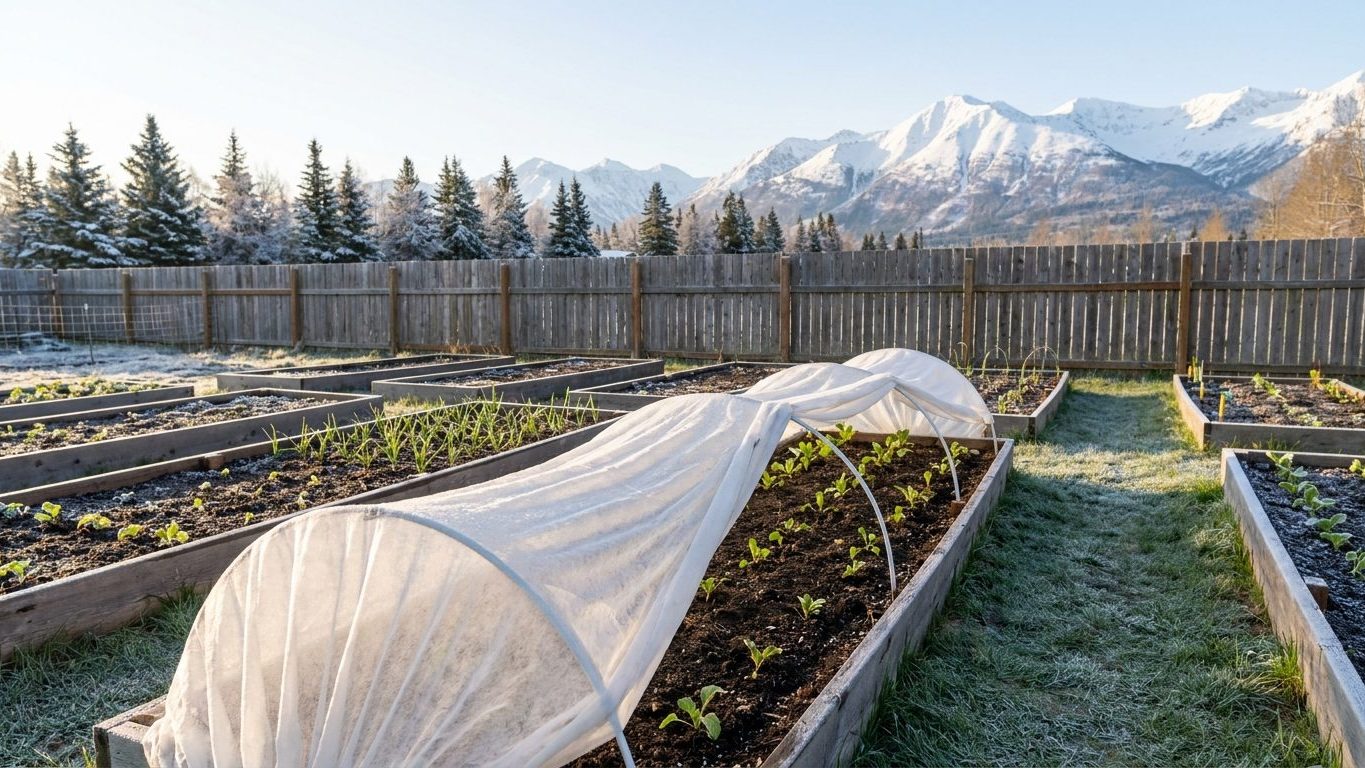

Cover the garden whenever the overnight forecast reaches 32°F. Keep covers within reach from late April through mid-May in spring, and from early or mid-September on in fall. Those two windows bracket the frost risk across much of South Dakota. Where your garden sits inside them depends on elevation, latitude, and whether you garden in town or on open ground.
The short answer for South Dakota
Cover tender plants on any night forecast near freezing, from about April 29 in spring and again from about September 24 in fall. At the Sioux Falls reference station, NOAA’s 1991-2020 Climate Normals put the last spring frost between April 29 and May 9 and the first fall frost between September 24 and October 4. Each range is the 30 to 70 percent probability band for a 32°F freeze. Inside it, a freeze is still a real possibility, and no single date inside it is safe.
These are figures for the Sioux Falls airport, a reference city. Suburban and rural gardens typically see the last spring frost later and the first fall frost earlier, often by one to two weeks, and more at elevation. A country garden may need covers into the third week of May, and again from the first half of September.
When do you cover in spring?
Two jobs, two timings. Lay row cover or a low tunnel over bare beds a week or so before transplanting, so the soil warms ahead of the plants. Then keep the cover on hand until the May range has passed, and drape it over frost-tender plants on any night the forecast dips toward 32°F. Cool-season crops such as lettuce, spinach, and peas tolerate light frost and can go under cover earlier, in April.
When do you cover in fall?
Start watching the forecast in early September. The first frost is often followed by weeks of mild weather, so a few covered nights can stretch tomatoes, peppers, beans, and squash well into October. Hardy greens, carrots, and beets keep going under a cover long after the tender crops are done. Pull covers off in the morning once the temperature climbs above freezing.
For fabric weights and structures, see Which Season Extenders Work in South Dakota.
What will not work here
Planting by the calendar and hoping fails first. The spring range runs ten days, and a rural garden can sit later still. A warm stretch in late April tempts many gardeners to set out tomatoes, then a freeze arrives in early May. Covers save those plants only if they are on hand and on the plants that evening.
A thin cover will not carry tender crops through a hard freeze. The coldest month here has a mean daily minimum of 8.5°F, so winter is long and severe. Season extension works at the edges of the season, adding a few degrees on a frosty night. Frost-tender plants will not survive winter under a cover, however many layers you add. For salad greens, kale, and spinach in the cold months, a cold frame or unheated tunnel with a second layer inside helps, and even that has limits.
Why do covers fail on the plains?
Wind. Open ground in South Dakota can be breezy even on calm-looking days, and an unanchored fabric cover lifts and loses its warmth. Pin the edges with soil, boards, or landscape staples, and add hoops so the fabric does not rest on foliage, where frost can burn the leaves it touches.
Trapped heat is the other failure. A clear, sunny day in May can cook seedlings under plastic, so vent or remove plastic by mid-morning. Cover left over squash and cucumber blossoms also blocks bees. Pull it off once female flowers open.
Finally, a short season defeats the slowest crops. The window between the last spring freeze and the first fall freeze is not long, and long-season melons, winter squash, and sweet potatoes need both an early start under cover and a late rescue in fall. Choosing early varieties does more than any fabric will. The first article in this series, Extending the Growing Season in South Dakota, covers that approach.
What changes across South Dakota
South Dakota has no single answer. The USDA Plant Hardiness Zone Map (2023, built on 1991-2020 normals) places the state in zones 3b through 5b. That range reflects how much the average coldest night of the year varies across the territory. A gardener at one end of the state is working with a different winter than one at the other.
Sioux Falls sits at 43.59 degrees north, so its frost dates describe the southeast. Farther north, the growing season shortens and spring comes later. Higher ground, such as the Black Hills country in the west, does the same: later last frosts, earlier first frosts, and a bigger swing between day and night. A reader in the north or at altitude should shift spring work later and fall protection earlier than the Sioux Falls dates, by more than the one to two weeks that typically separates rural from airport readings.
Hardiness zones deal in winter minimums. They tell you whether a perennial, shrub, or tree will survive, and they say little about the date of the last frost in spring. Use the zone for perennials and the frost dates for the vegetable garden. Look up your own zone on the USDA map by ZIP code rather than assuming one from a neighbor’s yard.
Day length also shifts with latitude, which matters for crops that respond to it, such as onions. Gardeners near the northern or southern edge of the state should check their own latitude when comparing varieties and sowing dates.
Where to check this for your own county
Start with South Dakota State University Extension. Its horticulture staff and county offices know how local soils and weather behave, and they publish guidance written for the state’s gardeners.
Two things are worth finding there. One is the local planting calendar, with frost dates and sowing windows for your part of the state. The other is the list of varieties trialled in your county or the nearest research site, which tells you which tomatoes, peppers, and squash have ripened in conditions like yours. If a county agent or master gardener program is nearby, ask about typical last-frost dates in your town. Those answers come from years of local observation.
A county recommendation beats a state one, because a state average blends very different climates. The Sioux Falls dates are the reference-city figures for the southeast corner of the state, and a garden elsewhere may differ by a week or two or more. Treat them as a reasonable starting point for a garden near Sioux Falls and as a rough guide elsewhere, then adjust to what your county office says.
Checking this against your own garden
Your own observations outrank every date above. Three things are worth watching, and none needs a tool.
- Soil warmth by feel. Push your hand into the bed at planting depth in the morning. If it feels cold and damp, wait, or lay a cover for several days. A bed that warms early tells you it has good sun and drainage. A bed that stays cold is probably shaded, low, or heavy.
- The first male squash flowers. Squash and cucumbers open male blooms before female ones. When you see them, remove covers during the day so bees can reach the flowers. The date they appear shows how fast your garden warms compared with a neighbor’s.
- The first true leaves. Seedlings show a pair of seed leaves first, then true leaves with the shape of the adult plant. If true leaves come slowly, or turn pale or purple, the soil or nights are still too cool. If they come quickly, your site is warmer than the average.
Check where frost shows first in the morning, too. White grass in a low corner while the slope stays green marks a frost pocket, and that is where covers go first.
Common questions
What date should I put out tomatoes in South Dakota?
At the Sioux Falls reference station, the last spring frost falls between April 29 and May 9. Many gardeners wait until the middle of that range or later, and keep a cover ready. Rural and higher gardens often need another one to two weeks.
Do I cover plants every night in fall?
No. Cover them only on nights forecast near 32°F. Check the forecast each evening from early September, and uncover in the morning once temperatures rise.
Is Sioux Falls frost timing right for my garden?
It is the reference city, and it is a fair guide for gardens nearby. Rural and higher gardens usually see later spring frost and earlier fall frost. The county office at SDSU Extension can give you local dates.
Will row cover keep plants alive through a South Dakota winter?
Tender plants will not survive. With the coldest month’s mean daily minimum at 8.5°F, covers only extend the season at either end. Hardy greens may last longer in a cold frame, but expect them to slow or stop growing in midwinter.