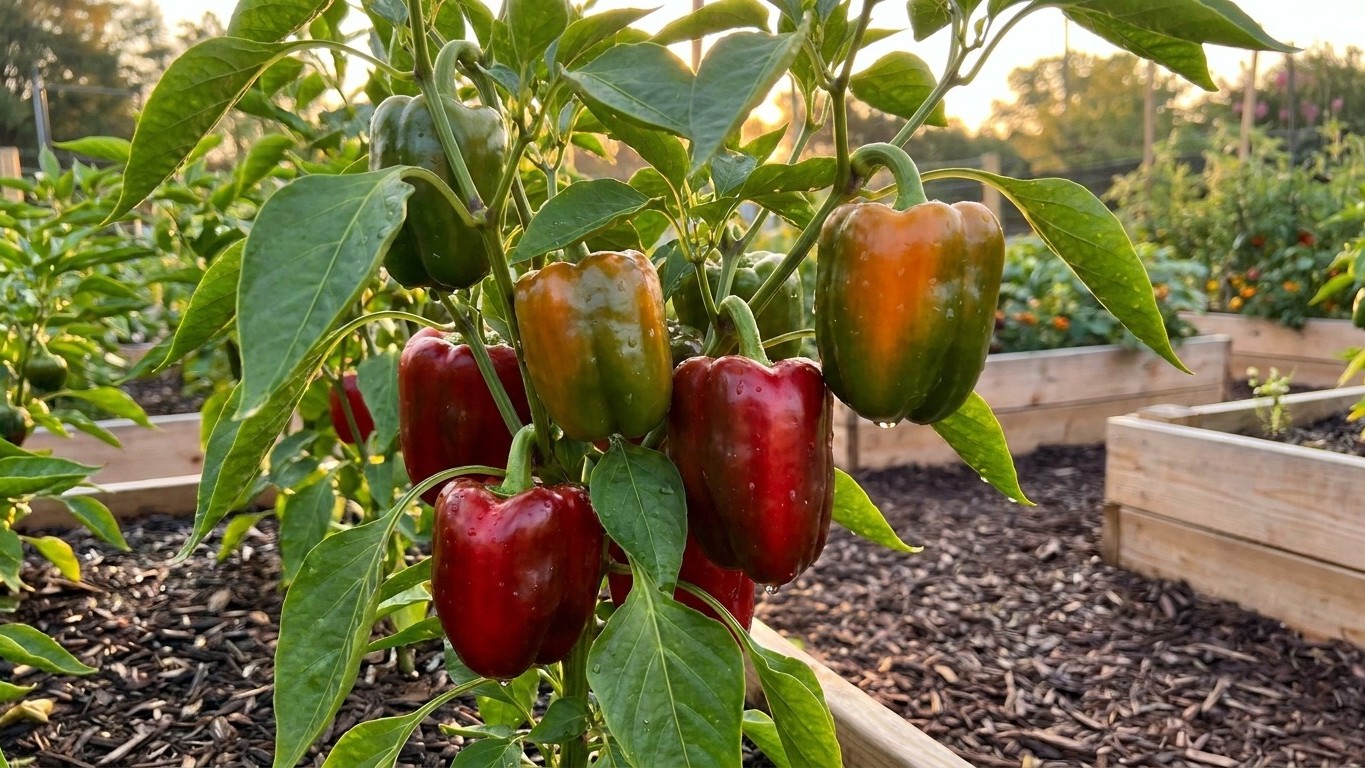

Pick a pepper when it is full size, firm and glossy, usually 70 to 85 days after the transplant went into the ground. Then keep it out of the refrigerator. Most gardeners do the opposite, and the fruit comes out pitted and soft within days. Utah’s summer heat decides when the first peppers arrive, and the room you store them in decides whether they last. For the full season plan, see Growing Peppers in Utah.
Keeping them, and for how long
A pepper is still alive after you cut it from the plant. It keeps breathing and losing water, and it reacts to temperature the way a warm-climate crop would. Too warm, and it wrinkles and rots. Too cold, and the skin cells break down. The window between those two problems is narrow, which is why the usual kitchen options all fall a little short.
How long do picked peppers keep?
Clemson Cooperative Extension gives the clearest numbers. Its Home & Garden Information Center says peppers “should be ready for harvest in about 70 to 85 days after transplanting,” and that “the optimal conditions for storage are temperatures of 45 to 50 °F and 80- to 90-percent relative humidity for two to three weeks.” The full factsheet is on the Clemson Extension pepper page.
Read that duration as a ceiling. Two to three weeks is what a perfect pepper achieves in perfect conditions. A fruit that was picked after a hot spell, nicked by a pruner or already a little soft will go sooner. A pepper held in a dry room at the right temperature will also shrivel before the three weeks are up, because the humidity half of the recipe matters as much as the temperature half.
Humidity of 80 to 90 percent is higher than most rooms in a Utah house. The state is dry, and indoor air gets drier still when the furnace runs. A loosely closed paper bag or a perforated plastic bag slows moisture loss without sealing the fruit into a wet pocket. A tightly sealed bag does the opposite and invites mold.
Why does the refrigerator ruin peppers?
A domestic refrigerator runs colder than the 45 to 50 °F range. Below about 45 °F, peppers develop chilling injury. The skin pits, the flesh softens, and the fruit turns watery and rots quickly once it warms up again. The damage builds with time, so a pepper can look fine on day two and slump on day five.
This is the mistake nearly everyone makes, and it is easy to see why. Fridge storage works for lettuce, carrots and most of what comes out of a garden. Peppers just happen to be on the short list of vegetables that dislike it. If a pepper has already been chilled, use it soon, cooked rather than raw, because the texture loss is permanent.
Where in the house that actually is
The target is cool, but not cold. A heated living space sits well above 50 °F, so a pepper left on the counter or in a warm pantry wrinkles within days. The refrigerator sits below the range. A garage can land inside it on a mild October day and then swing past both limits when a cold night follows a sunny afternoon, or when a hot afternoon turns it into an oven. Utah garages see big swings between day and night for much of the year.
| Place | What goes wrong | Verdict |
|---|---|---|
| Refrigerator | Colder than the range; chilling injury, pitting, softening | Avoid for whole peppers |
| Kitchen counter or heated pantry | Too warm; fruit loses water and softens fast | Fine for a few days only |
| Garage | Temperature swings with the weather | Unreliable |
| Basement or cool interior closet | Often close to the range; air can be dry | Best candidate |
In most Utah homes the closest match is a basement room or a cool interior closet away from the furnace and water heater, ideally on a shelf off the floor. Basements in the state usually run cooler than the main floor through summer and early fall, and the temperature stays steadier than in a garage. Whether a particular basement lands in the right range depends on the house, the insulation and where the ductwork runs.
So check before you commit a harvest to it. Leave a thermometer in the spot for two or three days, and use one that records the high and low so you catch the overnight swing. If the reading stays between 45 and 50 °F, you have a good place. If it runs warmer, use the peppers sooner. If it drops below 45 °F, move them. A cheap hygrometer will tell you whether the air is anywhere near 80 to 90 percent. Skipping the check costs you a shelf of pitted, soft peppers that looked fine when you put them away.
How do you know when a pepper is ready to pick in Utah?
Count from the transplant, then confirm by looking at the fruit. The Clemson figure of 70 to 85 days after transplanting is a starting estimate. Once a plant flowers, fruit generally needs 35 to 45 days to reach full size, and that clock runs from flowering, not from sowing or from planting out. A ripe-for-eating pepper is full size for its variety, firm, and shiny. Sweet peppers can be picked green, or left to turn red, yellow or orange, which takes longer and gives a sweeter fruit. Cut the stem with pruners or scissors. Pulling often snaps a branch.
The schedule starts early. Transplants need 8 to 10 weeks indoors, and Utah State University Extension advises setting them out when the soil reaches 60 F, after frost. In the mild Salt Lake valley the last spring frost falls between April 12 and April 29, based on the 30 to 70 percent probability band in NOAA’s climate normals. Most of Utah sits higher and colder than the valley, so the date comes later, while southern Utah is warmer. Soil at 60 F usually lags behind the last frost, which pushes the first harvest into mid to late summer.
Heat then shapes how the harvest arrives. At the Salt Lake City reference station, a typical year has 52.1 days at 90 F or more. USU Extension notes that pepper fruit set fails at both ends of the thermometer: days above 90 F and nights below 55 F. Flowers drop during hot spells, and you get a gap in the harvest a few weeks later, followed by a second wave when conditions settle. The cool end belongs to your own garden. Night lows vary a lot from one yard to the next, so watch your own thermometer in early summer and again in September rather than assuming. The troubleshooting steps are in Why Peppers Fail to Set Fruit in Utah.
Pick often once the plant is producing. Fruit left to hang slows new flowers, and ripe fruit is also what insects and birds go for first. What Eats Pepper in Utah, and When covers who shows up and when. Before the first fall frost, harvest everything that is full size. A frost kills the plant, and fruit that has been through near-freezing nights chills the same way it does in a refrigerator.
Common questions
Can I refrigerate peppers for just a day or two?
Chilling injury builds with time, so a day or two does less harm than a week. Still, a pepper that goes in the fridge tends to come out less crisp, and the pitting shows up once it warms. If you cut or cook a pepper, the fridge is fine, since the chilling issue applies to whole, uncut fruit.
Is it okay to pick peppers while they are still green?
Yes. Green peppers are mature enough to eat once they reach full size and feel firm. Leaving them on the plant lets them color up and sweeten, but it also keeps the plant putting energy into that fruit instead of new flowers. Many Utah gardeners pick some green and leave some to color.
How long do peppers keep if I get the conditions right?
Clemson Extension puts it at two to three weeks at 45 to 50 °F and 80- to 90-percent relative humidity. That is the best case. Fruit in a drier room, or picked in less than perfect shape, will not last that long.
Should I pick peppers before a frost?
Yes. Harvest every full-size fruit before the first frost, and bring in any that are close. A freeze ends the plant’s season, and fruit left outside on a near-freezing night can be damaged before the plant itself shows it. Watch the forecast in fall, and ask your county extension office what is typical for your elevation.