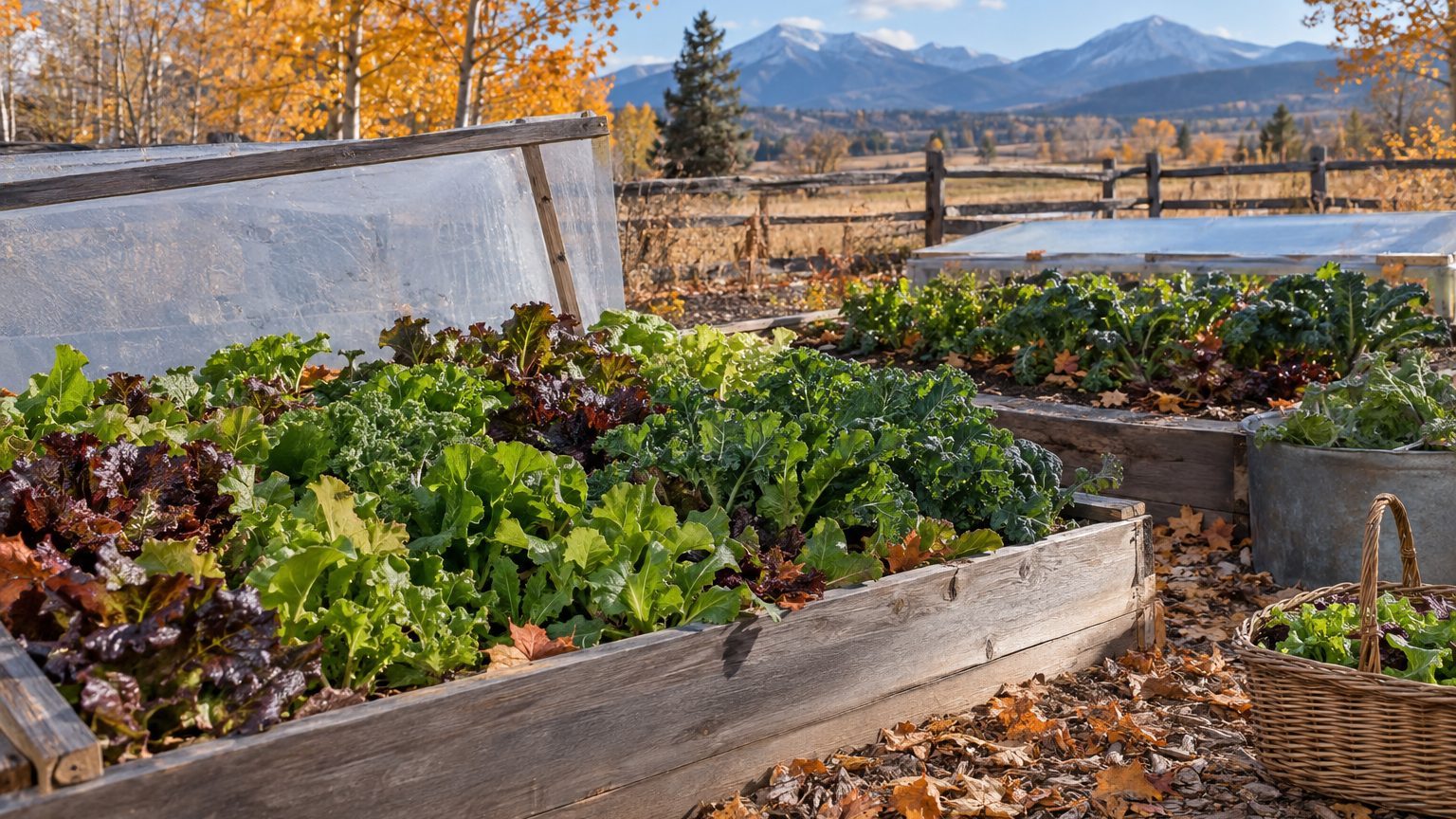

In the Boise valley, the last spring freeze falls between April 23 and May 7, and the first fall freeze between October 7 and October 21. Winter salads are built around those dates. Seed goes in during late summer, and the hardiest greens carry on through winter with a little cover. Most of Idaho sits higher and colder than Boise, so gardeners elsewhere in the state should shorten every window below.
When the soil is warm enough in Idaho

The date question comes first. The reference is Boise (NOAA NCEI 1991-2020 Climate Normals, station USW00024131), where the 32 F freeze probabilities in the 30 to 70 percent band put the last spring freeze between April 23 and May 7. A frost date is a probability: a freeze can still turn up after the band closes, and the farther you live from the valley floor, the later that band slides.
Salad greens respond to the soil more than to the air. Soil warms behind the air, so it reaches planting warmth after the frost risk has ended, not alongside it. A bed sown on the frost date itself can still be cold and soggy at root depth, and seed sits in that mud waiting. Raised beds and containers drain faster and warm sooner than ground-level beds, which is a real advantage in a heavy valley soil.
How can you tell the soil is ready for salad greens?
Push a soil thermometer about 2 inches down and read it first thing in the morning, when the bed is at its coldest. Do that for several mornings in a row. A single warm afternoon tells you little. Then grab a handful of soil and squeeze it. If it crumbles when you poke it, the bed is workable. If it smears or holds a slick shape, wait a few more days, because working wet soil leaves clods that crust over and block small seedlings.
Why does a spring date matter for a winter crop?
Spring sets the calendar for the whole year. Hardy greens sown once the ground is workable give an early cutting, and the slower types, such as endive, escarole and radicchio, can be started in flats for a late-summer move to the bed. By July the soil is warmer than it ever was in May. Lettuce-type seed struggles to sprout in that heat, so the late-summer sowing has to be shaded and kept moist until it comes up.
Gardeners at higher elevations should add weeks to the spring date and take weeks off the fall one. The state’s USDA hardiness zones run from 3b to 7b (USDA Plant Hardiness Zone Map 2023), and a mountain valley and a Snake River Plain garden are in different worlds. For the varieties that have been trialled in your own county, ask your local University of Idaho Extension office. A variety that thrives at one elevation can fail at another.
How long the season lasts here
The frost-free window runs from the April 23 to May 7 band to the October 7 to October 21 band.
What matters is what that length allows. At the valley floor, it allows a spring sowing of hardy greens, a gap through the worst of the summer heat, and a second sowing in late summer for fall and winter eating. It also leaves room to sow in installments, a short row every couple of weeks rather than one big planting, so the cutting stretches out instead of arriving all at once and bolting together. The main guide, Winter Salads: What Grows When Lettuce Will Not, lays out how to stagger sowings.
Does a shorter mountain season change the plan?
It does. Boise is a low valley, and most of the state is higher and colder, so the window in those higher areas is far shorter than the one above. Where the season is that short, the first sowing may be the only one. Every week counts, and the choice between transplanting and direct sowing starts to matter.
Greens with a taproot, such as spinach and arugula, resent being moved, and the check to their roots can eat a week or more of a short season. Lettuces and endive take transplanting well if the root ball stays intact, so they can use it to gain a head start. A long season forgives a slow start. A short one rewards seed sown straight into the bed, and for the fall crop, it rewards sowing earlier than feels natural, because light and warmth fade before the frost does.
Gardeners in other cold-winter, short-season places can compare notes with Winter Salads for South Dakota Gardens and Winter Salads for Ontario Gardens. The timing logic carries over even though the dates do not.
Heat and water in Idaho

The lower valleys have hot, dry summers, and the high country has cool nights and a much milder July. That split decides how you handle the late-summer sowing. In the valleys, rain contributes little to a salad bed in August, so the water comes from a hose, drip line or ditch turn. Seed needs to stay evenly moist until it sprouts, and that often means a light daily watering, a board or burlap over the row for a few days, and shade cloth or the afternoon shadow of taller plants. Mulch once the seedlings are up to keep the root zone cooler.
On cooler high ground the problem flips. Heat matters less, and what shows up instead is slow growth, leaves that stay wet after a cold rain or overhead watering, and mildew on crowded rows. Water at the base in the morning, thin seedlings to give air between them, and avoid sowing so thickly that the canopy never dries.
How cold is too cold for winter salads in Idaho?
The cold decides everything else. At the Boise reference station, the mean daily minimum of the coldest month is 25.4 F (NOAA NCEI Climate Normals 1991-2020). That is an average, so cold snaps run lower. The USDA system behind the zone map is built on a different variable, the average annual extreme minimum, and across Idaho it spans zones 3b to 7b. Boise is the reference city. Your own garden may be several zones colder.
Sorted by what they can take, the types fall into three groups:
- Spinach, mâche and claytonia are the likeliest to stand uncovered through a Boise-type winter, though growth slows to a crawl.
- Arugula, mustard-family greens, endive and escarole stay in edible shape longer under a row cover or low tunnel.
- Tender head lettuce and most baby lettuce mixes cannot manage hard freezes in an open bed. They belong in a cold frame or an unheated greenhouse, or in an early cut before the cold arrives.
In the colder zones, even the hardy group needs a cover, and some sites should treat winter salads as a fall crop and not a winter one.
The first fall frost, October 7 to October 21 at Boise, sets how late a sowing can still reach cuttable size before the light fails. Once days get short, plants hold what they have grown and add very little. So the sowing has to go in early enough that leaves are full size by the first freeze. Count backward from the frost band using the days on the seed packet, and add extra time because growth slows as the light fades.
Which winter salads suit Idaho
Idaho’s three main facts point in different directions, so the choice depends on where you garden. A short season favors the earliest types, the fast baby-leaf greens that can be cut young. Hot lowland summers favor types that can handle a warm late-summer sowing, plus a loose, open habit that gives air and shade at the root. Dampness, where it shows up, makes disease resistance the first thing to look for on the seed packet, with downy mildew resistance the usual claim.
| Type | Where it suits | What to know |
|---|---|---|
| Spinach and mâche | Cold sites and short seasons | Hardiest of the group. Growth is slow in deep winter, so sow early. |
| Claytonia and other low-growing hardy leaves | Bed edges, cold frames, colder valleys | The low habit sits close to the ground and tolerates cold. |
| Arugula and mustard greens | Short seasons, quick cuts | Fast to size, quick to bolt in heat, and they want cover in hard freezes. |
| Endive, escarole and radicchio | Long valley seasons, hot late-summer sowing | Cope with warm soil better than lettuce. Cover them in hard cold. |
| Loose-leaf lettuce | Cold frames and unheated greenhouses | Tender. Heading types are the most sensitive of all. |
A variety that holds well in the Treasure Valley can fail in the Wood River Valley, and the only recommendation that means anything comes from trials run near you. Land-grant extension programs hold that information. The county office of University of Idaho Extension can tell you which selections have done well at your elevation and in your soil.
Common questions
When should I sow winter salads in Idaho?
Late summer, counted backward from the first fall frost. At Boise that frost falls between October 7 and October 21, so sowings there go in well ahead of the band. At higher elevations the frost comes sooner, so the sowing date moves earlier as well. Your county extension office can narrow it further.
Will winter salads survive an Idaho winter without cover?
Spinach, mâche and claytonia often can in a Boise-type winter, where the coldest month has a mean daily minimum of 25.4 F. In colder zones, and for most other types, a row cover, low tunnel or cold frame is what keeps leaves in edible condition.
Can I grow winter salads in containers in Idaho?
Yes. Containers warm and drain faster in spring, and you can shade them in August or move them against a wall in winter. The roots are more exposed to cold than they are in the ground, so pots need cover, or a sheltered spot, sooner than a bed does.
Where can I find varieties that work in my county?
Ask the county office of University of Idaho Extension. Local trials and the Master Gardener volunteers who work with the extension service know which selections do well at your elevation, which matters more in Idaho than almost any other state because the range of conditions is so wide.