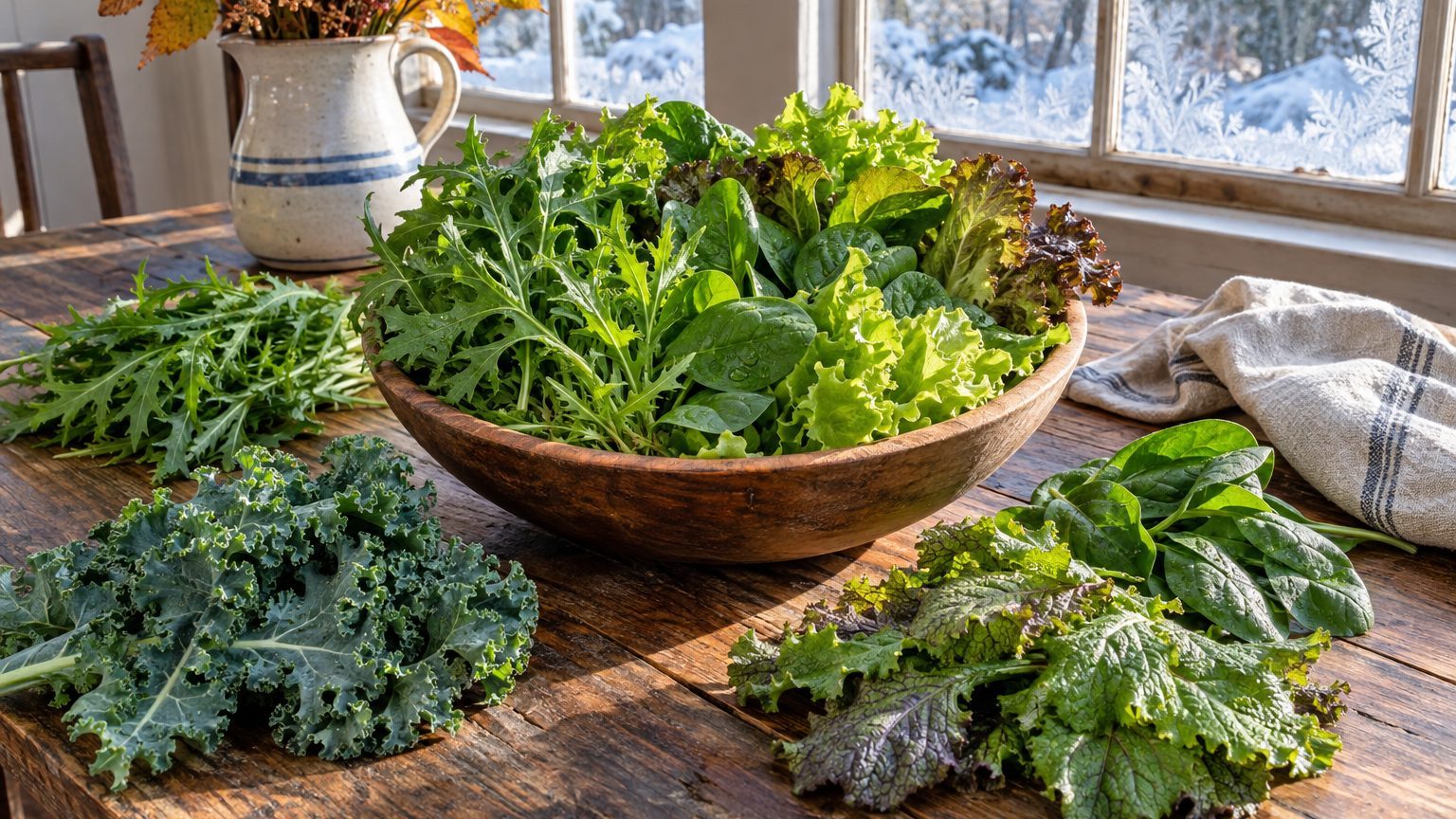

The best winter salads for Newfoundland and Labrador are cold-tolerant leaf crops that size up quickly: mâche, claytonia, hardy spinach, arugula, mizuna and tatsoi, with baby kale as a backup. Slow heading types like radicchio and large endive are the gamble. Coastal wind, damp air and a short, cool season set the rules, and a cold frame or low tunnel turns a fall salad into a winter one.
The short answer for Newfoundland and Labrador
Choose by type. Leaf crops that stand through frost and reach harvest size in a few weeks beat anything that has to build a head. The season at the reference station in St. John’s is short and cool, with little summer heat to push growth along, so every week of sowing delay costs you.
Which winter salad types suit a short, cool season?
| Type | Examples | Why it suits the climate | Watch for |
|---|---|---|---|
| Cold-hardy rosettes | Mâche, claytonia | Stand through hard frost and can be cut leaf by leaf | Slow growth in deep winter; slow to germinate |
| Hardy spinach | Winter-type spinach | Holds through frost and sweetens in the cold | Soggy soil; needs a late-summer sowing |
| Quick mustard greens | Arugula, mizuna, tatsoi | Ready fast from sowing, handle cool weather well | Bolting as spring days lengthen |
| Baby kale | Tender-leaf kale types | Frost-tolerant and cut-and-come-again | Slower than mustard greens |
| Heading types | Radicchio, large endive, head lettuce | Rewarding when they finish | Need a long run of growth; often caught half-grown |
Mâche, claytonia and spinach make the most dependable base for a bed you want to pick from after the first hard frosts. Add arugula, mizuna and tatsoi for early, fast cuttings, and keep a short row of baby kale for the colder stretch.
How long is the season for winter salad sowings?
The reference station, St. John’s airport, has about 140 frost-free days between the mean last spring frost on May 30 and the mean first fall frost on October 17. Both dates are averages from Environment and Climate Change Canada’s 1981-2010 normals, so they mark the middle of a window. In one year out of two the last spring frost falls later than May 30, and in one year out of two the first fall frost arrives before October 17. Northern and upland districts run weeks behind this station.
Winter salads are sown late enough that summer crops are finished but early enough that the plants are close to harvest size when frost arrives. The coldest month at this station has a mean daily minimum of -8.7 °C, and individual nights run colder. Hardy greens take light frost in stride, but covers carry them through that kind of cold. Exact sowing windows for the island’s milder spots are laid out in When to Sow Winter Salads in Newfoundland and Labrador.
What will not work here

Slow crops fail first, and the failures are predictable once you look at the calendar.
Why do heading salads struggle in Newfoundland and Labrador?
Radicchio, large endive and full-size head lettuce need many weeks of steady growth after sowing. With roughly 140 frost-free days on average, and the first frost arriving before October 17 in half of years, a late sowing leaves them half-grown just as light fades and growth slows. A sowing made after midsummer of any heading type is usually a loss. If you want them anyway, sow early and plan on a cold frame to finish the heads.
Lettuce varieties bred for summer salads fare worse. Hard frost damages them, and the coldest month’s mean daily minimum of -8.7 °C (16.4 °F, for readers comparing with US gardens) sits well below what they tolerate. Even the hardiest salad greens get tested on the nights that fall below that average, which is why an unprotected bed that looks fine in October can look ragged by January.
Transplanting on May 30 is another trap. That date is only the midpoint of the last-frost window, so in half of years frost arrives afterward. Seedlings of tender spring salads set out on the average date will sometimes meet a frost they were never hardened for.
What do wind, wet and fog do to a winter salad bed?
Coastal gales strip thin plastic, lift row cover and bend light hoops. Anchor covers along every edge with boards, sandbags or buried trim, and choose sturdier hoops than a sheltered inland garden would need. Wet snow adds weight to a low tunnel, so knock it off after a heavy fall before the hoops buckle.
Damp, cool air also favors slugs and gray mold. Spacing the packet recommends for baby leaf is a minimum here, and slightly wider spacing helps leaves dry between fogs and showers. Harvest the outer leaves regularly so air moves through the bed. Overcast weeks cut already short winter light, so a bed in a shaded corner will stall long before a sunny, sheltered one.
What changes across Newfoundland and Labrador
There is no single answer for the province. The Canadian plant hardiness zone for the reference city, St. John’s, is 6a, based on Natural Resources Canada’s 1991-2020 normals, and it describes only that municipality. The province stretches from the Avalon coast to northern Labrador, and zones vary widely across that span. Look up your own town on Canada’s Plant Hardiness Site rather than assuming the reference city’s number applies to you.
That zone is also Canadian, so it should never be read as a USDA zone. The Canadian system draws on seven climate variables, the USDA system on one, and Natural Resources Canada states plainly that there are no simple conversions between the two. A US hardiness chart will mislead you here.
North of the Avalon, or on higher ground, shift your plan in three ways. Frost dates run weeks behind those of the reference station, which means the first fall frost can arrive well before mid-October. Count backward from your own local first frost, and move sowings earlier by the same margin. Favor the fastest greens (mizuna, tatsoi, arugula, spinach) over anything that needs weeks to size up. And treat the cold frame as the main tool, because a winter harvest in the far north is mostly a late-fall one that the frame stretches.
Near the coast, the ocean softens cold snaps but brings wind and fog, so shelter matters more than hardiness. Inland sites get colder nights and earlier frosts, so lean on covers from the start. For the wider picture on varieties and structures, see Winter Salads for Newfoundland and Labrador Gardens.
Where to check this for your own county
Newfoundland and Labrador has no counties, so think in terms of your own town or region. Start with the Newfoundland and Labrador Department of Fisheries, Forestry and Agriculture, the provincial government’s agriculture office, and look for two things. The first is any local planting calendar for your region, ideally with sowing and transplant dates for cool-season vegetables. The second is a list of varieties that have grown well in your area, since a salad green that thrives on the northeast Avalon may stall somewhere windier or colder.
If the department has no leafy-greens guidance for your region, ask. Agriculture staff, local garden clubs and growers at farmers’ markets know which exposures freeze first and which slopes drain well. A neighbor who has run a cold frame for a few winters can tell you more about your wind than any regional chart.
A local recommendation beats a provincial one. The guidance in this article is a provincial picture built around one airport station in St. John’s. Another detail matters for US readers who compare notes: Canadian climate normals cover 1981-2010, while US figures commonly cover 1991-2020, so the two sets of dates do not line up year for year.
Checking this against your own garden
Your own observations outrank every date here. Three are worth watching, and none needs equipment.
- Soil warmth by feel. In late summer and early fall, push your hand into the bed in the afternoon. Soil that still feels warm at a few inches tells you the spot holds heat and can take a later sowing. A cold bed needs earlier sowing and covers sooner.
- First true leaves. The seed leaves come first. The first true leaves, which look like a tiny version of the adult leaf, show a seedling is established. Note how many days that takes in your bed, and you have a real measure of how fast your site grows greens.
- First frost in different corners. Look for frost on tender plants, the roof of a shed or the grass at dawn. If low spots frost days before the slope, you know which corner needs covers first.
Write the dates in a notebook for a couple of seasons. After two falls, your garden’s pattern will usually tell you more than the average at an airport station does. Late-sown greens also go dormant rather than die in the darkest weeks, so what you cut in March often comes from leaves that stopped growing in December.
Common questions
What is the easiest winter salad green to grow in Newfoundland and Labrador?
Spinach sown in late summer is the most forgiving, since hardy types survive repeated frost and sweeten in the cold. Arugula and mizuna are the quickest to harvest if you start a little late.
Do winter salads need a cold frame or tunnel?
Hardy greens survive light frost in open beds. The coldest month at St. John’s airport has a mean daily minimum of -8.7 °C, though, and wind and wet add stress. A cold frame or low tunnel, anchored well, keeps leaves cuttable for much longer.
When is the last spring frost in Newfoundland and Labrador?
At St. John’s airport it falls on average on May 30, based on 1981-2010 normals. That is a midpoint, so in half of years frost arrives later, and northern or upland areas run weeks behind.
Can I use a USDA hardiness zone chart here?
No. Canada uses its own system built from seven climate variables, and Natural Resources Canada says there are no simple conversions to USDA zones. Use the Canadian map and look up your municipality.