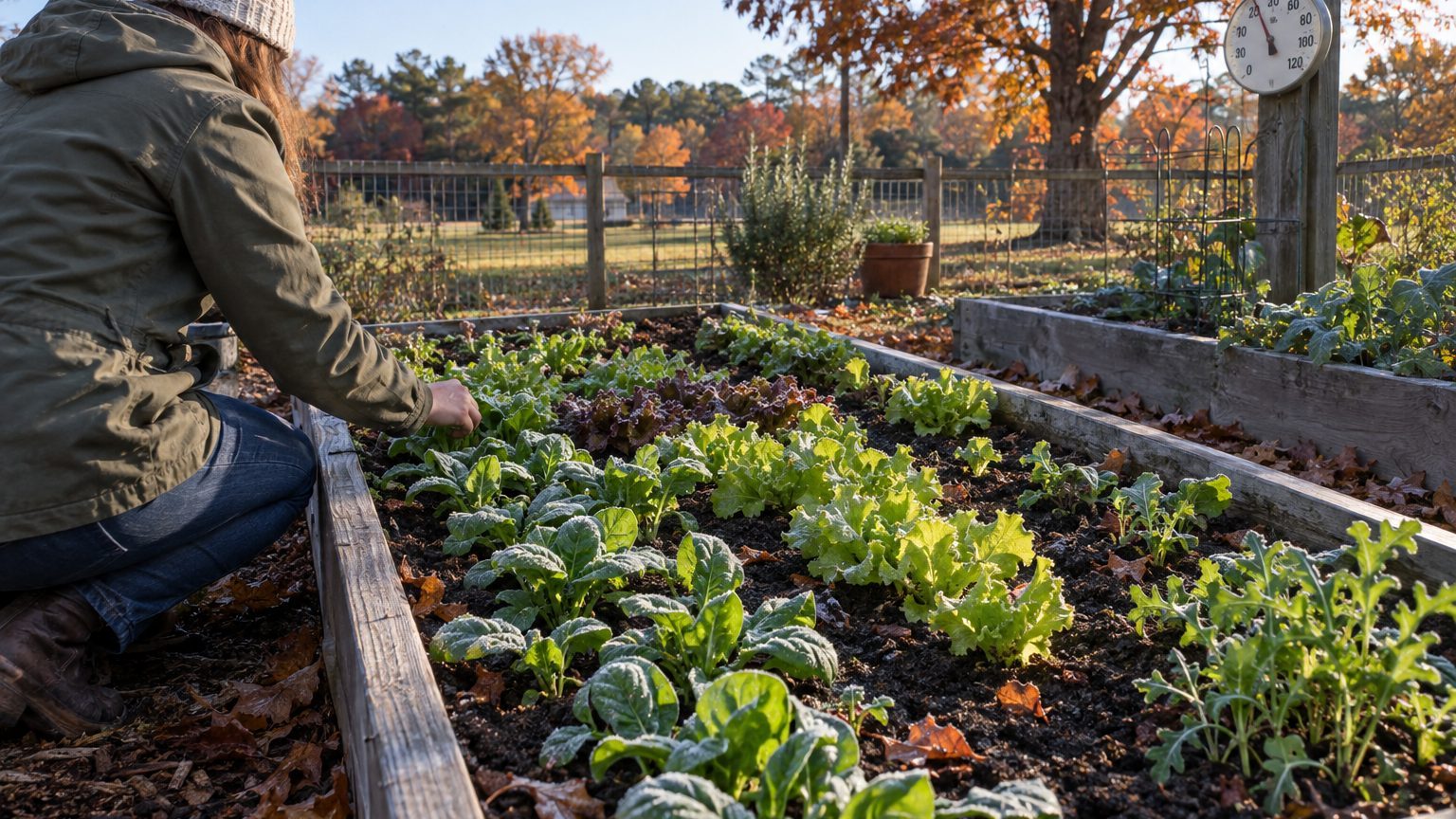

Sow Ontario winter salads from early August to late September, working back from the mean first fall frost of October 16 at the Toronto airport station. Hardy greens need time to reach size before the days shorten, so the later you sow, the hardier the crop has to be. Spring sowing runs on a different clock, anchored to a mean last frost of April 30.
The short answer for Ontario
The window closes in mid-September. It opens in early August for the crops that need the longest head start. Both ends hang on two averages from the Toronto Lester B. Pearson airport station (Environment and Climate Change Canada normals, 1981-2010): the last spring frost falls on average April 30, and the first fall frost on average October 16.
Each date is a midpoint. In one year out of two, the last spring frost lands later than April 30. In one year out of two, the first fall frost arrives earlier than October 16. A sowing that only works if frost holds off until October 16 will fail in half of all years. The station’s frost dates leave a growing season long enough for a summer crop to finish and a fall crop to start, but not enough to waste the first two weeks of September.
How do you count back from the first frost?
Winter salads grow in the weeks before the cold and then mostly hold. Growth slows to a crawl as days shorten and nights freeze, so what you pick in December is what the plants made in September and October. Count back from October 16 and give each type the lead time it needs.
| Type | Sow | Why |
|---|---|---|
| Mustards, arugula, baby kale, hardy lettuces | Early to late August | They need weeks of warm growth to reach harvest size before light fades |
| Spinach, mâche (corn salad), claytonia | Late August to late September | They tolerate cold at a small size and keep growing slowly into late fall |
In spring the clock runs the other way. Hardy greens can go in as soon as the soil is workable, which in most years is before April 30, because light frost does not hurt them. Plants that came through the winter will restart on their own in March or April and then run to seed as the days lengthen. Pull them when the flower stalks appear.
What will not work here

Sowing in October. With a mean first frost of October 16, seed that goes in during the first week of October is a seedling facing short days and cold nights, and it will sit there until spring. Plan for mid-September as the last sensible date for anything except mâche and spinach.
Leaving lettuce and arugula uncovered. The mean daily minimum of the coldest month at the reference station is -10.2 °C (13.6 °F), and that is an average. Individual nights run well below it. Spinach, mâche and kale handle those nights in open ground, and most lettuces, arugula and tender mustards do not. They need a cold frame, a low tunnel or at least a layer of row cover.
Why do early August sowings of lettuce fail?
Lettuce seed goes dormant in hot soil, and early August soil in southern Ontario is often hot. A seed bed that feels warm to the hand will give patchy germination. Sow in the evening, water the bed before and after, and shade it with a board or a piece of row cover until sprouts show. If you cannot keep the bed cool, wait for the soil to cool a little rather than sowing into it again and again.
Counting on the average date as a safe one. Half of all years bring frost earlier than October 16. If your covers are still in the shed on that date, a good sowing can be cut back before it has a chance to harden.
Dense spacing under cover is a smaller trap. Fall in Ontario is damp, and a closed tunnel holds humidity around leaves that are barely growing. Crowded plants stay wet and develop mildew and rot. Thin to the spacing on the seed packet, and open the ends of the tunnel on mild days.
What changes across Ontario
Ontario is not one garden. The reference city sits in zone 7a of Canada’s plant hardiness system, which is built on seven climate variables and does not convert to a USDA zone. It describes Toronto, not the province. The province spans several zones, from the mild lakeshores of the south to cold northern districts, so there is no single answer for the whole province, only a spread.
The frost dates move with it. Northern and upland districts run weeks behind the Toronto station in spring and weeks ahead of it in fall. A gardener there should shift every sowing date earlier by the gap between the local first frost and October 16. Mâche and spinach, which sit at the end of the window, are the crops that most often fall outside it. In the far north, the useful window may be only a few weeks in August, and cover is no longer an extra but a requirement.
Lake Ontario, Lake Erie and Georgian Bay soften fall and prolong the season along their shores. Snowbelt districts east of the lakes add a different effect: a deep, steady snow cover insulates plants beneath it. A tunnel under steady snow can stay well above the air temperature, while bare ground in a thaw-and-freeze winter is harder on crops than a colder, snowier site.
To see where your own municipality falls, look it up on Natural Resources Canada’s plant hardiness site and use the map rather than guessing from a neighbour’s garden. Note that the zones there use 1991-2020 normals while the frost dates above use 1981-2010, so the two will not line up exactly. For the choice of crops by type, see The Best Winter Salads for Ontario, and for the wider picture Winter Salads for Ontario Gardens.
Where to check this for your own county
Start with the Government of Ontario’s agriculture and food pages. Look for two things: a planting calendar written for your region, and a list of varieties that have been grown in trials near you. A calendar tells you when others in your climate sow. A variety list tells you which cultivars survived there, and that saves a season of guesswork.
A county or regional recommendation beats a provincial one every time. Anything written for all of Ontario is an average of very different places, and a single date such as October 16 comes from one airport. Where the two disagree, trust the local source and use the provincial dates only to know roughly where to begin.
When you read a local calendar, check three details. First, which frost dates it uses and what period they cover, since a mean date and a safe date are different things. Second, whether the sowing dates assume row cover or open ground. Third, whether the varieties listed are tested for fall sowing and not just for spring. A lettuce bred for spring heads can bolt, rot or stall when sown in August.
Local garden centres that sell seed in August are also worth a visit. What they stock for fall sowing usually reflects what customers in that area grow successfully.
Checking this against your own garden
Your own yard outranks every date above. Three observations cost nothing and need no equipment.
- Soil warmth by feel. In late summer, push your hand a couple of inches into the seed bed. If it feels warm, like a sunlit stone, lettuce seed will sulk or fail. A bed that feels cool, as it does in the shade of a fence or tall plants, will germinate sooner and tells you where to sow first.
- First true leaves. Seedlings first show two rounded seed leaves, then the true leaves with the shape of the adult plant. Seedlings with a few true leaves by mid-October are on schedule. If they are still at seed-leaf stage, they will probably wait until spring, and covering them is worth the effort.
- The first white frost on the grass. Note the date on which frost first whitens your lawn and compare it with October 16. A low corner that frosts a week before the rest has a cold pocket. A bed against a south-facing wall may escape it by days.
Write those dates down each year. After three seasons, they are a better calendar than any average.
Common questions
Can I sow winter salads in spring in Ontario?
Yes, as salad greens. Hardy types can go in once the soil is workable, usually before the April 30 mean last frost. They will not be winter crops, and they bolt as the days lengthen and the weather warms.
Is it too late to sow in October?
For most salad greens, yes. After the first week of October, seedlings will not grow enough before the light fades. Mâche and spinach are the exceptions, and even they do better under cover.
Do I need a cold frame?
For spinach, mâche and kale, no. For lettuce, arugula and tender mustards, yes, since the mean minimum of the coldest month at the reference station is -10.2 °C and some nights are far colder.
How do I know when the first frost will come?
You cannot know it far in advance. October 16 is a midpoint, and half of years bring frost earlier. Watch the forecast through late September and early October, and keep row cover where you can reach it quickly. A clear, calm evening with temperatures falling is the one to prepare for.