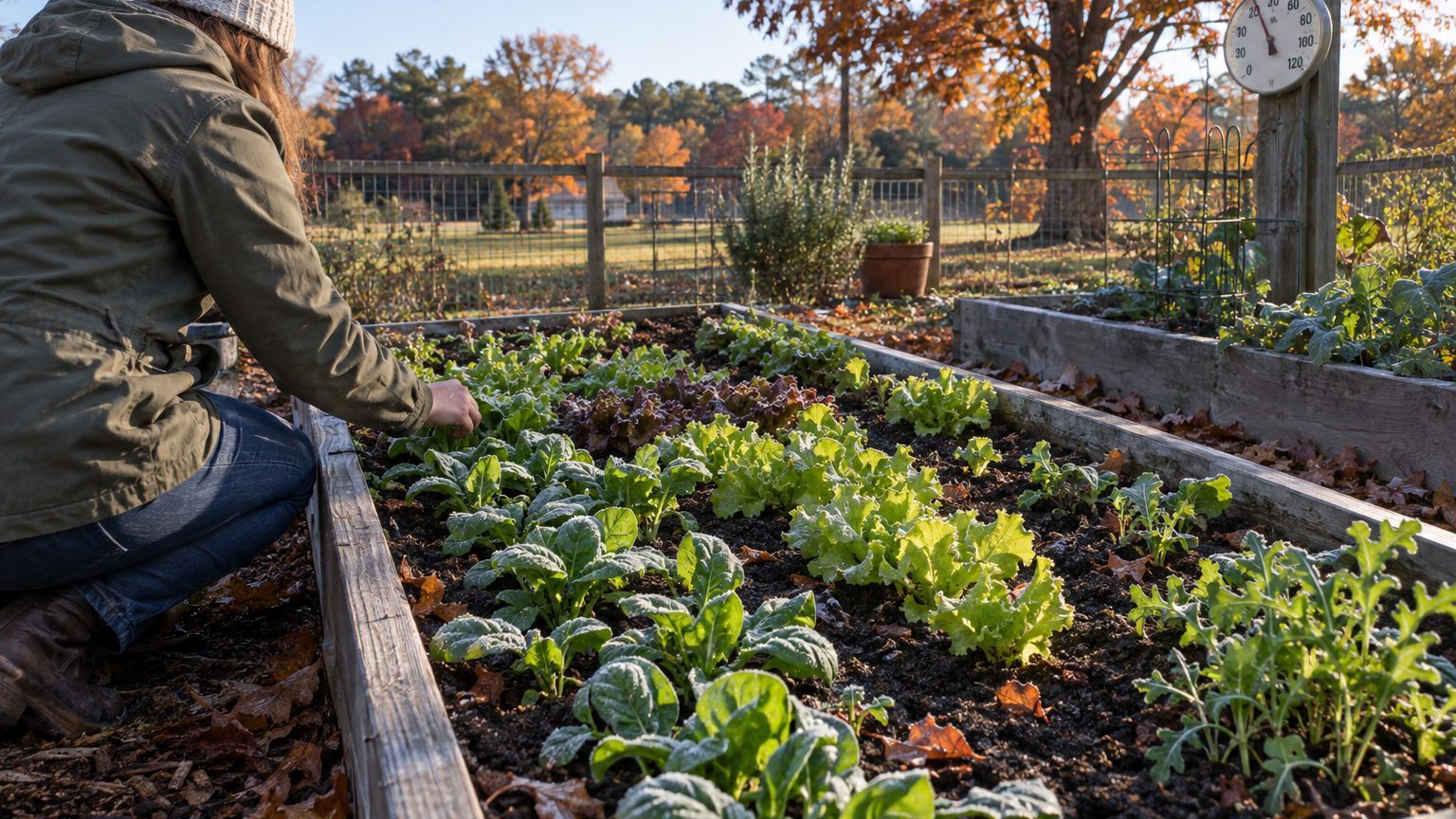

Sow winter salads in Newfoundland and Labrador from mid-July through late August. The hardiest leaves can stretch into early September if they go under a cover. The goal is a plant close to full size before November, when short, cold days nearly stop growth. Count back from the average first fall frost of October 17 to find your window, then adjust for your own ground.
The short answer for Newfoundland and Labrador
Start at October 17 and work backward. At the St. John’s airport station, the first fall frost arrives on average October 17 and the last spring frost on average May 30. Both are mean dates from Environment and Climate Change Canada’s 1981-2010 climate normals. In one year out of two the first frost comes earlier than October 17, and in one year out of two the last spring frost falls later than May 30. Each date is the midpoint of a window, never a safe date. The station has about 140 frost-free days between the mean last spring frost and the mean first fall frost.
Winter salads run on a different clock from the summer garden. They are sown so the plants reach size while there is still light and warmth, then stand in the bed and are cut through the dark months. Growth in November and December is minimal, so a plant that is still a seedling at that point mostly waits for spring. Sow in the second half of summer, and sow earlier than feels natural.
When should you sow winter salads in Newfoundland and Labrador, by type?
These are starting points for a coastal garden near the reference station. Check the seed packet for days to maturity, which count from sowing for all of these direct-sown leaves.
| Type of leaf | Sow outdoors | Cover |
|---|---|---|
| Quick baby leaves (arugula, mizuna, baby lettuce) | Mid-July to mid-August | Row cover from early October |
| Hardy greens (spinach, kale for baby leaf) | Early to late August | Low tunnel or cold frame by mid-October |
| Slow, cold-tolerant rosettes (mâche, claytonia) | Mid-August to early September | Cold frame or tunnel from the start |
How do you count back from the first frost?
Take the packet’s days to maturity and add two to three weeks, because cool nights slow growth through September and October. Anything sown after that date is a bet on a late frost, and the mean date says that bet loses about half the time.
For which types suit this climate, see The Best Winter Salads for Newfoundland and Labrador. For the wider picture of growing salads through the cold months here, start with Winter Salads for Newfoundland and Labrador Gardens.
What will not work here

The cool season and the cold nights set the limits. At the St. John’s reference station, the coldest month has a mean daily minimum of -8.7 °C (16.4 °F). That is an average night, so some nights run colder. Wind and wet snow make open ground harder on plants than the number suggests.
Do spring sowing dates work for winter salads?
No. A sowing made once the last frost has passed, around May 30 or later, gives a crop that is finished by August. Lettuce sown in June is ready in July and gone before the cold season you are trying to feed. Planting for winter means ignoring the spring calendar entirely and working from the fall frost date.
Why do September sowings outdoors fall short?
Roughly 140 frost-free days sounds generous, but light fades faster than the frost date suggests. Slow crops sown in September, such as head lettuce, Chinese cabbage and any variety needing 60 days or more from sowing, are still seedlings when the first frost hits. A seedling with two true leaves has little reserve against -8.7 °C nights and soil that heaves in repeated freeze and thaw. Even the hardy leaves need some size before they can sit out the winter.
Mâche is the usual temptation, because it germinates in cool soil and is known to be tough. It is also tiny and slow, so a late sowing in an open bed produces plants too small to cut before spring. Give it a cold frame or tunnel from the first week.
Can winter salads stay uncovered all winter?
Seldom. Wind on exposed coastal sites dries the leaves, and a damp, foggy fall favors slugs and gray mold. A bare bed of lettuce will not come through a typical winter. Even hardy spinach is far more productive under a low tunnel.
Covers have their own problems here. Lightweight fabric that is not anchored will leave in the first gale, and a sealed tunnel in drizzle traps moisture and invites rot. Thin plants so air moves between them, and vent the cover on mild, dry days.
What changes across Newfoundland and Labrador
The hardiness zone for the reference city, St. John’s, is 6a on Canada’s plant hardiness system, from Natural Resources Canada’s 1991-2020 normals. That is the zone of one city, not of the province. The island of Newfoundland and mainland Labrador span a wide climate range, so there is no single answer for the whole territory. Northern and upland districts run weeks behind the St. John’s station in both spring and fall.
The Canadian system is built on seven climate variables, while the USDA system uses one. Natural Resources Canada says there are no simple conversions between the two. Canadian zone 4a, for example, overlaps nine USDA zones, from 3a to 7a. Do not read 6a as a USDA zone, and do not apply the zone advice on a US seed catalogue to a Newfoundland garden. To find the zone for your own municipality, use the Canada’s Plant Hardiness Site map.
How should sowing dates shift in the north or at altitude?
Move the whole calendar earlier by the number of weeks your first fall frost arrives ahead of October 17. If local gardeners see frost sooner than the airport mean, a quick baby leaf sown near St. John’s should go in earlier. At higher elevation or farther north, the sowing window begins in early or mid-July and closes before August ends.
Colder places also need protection sooner and in more layers. A cold frame with a row cover inside, set up in early October, buys weeks of cutting. Choose the hardiest types in the table above and skip the tender lettuces. Along the sea, nights may stay milder into fall, but wind and salt spray will matter more than the frost date.
Where to check this for your own county
The dates above come from one airport station, and northern or upland districts run weeks behind it. A recommendation built from your own district’s frost records and local trials beats a provincial one every time. Start with the provincial agriculture department, Newfoundland and Labrador’s Department of Fisheries, Forestry and Agriculture. The province is not organized by county the way US states are, so ask for your region or the nearest agricultural office.
What should you look for there?
Look for a handful of specific things:
- A planting calendar for your region, ideally one that lists fall sowings and not just spring ones.
- Frost dates for a station near you rather than St. John’s.
- Vegetable and leafy-green varieties trialled in local conditions, not just varieties that grow well elsewhere.
- Advice on season extension, such as cold frames, row covers and wind protection.
If you are used to US extension calendars, note that Canadian climate normals cover 1981-2010, while the US ones cover 1991-2020. The two sets are roughly a decade apart, and a recent run of warmer seasons may make local frost dates a bit later than the older averages suggest. A local gardener or agricultural representative can tell you whether that holds in your valley or on your stretch of coast.
Checking this against your own garden
Your own observations outrank every date here. Three things are worth watching, and none needs any equipment.
- Soil warmth by feel. Push your fingers two or three inches into the bed at midday in late July. If the soil feels cold, like something out of the fridge, seed will germinate slowly. That bed is shaded or heavy, or both, and it wants a cover from the start or an earlier sowing.
- First true leaves. Seedlings first show two rounded seed leaves, then the first leaves with the plant’s real shape. If they appear within about two weeks of germination, the sowing date was fine. If seedlings are still at the seed-leaf stage in mid-September, they are running behind and need cover.
- First blackened leaves. Watch nasturtiums, basil or squash leaves, whichever you grow. The morning they blacken is your real first frost. Low spots in the yard turn first, and the gap between that date and October 17 tells you how much your garden differs from the station.
Write all three dates in a notebook. After two seasons they are a better sowing calendar than any mean date, and they show whether your garden should sow a week earlier, or can wait a few days longer.
Common questions
Can I sow winter salads in June?
Not for a winter harvest. Salad greens sown in June are ready by midsummer and bolt or finish before fall. Use June for succession sowings of summer salads and save the winter sowings for mid-July onward.
What if I miss the sowing window?
Early September is still workable for mâche and claytonia in a cold frame or tunnel. Quicker leaves sown that late will stay small. A second option is to sow hardy greens in early spring, as soon as the soil can be worked, and treat the winter crop as a gap to fill next year.
Do I need a cold frame or tunnel?
For cutting through winter, yes. With the coldest month averaging a nightly low of -8.7 °C, uncovered beds will not hold salad greens into the cold months. Even a simple low tunnel over a bed keeps wind and wet snow off the leaves.
Is Canadian zone 6a the same as USDA zone 6a?
No. The Canadian system uses seven climate variables and the USDA system uses one, and Natural Resources Canada says there are no simple conversions between them. Name the system when you cite a zone, and check the Canadian map for your own municipality.