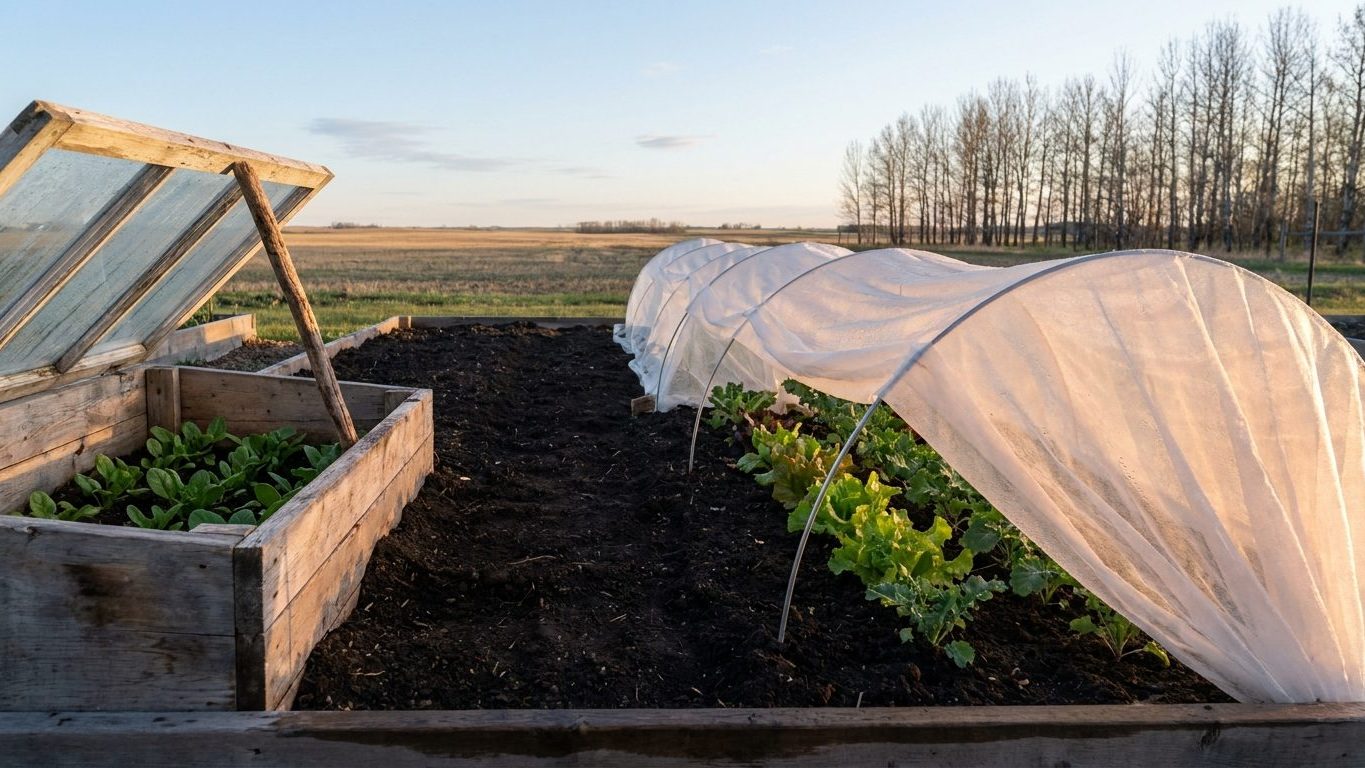

Low tunnels covered with row cover or plastic, plus vented cold frames, are the extenders that pay off in Minnesota. They add a few weeks at each end of the season, mostly for hardy crops and for getting tender ones through light frosts. They will not carry a vegetable bed through a January when the coldest month averages a daily low of 8.8°F. Pick the cover by the job it has to do.
The short answer for Minnesota
Start with low tunnels, which are metal or plastic hoops over a bed with row cover or clear plastic stretched across them, and add a cold frame for greens and seedlings. A high tunnel is the step up if you want to harvest well past the first hard freezes. Everything else, such as water-filled cloches or individual jugs, is a spot fix for a few plants.
The dates explain why. For the Twin Cities, the 30 to 70 percent band for a 32°F freeze runs from April 17 to April 30 in spring and from October 11 to October 23 in fall. Those are probabilities of a freeze at or below 32°F on or after (spring) or before (fall) a given date, taken from the 1991-2020 climate normals. A freeze in the first half of that spring band is a coin flip, and one can still arrive after it closes. The Twin Cities sit in the mild south of the state. The reference station is at 44.88 degrees north, which matters because day length shrinks fast after September whatever the thermometer says.
A cover works by holding heat that the soil stored during the day and by blocking wind. That is worth a few degrees on a frosty night. It nudges your frost dates, but it does not erase them. It fits the width of Minnesota’s frost bands well: a few degrees is exactly what separates a bed of lettuce that survives an April 20 freeze from one that does not.
| Extender | Works best for | Main limit |
|---|---|---|
| Row cover on hoops | Frost nights in spring and fall, protecting greens, brassicas, early beans | Only a few degrees of protection; wind and snow can wreck it |
| Low tunnel with clear plastic | Warming soil early, hardy crops into late fall | Heats up fast on sunny days and must be vented |
| Cold frame | Hardening off seedlings, spinach and other hardy greens late in the year | Small footprint; lid needs opening and closing |
| Water-filled cloche | Single tomato or pepper transplants set out early | Protects one plant at a time |
| High tunnel | Longest extension at both ends | Cost, space, and snow load on the frame |
For a wider look at how these fit together through the year, see Extending the Growing Season in Minnesota.
What will not work here
Setting out tomatoes or peppers in early April under a cover fails. The spring freeze band does not even begin until April 17, and it extends to April 30. Cold soil is the bigger problem: roots sit idle, and a cover only warms the air so much. Tender crops belong in the ground after that band closes, with a cover kept handy for the cold snap that sometimes follows.
One layer of anything will not get a tender crop through winter. The average daily low in the coldest month is 8.8°F. A single layer of row cover buys a few degrees, which turns 8.8 into something that still kills tomatoes, basil, and most herbs. Hardy crops like spinach, kale, and carrots can hold under a cover through cold spells, but growth nearly stops in the dark months.
Late sowing with high hopes is another common failure. At about 45 degrees north, days shorten quickly through fall. A crop that is only half grown by late September will not size up in October no matter what covers it. Cover keeps a mature crop from freezing. It does not make a young one grow in short light. If the plants are not close to full size by then, expect them to sit.
Unvented plastic is a quiet killer. A clear tunnel on a sunny April afternoon can climb far above the air temperature outside, and seedlings scorch or turn leggy. Humid summers cause a second problem: leave a tunnel closed up in wet weather and fungal disease follows. Plan to open the ends or lift the sides on any day that is clearly above freezing.
Snow and wind take their toll too. Light hoops bend under a heavy, wet snowfall, and floating row cover without enough anchoring blows off in a spring gale. Bury the edges, use clips or boards, and knock snow off a low tunnel. Timing matters as much as the hardware, and When to Cover Your Garden in Minnesota covers when a cover should go on and come off.
What changes across Minnesota
Minnesota does not have one growing climate. The USDA Plant Hardiness Zone Map (2023 edition, built on average annual extreme minimum temperature) puts the state anywhere from zone 3a to zone 5a. That is a wide spread, so no single recommendation holds from the Iowa line to the Canadian border. The Twin Cities figures here are the mild end.
Northern Minnesota runs two to three weeks tighter at both ends of the season. If you garden up north, shift the whole calendar: the spring freeze band opens later, and the fall one arrives sooner. That cuts the window in which a cover has useful work to do, and it makes heavier covers or a double layer more worthwhile. A second layer of row cover under plastic, or a cold frame with a thicker lid, is a common northern fix. For a high tunnel, the case is stronger in the north, where each extra week is a larger share of the season.
Latitude matters too. The 44.88 degrees north belongs to the Minneapolis station. A reader near the Canadian line is several degrees farther north, with a longer summer day and a steeper loss of light in fall. Check your own latitude if you are near the edge of the state, because it controls onions, spinach bolting, and how late sown crops finish.
Your own hardiness zone is a lookup, not a guess. Use the USDA Plant Hardiness Zone Map and enter your ZIP code. Zone tells you whether a perennial will survive winter. It says nothing about frost dates, so treat it separately from the planting calendar.
Where to check this for your own county
The state-level answer above is a starting point. A county recommendation beats a state one, and what you are reading is the state one. Frost dates, soil, and wind shift enough between a river valley and a hilltop farm that local advice is usually tighter.
The place to go is University of Minnesota Extension. Look for two things. First, the local planting calendar for your county or region, which gives sowing and transplant windows built on nearby frost records. Second, the varieties trialled in your county, since a cultivar that performs well under cover in one part of the state may bolt or stall in another.
County extension educators and Master Gardener volunteers can also tell you which tunnel designs have held up under local snow loads and wind. Ask about winter hardy greens, early potatoes, and any local pest problems that show up under covers, such as slugs or aphids that overwinter in sheltered beds. These details rarely appear in state summaries.
If your county has no specific calendar, use the nearest region with similar latitude and elevation, and allow extra margin in either direction. Cover for a few extra nights in spring and fall costs little, and a missed frost costs a whole bed.
Checking this against your own garden
Your own observation outranks every date above. Three things are worth watching, and none needs equipment.
- Soil warmth by feel. Push your hand into the bed and hold it there. If the soil feels cold enough to make your fingers ache, it is too early for tender transplants, cover or no cover. Beds that warm sooner than your neighbor’s are on a south slope or have lighter soil, and those are the ones to use first.
- The first male flowers on squash. Male blooms open before female ones. When they appear in your garden, the plants are settled and the weather has held warm for a while. If yours open a week ahead of a nearby garden, your site holds heat.
- The first true leaves on seedlings. The first pair are seed leaves. The next set, the true leaves, means roots are working. Seedlings that stay stuck at that stage under a cover are telling you the bed is cold, shaded, or both.
Over a season or two these observations add up to a map of your own microclimate: the warm corner by a south wall, the low spot where cold air settles and frost lingers, the windy edge where covers fail first. Note the dates in a notebook and compare them with the frost bands above. A few years of notes tell you more than any regional table.
Common questions
Is row cover or plastic better for Minnesota?
Row cover is better for frost protection because it breathes and is hard to overheat. Clear plastic warms soil faster in early spring but needs venting on sunny days. Many gardeners keep both and use each for the job it suits.
Can I grow vegetables through a Minnesota winter with a cold frame?
Hardy greens such as spinach and kale can survive under a cold frame, but they grow very little in the shortest days. Plan on harvesting what grew in fall and getting a small flush at the end of winter. Tender crops will not make it.
When can I plant tomatoes outside with protection?
Wait until after the spring freeze band closes on April 30 in the Twin Cities, and later in the north. Cover helps with a cold snap after planting, but cold soil still slows the roots, so waiting a bit longer often produces better plants.
Is a high tunnel worth it for a home garden?
It can be, especially in the north, where it adds the most days at each end. It costs more, takes space, and the frame must handle snow. Start with low tunnels and see how much extra season you actually use.