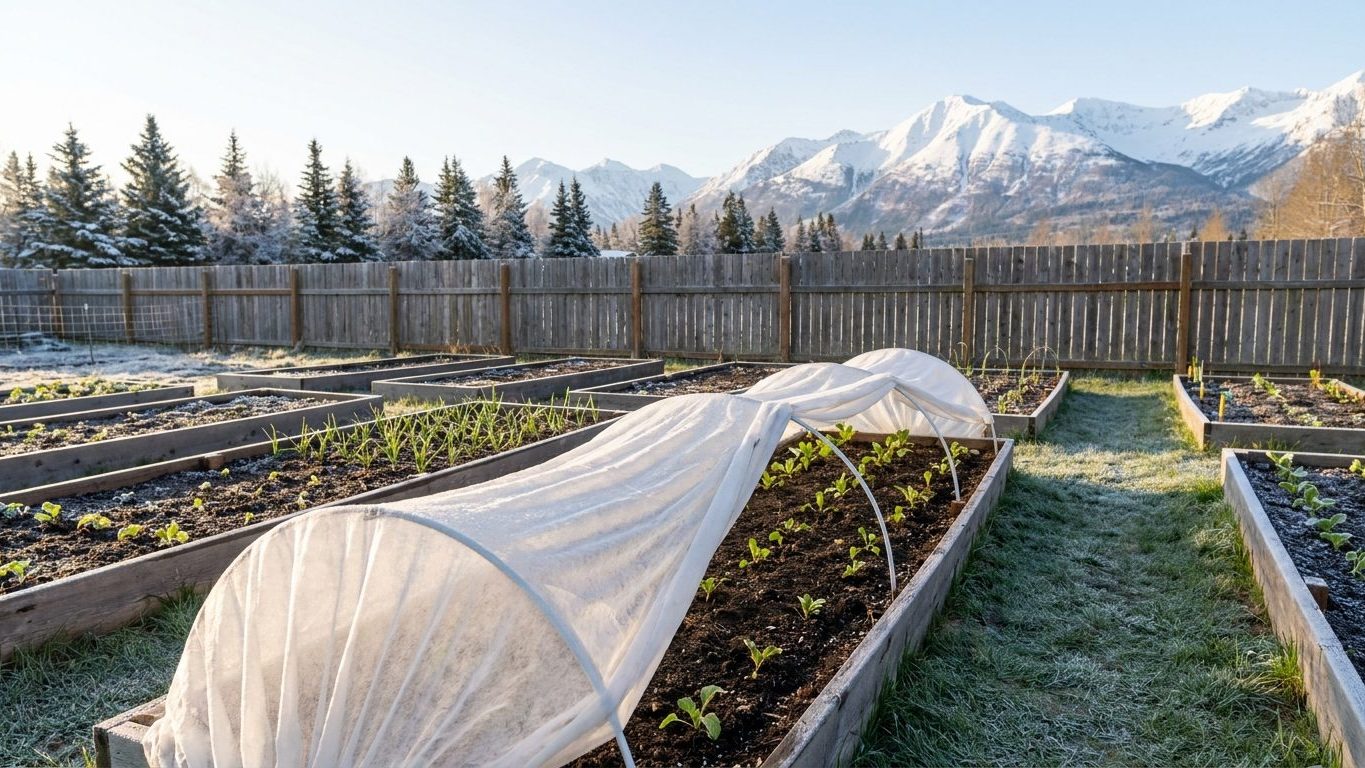

Cover your plants on any night the forecast low gets close to 32°F, and keep tender seedlings under cover from transplanting day until the spring freeze risk is truly over. In fall, put covers back on before the first hard freeze, not after it. The calendar gives you the windows to watch, and the overnight forecast tells you which night to act.
The short answer for Minnesota
In the Twin Cities, the last spring freeze at 32°F falls between April 17 and April 30, and the first fall freeze falls between October 11 and October 23. Those dates are probabilities. They mark the stretch when the odds of a 32°F freeze run between 30 and 70 percent, according to NOAA’s 1991-2020 Climate Normals for the Minneapolis station. A freeze can still show up after April 30 or before October 11 in a given year. The band tells you when to start paying attention, and the forecast tells you which night.
The sorting job is easy once you split plants by how much cold they take. Tomatoes, peppers, squash, cucumbers, and beans are damaged at or near freezing. Lettuce, spinach, kale, peas, and radishes shrug off a light frost. Carrots and beets sit in between and tolerate it well, especially with a little cover.
| Plant group | Examples | When to cover |
|---|---|---|
| Tender | Tomatoes, peppers, squash, cucumbers, beans | Every night with a forecast low near freezing, from transplanting until well past the spring band, and again from the start of the fall band |
| Frost-tolerant | Lettuce, spinach, kale, peas, radishes | Hard freezes only, or to hold growth steady in early spring and late fall |
| In between | Carrots, beets, chard | When the forecast calls for a hard freeze, mostly in fall |
A few details decide whether the cover actually works. Put it on in the late afternoon, while the soil is still holding the day’s heat, and take it off the next morning once temperatures are above freezing. A cover traps warmth rising from the ground, so it only helps if it reaches the soil or hangs close to it. Anchor the edges with soil, boards, or bricks. A cover flapping loose lets the heat out.
Clear, calm nights are the dangerous ones. With no clouds and no wind, heat escapes upward and the air near the ground can drop several degrees below what the forecast says for the area. A forecast of 34°F on a still, starry night deserves the same response as a forecast of 31°F. Cloudy, windy nights are far more forgiving.
Covering is also a way to start earlier, not only to rescue plants. Fabric or plastic over tender transplants can buy a week or two on either end of the season. The gear itself is covered in Which Season Extenders Work in Minnesota, and the bigger picture is in Extending the Growing Season in Minnesota.
What will not work here
A cover that is only on hand “just in case” fails first. Minnesota’s spring is a run of warm spells followed by sharp cold snaps, and the fall freeze band opens in the second week of October. Gardeners who wait for a frost to arrive before they dig out the fabric usually find the damage done by morning. Keep the cover folded at the edge of the bed from the start of the band, ready to throw over the plants.
Why can’t a single layer carry tender crops through a hard freeze?
A light row cover gives a few degrees of protection. That works for a night at 30°F or 31°F. Against a deeper freeze, tender plants need a second layer, a hoop-supported cover, or a move indoors. Tomato and pepper plants that already carry fruit are better picked and ripened inside than gambled on a thin sheet.
Will covers keep winter crops alive all winter?
Not by themselves. The mean daily minimum in the coldest month at the Minneapolis station is 8.8°F. At that temperature, a plastic tunnel or fabric over a bed of leafy greens ends up frozen solid, and plants that were fine through November die by January. Spinach and a few other hardy greens can overwinter under heavy protection, but the harvest comes in early spring, not through the cold months.
Plastic left on in a sunny spell is the other common failure. On a clear, calm day in April, the air under a closed tunnel gets hot fast, and seedlings that survived the freeze can cook by early afternoon. Open the ends or lift the edges on any sunny day, and close them again before sundown. Fabric breathes better and forgives more, which suits gardeners who are away all day.
Waiting for the soil to warm up is a mistake in the opposite direction. Covers warm the air above the soil and slow the loss of heat at night. They cannot turn cold, wet ground into warm ground in a week. Heat-lovers such as melons, sweet potatoes, and eggplant sulk when set into cold soil even under cover.
Snow is a Minnesota-specific problem for any hoop structure. Wet spring or fall snow is heavy, and thin hoops bend and collapse. If a heavy storm is forecast, brush snow off covers promptly, or take the plastic off the hoops and let the bare frame stand. Wind is the other failure point: a cover that is lightly weighted blows away in the first strong gust.
What changes across Minnesota
Minnesota is not one garden. The USDA Plant Hardiness Zone Map (2023, built on 1991-2020 normals) places the state in zones 3a through 5a. That is a wide spread, so there is no single answer for when to cover. The dates above belong to the Twin Cities, which are in the mild south of the state.
Northern Minnesota runs two to three weeks tighter at both ends. The last spring freeze comes two to three weeks later than April 17 to April 30, and the first fall freeze arrives two to three weeks earlier than October 11 to October 23. A gardener near the Canadian border has a growing season squeezed from both sides, so covers matter even more there, and there is less room for error. Look up your location on the USDA Plant Hardiness Zone Map rather than guessing from a neighbor’s garden or from a seed packet.
Latitude adds one more shift. The Twin Cities sit at 44.88 degrees north. Day length in summer grows with latitude, and day length (not warmth) is what tells an onion to stop making leaves and start making a bulb. A reader well north or south of Minneapolis should check their own latitude, because onion varieties are matched to day length.
Small differences matter inside a single yard, too. Low spots collect cold air and frost first. A bed against a south-facing wall stays warmer than an open bed. Lake shores, river valleys, and hillsides all behave differently from the flat ground that the station readings describe. Add a week of caution in a low or exposed spot, and take a week off in a sheltered one.
Where to check this for your own county
Your state extension service has the local answer. University of Minnesota Extension publishes gardening guidance written for Minnesota conditions, and its educators work with county-level knowledge that a statewide article cannot match.
Two things are worth looking for there. The first is the local planting calendar, which shows sowing and transplanting windows for your part of the state and often lists average frost dates for nearby towns. The second is the list of varieties trialled in your county or a similar one. A variety that performed well in a trial in your region is far safer than one chosen for its catalog description, because it has already faced local soil, cold snaps, and summer heat.
A county recommendation beats a state one. The dates and rules here describe the Twin Cities and cannot reflect your valley, your lakeshore, or the hill your garden sits on. If the extension calendar for your county gives different dates, follow the extension calendar.
Checking this against your own garden
Your own garden outranks every date in this article. Two observations will tell you more than a calendar, and neither needs any equipment.
The first is soil warmth by feel. Push your hand into the bed to a depth of a few inches. If the soil feels cold and damp and your hand is uncomfortable after a minute, tender transplants are not ready, covered or not. Compare two beds, one against a south wall and one in the open. The difference you feel tells you how much of a head start the sheltered spot gives you.
The second is frost on the grass. Look at which patches of the yard are white first on a cold morning, and which stay green. The white patches mark your frost pockets, and those are the spots where covers need to go on first.
Common questions
Should I cover plants when the forecast low is 34°F?
Yes, if the night will be clear and calm. Air near the ground can run several degrees colder than the forecast, especially in low spots. On a cloudy, windy night at 34°F, tender plants are usually fine.
Can I leave row cover on all day?
Lightweight fabric can stay on through the day because it lets air, light, and water through. Plastic tunnels and clear covers need to be vented or opened on sunny days, or the plants overheat.
What time of day should I put covers on and take them off?
Cover late in the afternoon, before the soil loses the day’s warmth. Uncover in the morning once temperatures are above freezing and frost on the cover has melted.
How much longer can covers extend the fall in Minnesota?
Covers can hold off a light freeze and keep plants going for a week or two past the first fall frost band, but a hard freeze will still end the season for tender crops. Hardy greens and root crops last much longer. The details are in Which Season Extenders Work in Minnesota.