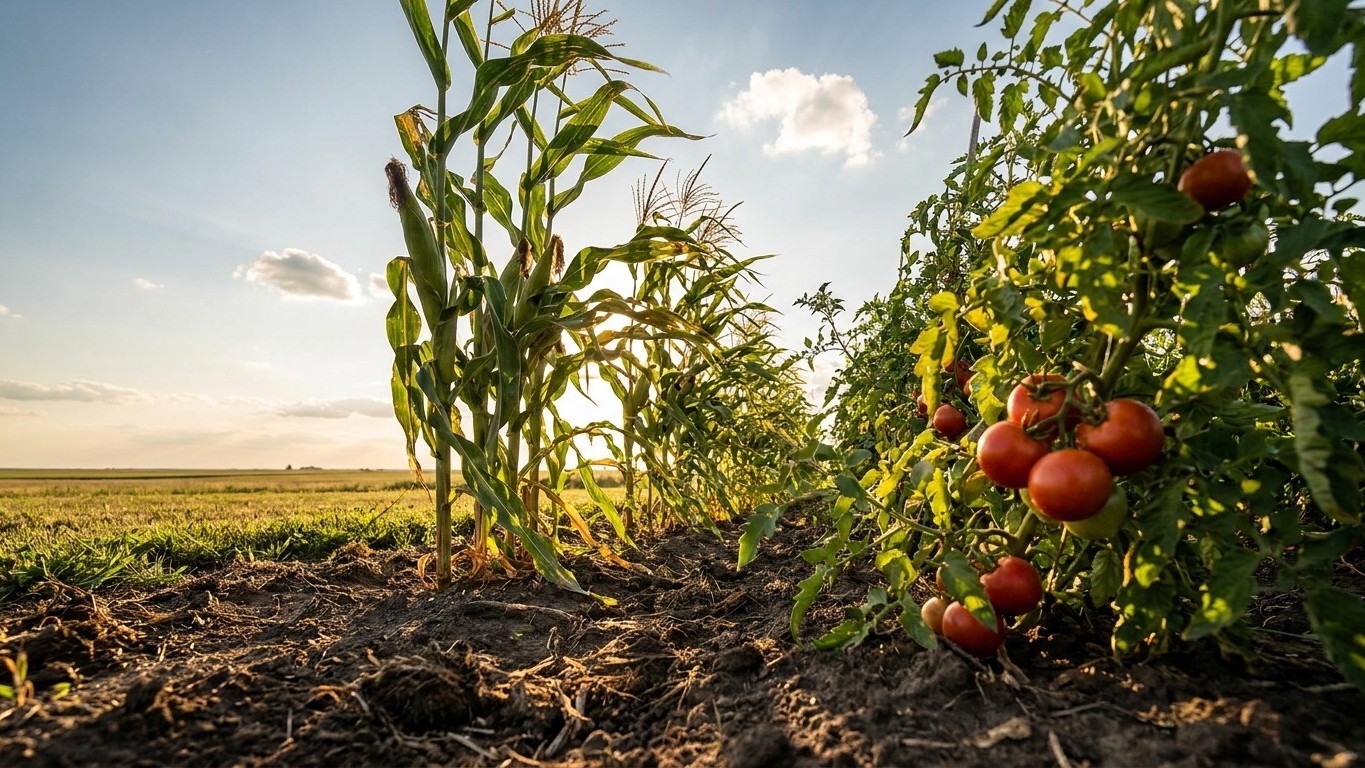

Sweet corn gets eaten at four points: the seed and seedling at the soil line, the leaves and central whorl, the silks and ear tip, and the filling kernels. Each point comes at a different growth stage, so the timing of the damage tells you which kind of feeder you are dealing with. The county office of the Mississippi State University Extension Service names the species active near you. What follows sorts the groups, the calendar, the look-alikes, and the fixes that pay off.
Which pests attack corn in Mississippi
The Mississippi State University Extension Service is the body that documents which insects and animals feed on corn across the state. In a home garden they show up in four groups, sorted by the part of the plant they go after:
- Seed and seedling feeders that work at or below the soil line, before the plant is knee high.
- Leaf and whorl chewers, mostly caterpillars and beetles that feed on the rolled-up center leaves and the blades around them.
- Silk and ear feeders, which chew the silks and then tunnel into the tip of the ear.
- Birds and mammals that pull sprouted seed, knock down stalks, or strip husks once kernels turn sweet.
Some pests on a general garden-pest list have nothing to do with corn. Borers that bore into tree trunks and fruit trees are one example, since corn is a grass with no wood or fruit for them. The same goes for insects that specialize in the tomato or squash families. A pest found on a neighboring plant is not automatically the cause of corn damage.
The four groups overlap, and a single insect species can fit more than one at different life stages. A caterpillar that chews whorl leaves early may turn up in the ear tip a few weeks later. Look inside the whorl and under the husk tip before you name a culprit, because the chewing you can see on a leaf is usually the smallest part of what is happening.
When each one shows up, and what it does first
The clock starts with the weather. At the reference station, the mean last spring frost falls between March 6 and March 22, and the mean first fall frost between November 7 and November 22. Gardens outside town usually see the last spring frost one to two weeks later, and the first fall frost one to two weeks earlier. Soil warmth comes well after the last frost, so sweet corn goes in later than the frost date alone suggests. Standard types wait until the soil at the 4-inch depth is at least 50 °F, and extra-sweet types wait until it reaches 65 °F. The When to Sow Sweet Corn in Mississippi guide covers that window in more detail. Everything below is counted from that sowing.
What shows up in the first weeks after the seedlings emerge?
Seed and seedling feeders come first. The earliest sign is a row with gaps where seeds never came up, or a seedling with its center leaf wilted and dead while the outer leaves look fine. Cool, wet soil that slows germination keeps the seed in the danger zone longer, which is one more reason to wait for the right soil temperature.
What happens as the plants grow toward tassel?
Leaf and whorl chewers arrive as the plants put on height. The first sign is a row of small holes that line up across the leaf when the whorl unfolds, because the feeder chewed through the folded layers together. Frass in the whorl, which looks like fine sawdust, points to something feeding inside the plant rather than a cosmetic problem on the leaf surface.
When do silk and ear feeders start?
When silks emerge, the ear feeders follow. Chewed, shortened silks come first, then a damp or sawdusty tip under the husk. The ripening clock runs separately from the season clock: sweet corn needs 60 to 90 days from planting to fit the season, while picking is timed from silk emergence, watching the silks and the ears as they mature. Ready ears show three signs together: dry brown silks, husks still moist and green, and milky juice when a kernel is punctured.
A late planting has to fit between warm soil and that first fall frost, as the Will Sweet Corn Ripen in Mississippi? page works through. It is also exposed to whatever feeders have built up in the garden over the summer. Birds and mammals tend to arrive last, once the kernels are at the milk stage, and their signs are husks peeled back, whole ears pulled off, and stalks bent over.
Telling the damage apart from everything else
Plenty of corn problems look like insect damage and are not. Heat is a common one, since the Jackson reference station averages 71.1 days a year at 90 °F or more, and corn under that load rolls its leaves and stalls without any insect involved. The table lists what each symptom could be and the sign that settles it. It does not name the cause in your garden. Only a look at your own plants, ideally with the county office, can do that.
| What you see | Other possible causes | What tells them apart |
|---|---|---|
| Ragged holes or torn leaves | Wind, hail, or leaf blades whipping against each other | Chewing leaves a defined edge and often droppings; tearing is straight and runs with the veins |
| Rolled, grayish leaves | Water stress and heat | Leaves that open again by morning point to water; leaves that stay rolled, with insects present, are another matter |
| Yellowing from the leaf tip, V-shaped along the midrib | Nutrient shortage | An even pattern across many plants, with no chewing, differs from scattered damage on single plants |
| Ears with scattered missing kernels | Poor pollination, drought while silking, or a planting too narrow | Chewed kernels leave droppings and a damaged tip; unfilled kernels leave clean, empty spots |
| Starchy, bland kernels | Types that tasseled at the same time and crossed | Check which types were planted nearby and whether they tasseled together |
| Flattened or leaning stalks | Wind, heavy rain, or animals | Roots lifted with an intact stalk suggest wind; gnawed stalks and husks suggest animals |
Sweetness has its own timing rule. Sweet corn types lose their sweetness if su, se and sh2 types tassel at the same time, and the plants should go in as blocks of three or more rows. A single long row sheds pollen poorly, which leaves gaps in the ears.
What actually works here, and what is a waste of time
On a season this long and humid, the calendar does more than any product. Planting when the soil at the 4-inch depth reaches 50 °F for standard types, or 65 °F for extra-sweet types, gets seedlings through the vulnerable stage quickly. A supersweet seed sown too early rots in cold soil, and the failed stand looks like seedling pests when it is not.
Physical barriers beat treatments. Fencing or netting that goes up before the ears fill keeps out birds and mammals, because by the time you see the first stripped ear the rest are usually next. A compact block of three or more rows is also easier to protect than a long single row. Check plants weekly from emergence on, starting in the whorl and moving to the silks, so you see damage while it is still small.
Picking as soon as the ears ripen after silk emergence also helps, because ears left on the stalk past ripeness stay exposed to feeders and animals. After picking, clear the stalks and till or remove the residue so overwintering stages have less to hide in.
Several things waste time. Spraying on a fixed schedule, with no scouting, treats a calendar rather than a problem. Treating after damage shows inside the ear is too late, because the feeder is already protected under the husk. Replanting several times in cold, wet soil only feeds the seed-and-seedling group. Which products are approved for corn in the state is for the Mississippi State University Extension Service to say, not this article. They know what is currently labeled and what suits a home garden.
Where to check this for your own county
Start with the county office of the Mississippi State University Extension Service. Pest pressure varies inside the state, and a species common on the Gulf Coast may be rare in the northern hills. What the service documents statewide does not tell you what is in your garden, so a local office or agent is the right place to ask.
The frost dates in this article come from NOAA NCEI climate normals for the reference station. They are one city’s numbers, not a guarantee for every garden, and a later sowing shifts every stage in the calendar above. If you need the full picture of the crop, the Growing Sweet Corn in Mississippi guide is the place to begin.
Before you call or visit, write down the planting date, the types you grew, and the stage the plants were in when the damage began. A clear photo of the damage and a sample of the feeder, if you find one, make the answer faster and more reliable.
Common questions
When do pests start attacking sweet corn?
They start at sowing, with seed and seedling feeders, and the next groups follow in order: whorl chewers as the plants grow, silk and ear feeders once silks emerge, and birds and mammals as kernels fill.
How can I tell insect damage from heat stress?
Check the leaves in the morning. Leaves rolled in the afternoon that are flat by morning point to water and heat. Chewed edges, droppings, or an insect present point to a feeder.
Does planting in blocks help?
Blocks of three or more rows help pollination, and a compact block is easier to net or fence than a long single row. Block planting does not stop insects on its own.
Can I still eat ears with damage at the tip?
Ears with minor tip damage are usually trimmed back to clean kernels. Ask the county office whether the feeder involved changes that advice, and pick as soon as the ears ripen after silk emergence so fewer ears are left exposed.