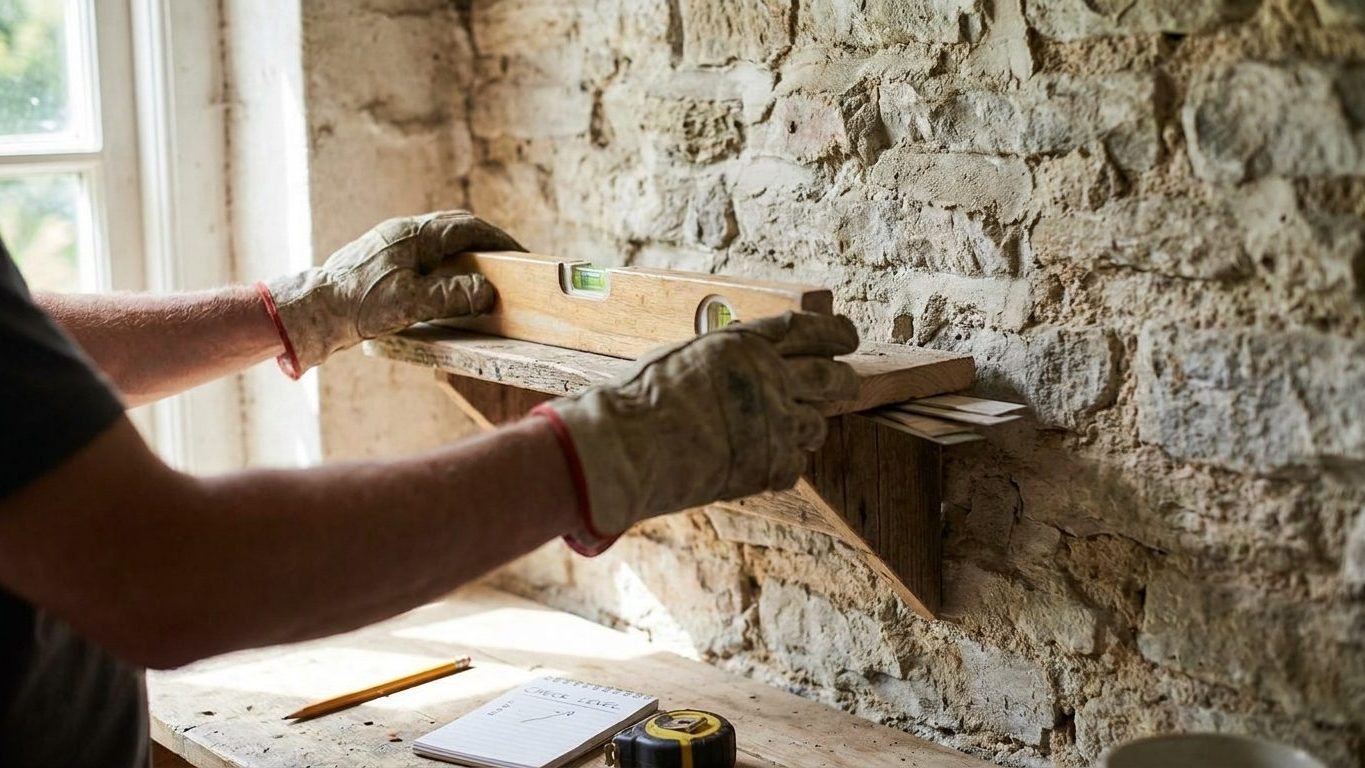

Hang a shelf dead level under a ceiling that slopes, and the shelf will look like it’s sliding downhill even though the bubble sits perfectly centered. A spirit level only reports gravity, not the room around it. Check the wall’s actual lean first, with a level held against the trim and against the object itself, then decide whether to follow the level exactly or split the difference toward the sight lines the room already gives you.
What is actually going on

A spirit level answers one question only: is this line perpendicular to gravity. It does not know or care what the ceiling is doing, what the floor is doing, or where the picture rail sits six inches above. The eye works differently. It reads a shelf, a frame or a run of cabinets against whatever lines already surround it, the top of a baseboard, the underside of a crown, the head of a door casing. In a house built decades ago, those surrounding lines are rarely true to gravity themselves. Framing settles. Sills sag under the weight of years of foot traffic and seasonal movement. Plaster walls bow outward between studs as old lath dries and shrinks. Ceiling joists sag more toward the middle of a span than at the wall, so a ceiling that reads flat from below is often lower in the center than at the edges.
This is why leveling to the floor and leveling to the ceiling can give two different answers on the same wall. If the floor has settled toward one corner of a room, and the wall has been replastered flat since, a genuinely level shelf sits parallel to neither the old floor nor the newer trim exactly. The wall you are fixing to and the wall the eye is comparing against are not always the same surface, and in an old house they often disagree by a visible margin.
The disagreement gets worse over distance. A gap that is barely noticeable at one end of a picture rail can flare open by the time it reaches the far wall, because the rail and the level are diverging at a constant rate across the whole run. A single shelf hides this kind of drift. A row of frames, a run of open shelving, or a chair rail that continues around a corner does not.
All of this assumes you have already found somewhere solid to fix into, the step covered in Hanging, Shelving and Fixing: The Wall Decides. Leveling only matters once you know where the screw or anchor is actually going.
There is no single correct answer here, only a usual one. The convention among people who hang a lot of pictures is to trust the level for anything standing alone with open wall around it, and to trust the surrounding trim for anything hung close enough to a fixed line that the two will be compared directly.
Doing it
Work out which line the eye will actually use before touching a drill.
- Hold the level against the wall itself, top to bottom and side to side, in more than one spot, and note where it disagrees with the trim. Skip this and you discover the lean only after the shelf is already up.
- Hold the level against the ceiling line and the floor line separately, not just the wall, since an old room can slope in two different directions at once. Skip this and you correct for the wrong surface while the object still looks off.
- Decide what the finished piece will actually be compared against. An isolated piece near open wall gets compared to gravity, so use the level. A piece running parallel to a rail, cornice, wainscot cap or a row of windows will be read against that line instead, so trust the surrounding line, not the level, even when the two disagree.
- For anything spanning more than an arm’s length, mark both ends independently against the nearby reference line rather than measuring once and extending a level across the whole run. Skip this and small errors compound, so the finished piece bows visibly from one end to the other.
- For a row of separate objects, level and space them relative to each other first, then adjust the whole group relative to the room, rather than leveling each piece individually against gravity. Skip this and you get a row where every piece is technically level but the tops don’t line up with each other, which will read as more wrong than any single tilt would.
- Step back to the far side of the room before committing to a fixing, since a tilt that is invisible up close often becomes obvious at viewing distance. Skip this and you find out from across the room, after the holes are already drilled.
If you are avoiding fixings altogether and using adhesive strips or hooks instead, the same decision about which line to trust still applies, covered in Hanging Things Without Drilling. A stick-on hook holds no better than a screw does against a wall that is out of square, it just fails differently when the answer is wrong.
What it looks like when it goes wrong
Most failures on a wall that isn’t square are cosmetic, and most of them correct without redoing the fixing itself.
| What you see | Correctable or must redo | Likely cause |
|---|---|---|
| Single shelf reads crooked next to a rail or cornice | Correctable, re-mark and rehang | Level trusted over a wall that leans, when the trim was the real reference |
| Gap to the ceiling widens across a run of frames | Correctable, re-space the group | Level trusted over a sloped ceiling across too long a run |
| Shelf rocks, or shows a shadow gap at its center | Correctable, shim behind the low point | The wall bows rather than leans |
| Fixing driven at an angle to fake a level look | Must redo, straight fixing only | Compensating for wall lean at the screw instead of the object |
| Plaster cracked or crumbled around the fixing point | Must redo, patch and re-drill | Loose or hollow plaster won’t hold regardless of angle |
The one failure on this list that isn’t cosmetic is the angled fixing. An anchor or screw seated at an angle to make a crooked-looking result appear level has less material gripping it than one driven straight in, and it is the fixing, not the eye, that decides whether the object stays on the wall. A shelf or mirror with real weight behind it that wobbles, or that tilts more than it did when first hung, is worth a plain check for a loose or angled fixing, separate from any question of how it looks.
Plaster that has cracked or crumbled around an existing fixing point cannot be leveled around. It has to be patched, left to cure, and re-drilled, because a fixing into loose or hollow plaster is unreliable regardless of how straight it looks going in.
What to settle first
Before any of the leveling decisions above matter, settle what the wall actually is. Plaster and lath, drywall over studs, and masonry each hold a fixing differently, and each responds differently to a wall that is out of square. Plaster can sometimes be shaved or built up locally to true a surface without touching the framing behind it. Drywall over a stud wall generally cannot, since the studs behind it set the plane no matter what happens at the surface.
What’s inside the wall
Find out what is inside the wall before deciding how to correct for its lean. A stud, a section of masonry or an open cavity behind plaster all take a fixing differently, and pipework or wiring routed through the wall changes where you are willing to drill at all, regardless of what the level says looks best. This is worth settling with a stud finder, and in a house with unknown wiring, some care around where outlets and switches sit on the same wall.
Settle, too, whether the wall should be carrying the load at all. A partition built from lighter framing, or a wall that has already cracked under its own settling, may not be the right place for a heavy mirror or a loaded run of shelving regardless of how well it can be made to look level. Local building departments can advise on load-bearing questions specific to a house’s construction, and that answer matters more than any cosmetic fix once real weight is involved.
In a small room the whole wall is visible in one glance, which makes any disagreement between the level and the trim harder to hide than it would be on a longer wall, a problem covered in Making a Small Room Work. Settling the wall’s true condition before hanging anything saves the redo later.
Common questions
Should I level to the floor or to the ceiling?
Neither one automatically. Check both independently with a level, since an old house can have a floor and a ceiling that slope in different directions or by different amounts. Match whichever surface the eye will actually compare the object against, usually the closer one.
Can I just eyeball it instead of using a level?
For a single small object with nothing nearby to compare it to, eyeballing against the trim often works better than a level, since the trim is what a visitor’s eye will use anyway. For anything spanning a wall or sitting near a strong architectural line, start with the level and adjust from there rather than skipping it entirely.
Why does my shelf look crooked when the level says it’s straight?
Because it is being read against something else in the room that isn’t straight, most often a ceiling line, a picture rail, or a window head. The level is correct about gravity. The complaint is about the relationship to a different line entirely.
How do I hang a row of frames on a wall that isn’t square?
Level and space the frames relative to each other first, as a group, before worrying about gravity at all. A row that agrees with itself reads as intentional even when the whole group sits a little off true level, while a row where each frame is individually perfect but inconsistent with its neighbors reads as a mistake.