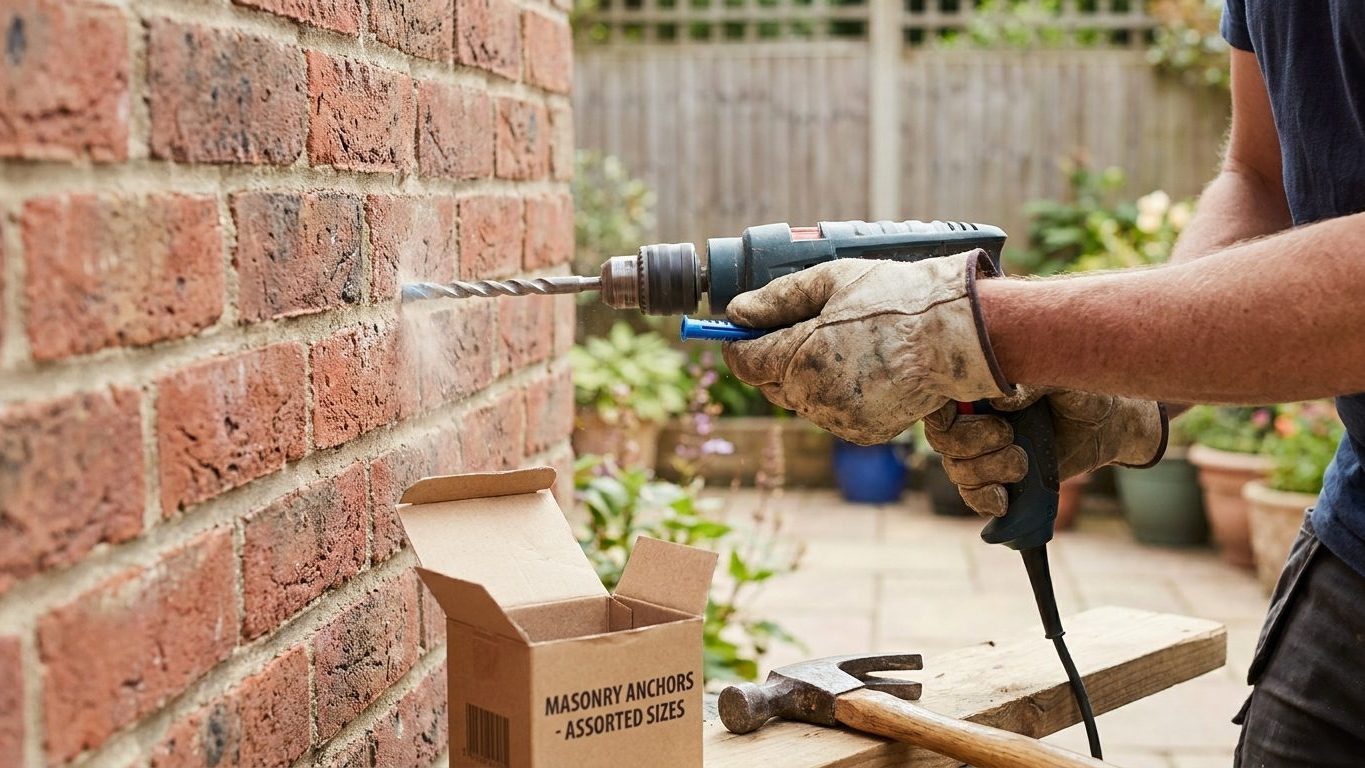

Brick, block and concrete hold a screw by friction against the sides of a drilled hole, not by the material gripping the threads the way wood does. Match the plug, the drill bit and the hole depth to the exact wall type before you drill, because a plug sized for solid brick will spin loose all day in lightweight block.
What is actually going on

The thing to understand about any masonry fixing is expansion. A plug goes into a drilled hole and, as the screw is driven in, its body swells outward and jams against the sides of the hole. The grip comes entirely from that pressure. Get the hole diameter wrong by even a millimeter, or drill it too shallow, and the plug either spins freely with nothing to bite or bottoms out before it can expand properly.
Why solid walls behave differently to hollow ones
Solid brick, dense block and poured concrete hold far more than a hollow wall, and they are also far less forgiving of sloppy technique. In a hollow or cavity wall there is often some give, and a slightly oversize hole can still find purchase against an inner face. In solid masonry there is no second chance. The hole is either the right size and depth for that plug or it is not, and there is no soft material behind it to bail you out.
What’s actually inside the wall
Before any of that matters, you need to know what is behind the surface. Cables, and in some houses water or gas pipework, run inside walls, and the conventions about where they are routed are just conventions. Older houses in particular follow none of them reliably. Check with a cable and pipe detector before drilling, and if you cannot check with any confidence, do not drill in that spot. This is not a step to skip because a wall looks solid and undisturbed.
Common places to find hidden services include:
- Straight lines running up or down from switches and outlets
- Anywhere near a boiler, water heater or kitchen plumbing run
- Chimney breasts, where old gas pipes for fires sometimes still run
- Areas above and below outlets, where cable often runs vertically by convention only
If the job in front of you involves running new wiring or moving a fixture that needs power, that is electrical work and belongs with a licensed electrician, not with a drill and a wall plug.
Doing it
Once you know the wall is clear of services, the job is mostly about matching tool to material and being patient with dust. The three common substrates behave differently enough that the same drill bit and plug rarely suit all three.
| Wall type | Typical drill bit | What tends to go wrong |
|---|---|---|
| Brick | Standard masonry bit, hammer action | Old, soft brick crumbles around the hole edge if you push too hard |
| Dense concrete block or poured concrete | Masonry bit or SDS bit for harder mixes | Bit skates on the surface before it bites, or wears out fast |
| Lightweight or aerated block | Masonry bit, often without hammer action | Standard plugs spin loose because the material is too soft to grip |
- Identify the wall type before you pick a drill bit. Guessing wrong here undoes every step that follows, since a plug rated for solid brick will not perform the same way in aerated block.
- Mark the hole depth on the drill bit with tape, matching the plug length plus a small margin. Skip this and you will either stop short, leaving the plug unable to expand fully, or go too deep and lose the screw’s grip at the surface.
- Drill square to the wall, at a steady speed, easing off if you hit an air pocket or a mortar joint. Angling the hole even slightly means the plug sits crooked and only part of it ever makes contact.
- Clear the dust out of the hole with a blower bulb or by tapping the drill in and out a few times. A hole packed with dust stops the plug from expanding against solid material, and this single skipped step accounts for a large share of fixings that later work loose.
- Push the plug in until it sits flush, not proud and not below the surface. A plug left protruding will crack the wall face when the screw is driven home.
- Drive the screw steadily and stop as soon as it feels solid. Overtightening in brick or lightweight block can shatter the material around the plug rather than seating it.
What it looks like when it goes wrong
Some failures show up the moment you drive the screw, others only after the fixture has been hanging for weeks.
Cosmetic problems that can be fixed
A screw that spins without tightening usually means the hole is oversize for the plug, or the plug is sitting in dust rather than solid material. Pull it out, clear the hole properly, and if it is now too wide, step up to the next plug size rather than forcing the original one in. Chipping at the surface around the hole, sometimes called spalling, is common in older or softer brick and is mostly cosmetic if the plug still seats. A cracked mortar joint around a small fixing hole can usually be patched once the fixing is out.
Failures that mean starting over, or worse
A fixing that feels solid going in but slowly sinks or tilts under load is a safety failure, not a cosmetic one. It means the plug never gripped properly, and the load is being carried by friction that is failing under weight. This is especially serious for anything heavy mounted at height, since a shelf, mirror or television that comes away from the wall causes real injury on the way down. Any fixing that shows movement, a fresh crack radiating from the hole, or a screw head that has visibly pulled forward should be treated as failed. Do not test it by adding more weight or waiting to see if it holds. Take it down, drill a fresh hole in solid material nearby, and start again with the right plug for that wall.
A hole drilled into a mortar joint instead of the brick or block itself is weaker by nature, since mortar is softer and less consistent than the masonry around it. If a fixing there already shows cracking or movement, move the hole into the solid unit rather than repairing the joint.
What to settle first
Before any drill touches the wall, settle what the wall actually is. Brick, dense block, lightweight block and poured concrete all take different plugs and different drill bits, and the packaging on the fixing itself will say which wall types it is rated for and, where given, the load figures for each one. That packaging is the only reliable number to work from, since what a fixing holds depends on the wall, the fixing itself, and how well it was installed, not on any general rule. For a fuller look at how those figures are worked out, see “/decor/how-much-weight/”>How Much Weight a Wall Fixing Holds.
What’s behind the surface, and what’s going on it
Settle next what is hidden in the wall. Check for cables and pipework with a detector, and where you cannot be sure, choose a different spot rather than drilling blind. This matters as much for a small picture hook as for a heavy mirror, since the risk is to you and the wiring, not to the fixing.
Finally, settle what the wall is actually going to carry, and in which direction. A shelf loaded with books pulls down and slightly out. A curtain pole, including the kind used for full-length drapes where how long curtains should be affects how much fabric weight the pole carries, pulls mostly down along its whole length. A wall-mounted television pulls down but also forward, and any knock to it adds a sudden load the fixing was never tested against. If you are unsure how any of this applies to your wall and your fixture, the general approach in Hanging, Shelving and Fixing: The Wall Decides is worth reading before you buy plugs at all. When in doubt about a wall’s condition, its load-bearing role, or what is buried in it, that is the point to bring in a builder or a structural engineer rather than press on.
Common questions
Can I use a normal wall plug in old lime mortar?
Not reliably. Lime mortar is softer than modern cement mortar and often crumbles around a standard plug instead of gripping it. Where possible, move the hole into the brick or block itself rather than the joint, and if the wall is entirely lime mortar construction, get advice from a specialist before fixing anything load-bearing to it.
The drill just spins and won’t go in, what does that mean?
Usually it means you have hit something denser than the surrounding wall, such as a piece of aggregate in concrete or a stone in older rubble-filled brickwork. Ease off the pressure, let the bit work slowly, and if it still will not progress, shift the hole slightly rather than forcing it.
Is it okay to fix into the mortar joint instead of the brick?
It is weaker than fixing into the brick or block itself, since mortar is softer and less uniform. For anything beyond a very light picture hook, move the hole into the solid masonry unit rather than the joint between them.
Do outdoor brick walls need different fixings than indoor block walls?
Often yes, because outdoor fixings need to cope with damp and temperature swings that indoor ones never see. Check the fixing’s packaging for whether it is rated for exterior use, since a plug and screw combination fine indoors can corrode or degrade outside within a season or two.