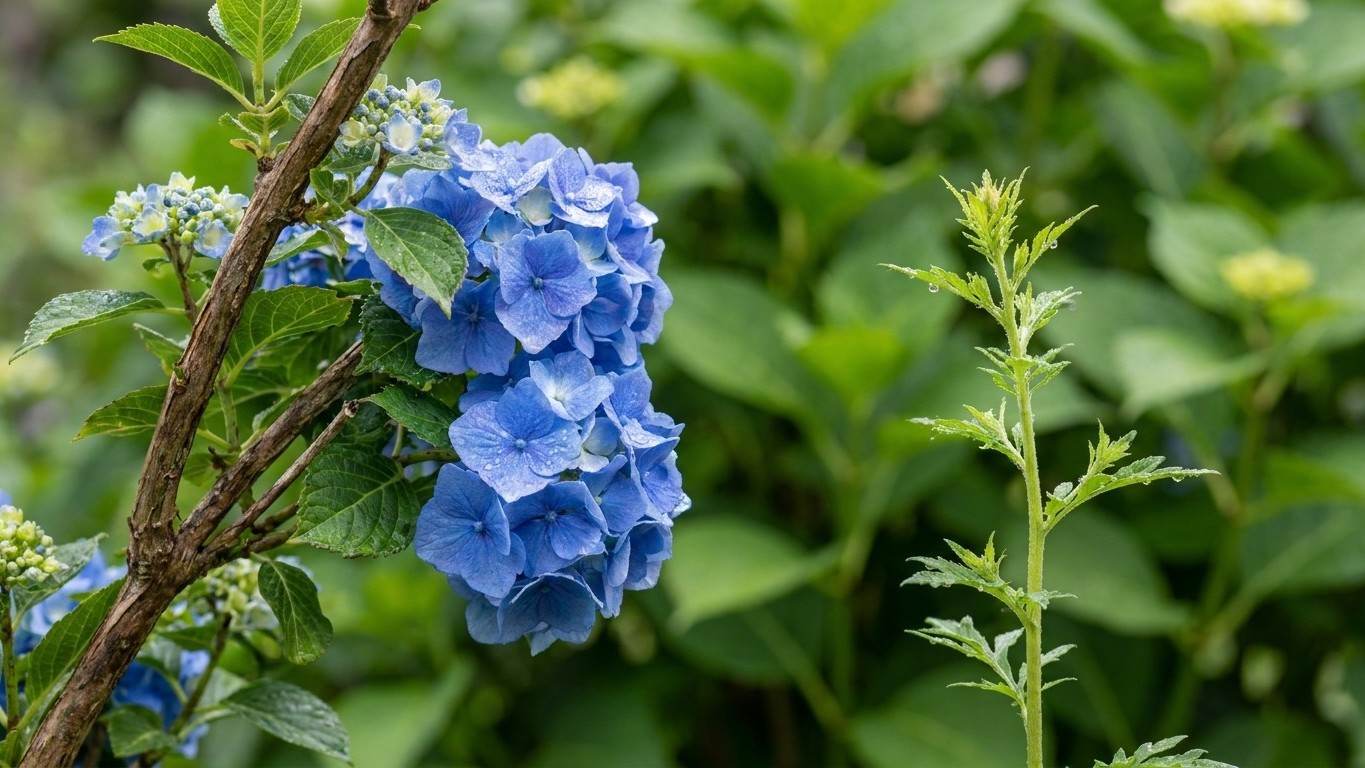

Hydrangeas turn pink in most Virginia yards because the soil is near neutral or has been limed. At that pH, the aluminum a bigleaf hydrangea needs for blue flowers stays locked in the soil. Bring the pH down to about 5.5 or lower, keep phosphorus modest, and the same shrub can flower blue. The shift takes a full growing season, sometimes two, and it only works on certain species.
What this comes down to in Virginia

The work of turning pink to blue begins as buds swell, around the last spring frost, which falls between March 20 and April 3 at the NAS Oceana station in Virginia Beach, the reference point in NOAA NCEI climate normals. Treatments run through early summer, and a second round in fall sets up the next year, ahead of the first fall frost between November 10 and November 24 at that same station. Virginia Beach is the mild end of the state. The Blue Ridge and southwest Virginia run weeks later in spring and earlier in fall.
What soil pH turns hydrangeas pink or blue?
Roots can only absorb aluminum when it is dissolved in the soil water, and that happens in acid soil. At pH 5.5 or lower, aluminum is available and the flowers come out blue. At pH 6.5 or higher, it is locked up and the flowers are pink. Between the two you get purple, or a bush with both colors. The pigment is the same in every case. Aluminum is what shifts it toward blue.
Virginia gardeners push their soil toward pink without meaning to. Lawn lime spreads into nearby beds, and concrete foundations leach lime into the soil beside them. Fertilizers high in phosphorus, the middle number on the bag, bind aluminum in the soil even where the pH is right. The Shenandoah Valley sits over limestone, so the native soil there starts out higher in pH than the red clay of the Piedmont.
Which hydrangeas can change color at all?
Only bigleaf hydrangeas (Hydrangea macrophylla) and mountain hydrangeas (Hydrangea serrata) respond to soil chemistry. ‘Nikko Blue’ is a classic example. It blooms on old wood, meaning stems that grew the previous season. ‘Endless Summer’ is a bigleaf that blooms on both old and new wood, and its color also follows pH.
Smooth hydrangeas such as ‘Annabelle’ stay white whatever you do to the soil. Panicle types such as ‘Limelight’ open green-white and blush pink as nights cool in late summer, and that has nothing to do with aluminum. White-flowered bigleafs stay white. If your pink flowers sit on a smooth, panicle or oakleaf hydrangea, no soil treatment will make them blue.
Working it out for your own garden
How do you check soil pH before changing flower color?
Test the soil at the drip line of the shrub before buying anything. Your county extension office can send you a sample kit, and the result tells you the pH and how much sulfur, if any, the soil needs. Garden-center strips work for a rough read, but they will not tell you how much to apply. A soil at pH 6.8 needs a long, deliberate push. A soil already near 6.0 may only need a change of fertilizer.
How do you time aluminum sulfate to the frost window?
Aluminum sulfate works in weeks, because it supplies aluminum and acidifies at once. The usual routine is one tablespoon dissolved per gallon of water, poured around the base of a well-watered plant, three times about four weeks apart. Wet the soil first, since a drench on dry roots can burn them.
Here is the arithmetic. If the first drench goes on as buds swell, in the March 20 to April 3 window at the reference station, then adding eight weeks puts the third drench between May 15 and May 29. Bigleaf flowers typically open from late May into June, so the last dose lands while the flower heads are still developing. Inland, shift the spring schedule later by the number of weeks your spring runs behind the coast, and move the October sulfur application earlier to match your earlier first fall frost.
Elemental sulfur is slower, because soil microbes have to convert it to acid. Apply it in October, while the soil is still warm, well ahead of the November 10 to 24 first-frost window at the reference station. That gives it winter and early spring to lower the pH before the next bloom season.
Take a pink ‘Nikko Blue’ in limed clay at pH 6.8, treated from late March. Its flower buds formed last summer, so this year’s bloom shows only a purple shift. The following year it is noticeably bluer. Move that same shrub to the Blue Ridge, where a freeze after bud break can kill old-wood buds, and the bush may leaf out with no flowers at all. Color treatment is wasted there. ‘Endless Summer’ is the fallback, since it can flower on new growth after a late freeze.
What changes across the state
Soil, more than weather, decides which end of the color range you start from, and Virginia’s soils differ sharply by region. The USDA Plant Hardiness Zone Map, which is built only on the average annual extreme minimum temperature, runs from 5a to 8b across the state. That spread also decides whether old-wood buds survive winter in a given spot.
| Region | Typical soil | What to expect |
|---|---|---|
| Coastal Plain | Sandy, low buffering | pH moves fast in either direction, so treatments work quickly and wear off quickly |
| Piedmont | Red clay, naturally acidic | Often blue to purple until lawn lime and foundations push it up |
| Shenandoah Valley | Limestone-derived, higher pH | Pink is the default, and blue takes steady effort |
| Blue Ridge and southwest | Acidic on the ridges, limestone pockets in the valleys | Blue comes easily on ridges, but late freezes threaten old-wood buds |
Water matters too. Wells drawn from limestone formations carry dissolved lime, and regular watering from them raises the soil pH over a season. Rainwater from a barrel is the gentler choice for a shrub you are trying to acidify. Spring also arrives weeks later in the mountains than at the reference station, so the spring dates in the previous section slide later there, while the fall sulfur date moves earlier.
The mistakes this state punishes

A warm spell in February or March can start bud break early. Then a freeze at 32F arrives inside the late-March to early-April window, and the swollen buds are lost. Watch the forecast once buds swell and cover the shrubs with a sheet or frost cloth when a freeze is coming.
Pruning in the wrong season removes the flower buds you were trying to color. Bigleafs that bloom on old wood set buds in late summer, so a fall or early-spring cut takes next year’s flowers with it. The timing is covered in When to Prune Hydrangeas in Virginia.
Several other habits waste a season:
- Pouring aluminum sulfate on soil without testing it. Heavy doses burn roots, and a limed bed can drift back to pink within weeks.
- Feeding with a high-phosphorus fertilizer. Choose one low in phosphorus and higher in potassium.
- Planting next to a concrete foundation or the edge of a limed lawn. Move the bed, or put the shrub in a large container of acidic mix.
- Expecting results the same summer. Buds are already formed by spring, so the visible change comes in the following bloom.
Checking this against your county
The dates above come from one coastal station, and your yard may differ by weeks, and in soil pH, from your neighbor’s. Your county office of Virginia Cooperative Extension can run the soil test and tell you which fertilizer and sulfur rates suit your soil. For general planting and care, see growing hydrangeas in Virginia.
Common questions
Can I turn a pink hydrangea blue in one season? Usually not fully. Buds are already set by spring, so expect purple tones the first year and a clearer blue the next.
Will coffee grounds or pine bark turn hydrangeas blue? They have little effect on soil pH, and nothing close to what a measured sulfur or aluminum sulfate application does. Test the soil and follow the result.
Can I go from blue back to pink? Yes. Garden lime raised to a pH of 6.5 or higher, plus a high-phosphorus fertilizer, shifts the flowers toward pink. Apply it in fall or early spring, based on soil test rates.
Why is one shrub pink on one side and blue on the other? Roots on the side nearer a foundation or lawn lime sit in higher-pH soil. Roots on the other side sit in native acidic soil, so each half of the shrub takes up different amounts of aluminum.