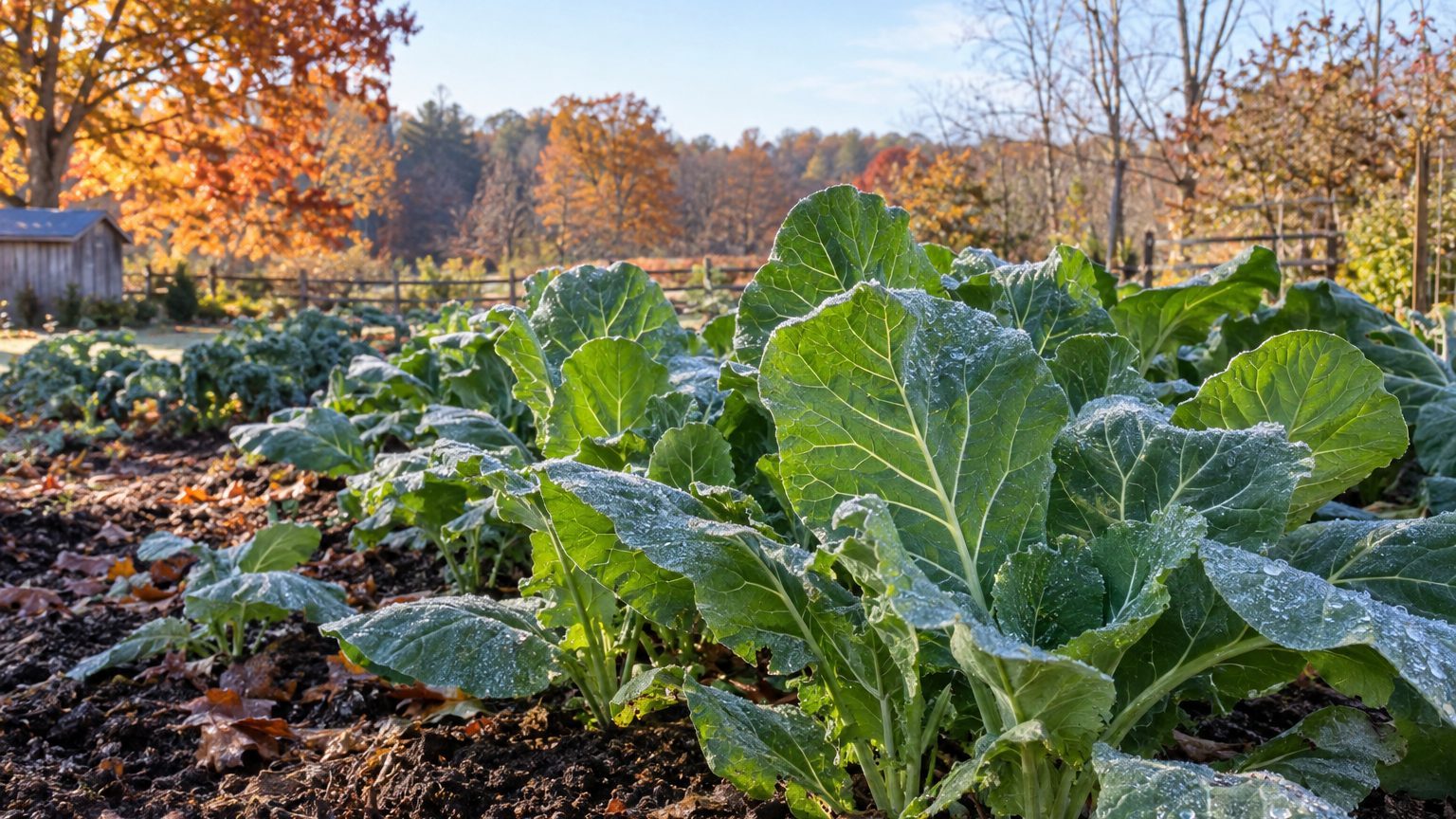

Alabama gardeners get two windows for collards: a spring one bound by the last frost, and a fall one bound by the first. The fall window carries the state’s collard crop. Sow seed outdoors roughly 8 to 10 weeks before the first fall frost, which at the Huntsville reference station falls between November 2 and November 16.
The short answer for Alabama
Collards tolerate cold better than almost any garden green grown in the South, so the calendar here works backward from frost rather than forward from it. The Huntsville station (USW00003856) puts the first fall freeze at 32°F somewhere between November 2 and November 16. Counting back 8 to 10 weeks from that window lands most Alabama plantings in early September, which is why sowing collard seed outdoors in early September is the single date worth writing on a calendar for this state.
Those November dates are not a guarantee. NOAA’s 1991-2020 Climate Normals describe them as a 30 to 70 percent probability band, meaning frost has roughly a coin-flip chance of arriving on any given day inside that stretch, and a real chance of showing up earlier or later than either edge. A gardener who treats November 2 as a hard deadline is reading the data too literally; it is a range of likelihood, not a switch that flips on a single night.
Spring offers a second, shorter window. The last spring frost at the same station falls between March 19 and April 3. Collards handle a light freeze as mature plants, so direct seeding two to three weeks ahead of that window is workable for a spring crop, provided the gardener accepts some risk to young seedlings if a late cold snap runs past April 3. The bigger limit on the spring crop isn’t frost, though. It’s what comes after: Alabama’s early summer heat pushes collards toward bolting and bitterness faster than most other Southern states, which is the real reason fall carries the crop here.
Both windows depend on one station’s data. Huntsville sits in the Tennessee Valley, and its frost dates run earlier than a warmer Gulf Coast county and later than a cold pocket in the mountains of the northeast corner. Treat the September date as a starting point for this state, then adjust using the zone spread and county resources covered further down this page.
What will not work here

Sowing fall collards after mid-September is the most common mistake in this state, and the frost math explains why. Collards typically need somewhere in the range of 60 to 75 days from seed to a harvestable head of leaves. Count forward from a September 20 sowing and the plant is still building leaf mass when the first frost band opens on November 2. Do not sow fall collards after mid-September if the goal is a full harvest before the coldest nights arrive, because the calendar simply runs out.
A slow-maturing variety compounds that same problem. Alabama’s fall growing window, measured from an early-September sowing to a first-frost date in early November, gives roughly 8 to 9 weeks of frost-free growth before the freeze probability climbs. A collard that needs the long end of the maturity range has almost no cushion left if that first frost lands on the early side of the November 2 to 16 band.
On the other end of the calendar, treating collards like a drought-tolerant summer crop backfires just as fast. A spring-sown planting that stretches into Alabama’s early summer meets heat and humidity that push the plant to bolt, and a once-a-week watering schedule during that stretch leaves the root zone dry enough to accelerate the process. Collards want steady moisture through establishment, not a deep soak followed by several dry days, and Alabama’s summer heat evaporates soil moisture fast enough that a weekly schedule regularly falls short.
Assuming collards can sit unprotected outdoors all winter without a second thought is also shakier than it looks. The coldest month’s average daily minimum at the Huntsville reference point is 33.1°F, which is why mature collards generally winter over fine across most of the state. But that figure is an average, not a floor, and a transplant set out late with a small root system can still take real damage on the nights that dip well under that mean. Timing the fall sowing early enough that plants are well established before winter matters more in Alabama than the average winter minimum alone suggests.
What changes across Alabama
Alabama is not one growing zone, and treating it that way is where a lot of frustration starts. The USDA Plant Hardiness Zone Map places the state across a spread from zone 7a to 9a, built from average annual extreme minimum temperatures. That’s roughly a 10 to 15 degree difference in how cold the coldest night of a typical year gets, depending on where in the state a garden sits.
That spread changes the practical calendar in both directions. A garden in the cooler 7a end, generally the higher elevations of the northeast, is working with a shorter frost-free season than the Huntsville dates alone suggest, and should lean toward the earlier side of the fall sowing window rather than the later side. A garden closer to the warmer 9a end, generally the Gulf Coast counties, can often push fall sowing later into September and may see a milder enough winter that collards keep producing leaves well past the point a north Alabama garden has gone dormant.
None of this replaces knowing exactly where a given property falls. The zone figures here describe the state as a whole, and the Huntsville frost dates come from one weather station in the Tennessee Valley, not from every county. A reader gardening at higher elevation or in a low-lying frost pocket should expect their own last spring frost later and their first fall frost earlier than the Huntsville numbers by a week or two, sometimes more. The right move is checking the current USDA Plant Hardiness Zone Map for the specific county in question rather than assuming either end of the state’s 7a-9a range applies.
Where to check this for your own county
The Alabama Cooperative Extension System, at https://www.aces.edu/, is the next stop for anyone who wants a number sharper than what a statewide page like this one can offer. This page works from a single reference station’s frost data and a statewide hardiness range. A county extension office works from local trial data and years of observation specific to that county’s soil and microclimate, and a county recommendation beats a state one every time they disagree.
Two things are worth pulling from the extension site specifically. The first is a local or regional planting calendar, if the county or a nearby research station has published one, since it will already account for the elevation, frost pocket behavior, and typical first-frost timing that a single Huntsville station can’t capture for a garden three counties away. The second is variety trial information: which collard varieties the extension system or nearby land-grant research has actually grown and evaluated in Alabama conditions, rather than a national seed catalog’s generic maturity claims.
Contacting the local county extension office directly is worth the phone call or email. Extension agents field this exact question every fall and spring, and they typically know, county by county, whether the safe fall sowing date runs a week earlier or later than the general early-September figure this page gives for the state. Reach out to the county extension office before locking in a sowing date if the garden sits anywhere near an elevation change, a river valley, or the edge of a zone boundary, since those are exactly the spots where a statewide date and a local reality tend to part ways.
Checking this against your own garden
Every date on this page is a starting estimate, and a garden’s own signals will always outrank it. Three things are worth watching, and none require anything more than hands and eyes.
Soil feel comes first. Press a hand into the top few inches of the bed before sowing. Collard seed germinates reliably once that soil no longer feels uncomfortably hot at midday, which in most Alabama gardens lines up with early September but can run a week or so either direction depending on sun exposure, mulch, and soil type. A bed in full afternoon sun will run warmer than the state average suggests; a shaded or heavily mulched bed will run cooler.
First true leaves come next. The initial pair of leaves a collard seedling produces are rounded seed leaves, not the true leaves; the true leaves that follow, with their more recognizable collard shape, are the sign germination actually succeeded rather than stalled. Count the days to that first true leaf and compare it to the roughly one-week germination window collards typically show in warm soil. A longer wait points to a cooler microclimate than the state’s average, useful information for adjusting next year’s sowing date earlier or later.
Finally, watch for a flower stalk on any collard that overwinters or gets planted too early in spring. Once a plant sends up that stalk, it has shifted from making leaves to making seed, and leaf quality drops from that point on. Seeing it earlier than expected in a spring planting is a clear, garden-specific signal that the spring window closed sooner in that yard than the calendar dates alone would have predicted.
If you follow the almanac, here is when to plant collard greens by the moon. It is a tradition, not a proven method.