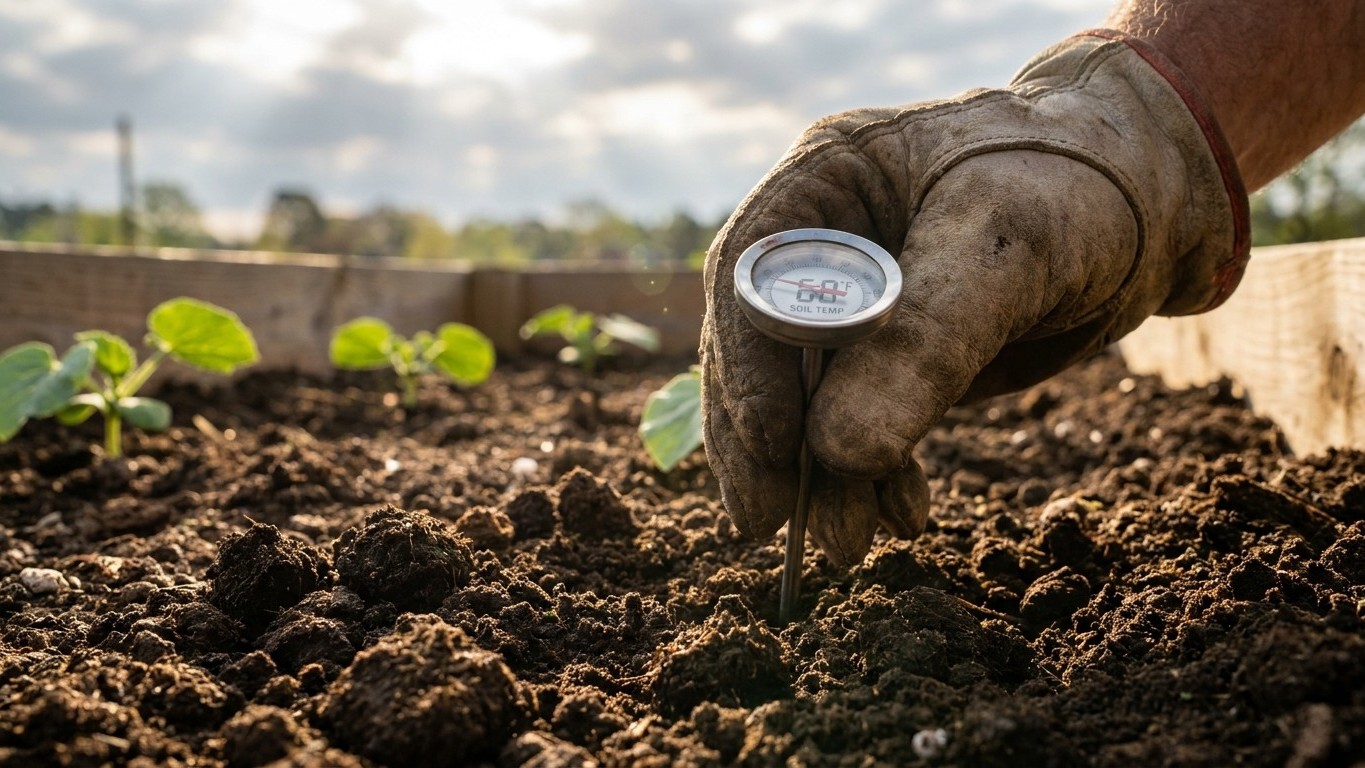

Melons are a marginal, high-effort crop in Newfoundland and Labrador. With a Canadian hardiness zone of 6a at St. John’s and essentially no days above 90°F, the climate offers little of the sustained heat melons crave. Growers who succeed do it with black plastic mulch, row cover, and short-season types rather than by picking a lucky sowing date.
When the soil is warm enough in Newfoundland and Labrador
The average last spring frost at ST JOHN’S A is May 30, according to Environment and Climate Change Canada’s 1981-2010 Climate Normals. That date gets treated like a starting gun by a lot of gardeners, and that’s the mistake. Melon seed germinates poorly in cold ground, and the soil itself takes longer to warm than the air does. Frost date tells you when the risk of a killing freeze drops off. It doesn’t tell you when the dirt six inches down is warm enough for a melon root to do anything useful.
There’s a second problem with that May 30 figure: it’s a mean, not a guarantee. In roughly half the years on record, frost arrived after that date at the reference station. Treat it as the midpoint of a window, not a green light. A gardener who plants melons outdoors on May 31 in a year running late is gambling on a coin flip.
The practical answer is to stop watching the calendar and start watching the soil. Warming it artificially, with black plastic laid down two to three weeks ahead of transplanting, or with a cold frame or low tunnel over the bed, does more for a melon crop here than any date on a seed packet. This matters more in Newfoundland and Labrador than in most of the melon-growing world, because the province sits in Canadian hardiness zone 6a at St. John’s, a rating built from seven climate variables and not comparable to the single-variable USDA system used elsewhere on this site. That zone number is specific to the reference city, too. A garden further inland, at higher elevation, or along a colder stretch of coast runs behind it, sometimes by weeks.
What this means for timing: start seed indoors, don’t direct-sow. Transplants raised inside for four to six weeks give the plant a head start the outdoor season won’t. Move them out only once night temperatures hold reasonably above the danger zone and the covered soil feels warm to the hand, not by the date on a calendar. Skip pesticide product recommendations here; the practice that matters most before planting is warming and drying the bed, not spraying it. For the varieties that have actually been trialled in Newfoundland and Labrador conditions, the province’s own agriculture office is the source to check, not a generic seed catalog.
How long the season lasts here
Subtract the two ST JOHN’S A normals and the frost-free window at the reference station runs about 140 days, from an average May 30 last spring frost to an average October 17 first fall frost. On paper, that’s not a short season by Canadian standards. In practice, for a heat-loving crop like melon, the number that matters isn’t the count of frost-free days. It’s how many of those days carry enough warmth to push a fruit from flower to ripeness, and in a zone 6a coastal climate with essentially no days above 90°F, a lot of those 140 days are milder than melons would prefer.
That changes the math on succession sowing. In warmer melon Territories, a long frost-free window means a gardener can put in a second planting a few weeks after the first, insuring against a bad early stretch or stretching the harvest later into the season. Here, the honest answer is different: the 140-day window is generally the one shot, not the first of two. A second sowing in July would be racing an October 17 frost with a plant that needs sustained summer heat to finish, and in a climate that rarely delivers extreme heat, that’s a race it’s likely to lose. Readers weighing a second sowing anyway, or gardening in a milder microclimate within the province, should work through the site’s succession sowing guide before committing bed space to it.
The 140-day figure also settles the transplant question. Because the season doesn’t have room to spare, starting seed indoors and setting out strong transplants is worth the extra step and the root-disturbance risk it carries. Direct-sowing outdoors, waiting on soil to warm naturally, uses up growing days the province’s climate doesn’t have to give away. Handle the transplant gently, since melon roots dislike disturbance, but the alternative, losing two or three weeks to slow outdoor germination, costs more in a short season than a careful transplanting job does.
Heat and water in Newfoundland and Labrador
The reference station at St. John’s records a mean of 0.0 days a year at or above 90°F. That’s not a rounding of a small number. It’s a flat zero, and it’s the single most decisive fact for melon-growing in this province. Melons don’t ripen on day count alone, they ripen on accumulated heat, and a climate that never delivers a genuinely hot day is one where sugar development and fruit sizing both run slow and uncertain regardless of how carefully the calendar is followed.
Pair that with summer rainfall, and the picture gets clearer. St. John’s averages about 11.4 inches of rain across June, July, and August combined, with July running driest at 3.61 inches, June at 3.84, and August at 3.94. That’s a genuinely wet summer by melon standards, and it arrives without the heat load that would normally help dry the ground back out between rains. This is the opposite problem from the one melon growers face in hot, dry territories, where irrigation decides fruit size and a dry final fortnight decides sugar content. Here, the risk isn’t drought. It’s the combination of cool temperatures and steady moisture that favors powdery mildew, slow fruit ripening, and rot at the point where a melon touches damp soil.
What a cool, damp summer changes in practice
Growers in this climate get more out of managing airflow and moisture than out of managing irrigation. A few adjustments matter more here than in a hot climate:
- Raise developing fruit off the soil with a board, mulch, or sling, so it isn’t sitting in damp ground during a wet stretch
- Space plants for airflow rather than maximum density, since still, humid air around foliage is what drives mildew
- Water at the base of the plant rather than overhead, to keep leaves drier through the cool, damp months
- Use black plastic mulch to add what heat accumulation the climate itself won’t provide
None of this turns Newfoundland and Labrador into a hot-climate melon territory. It just means the leverage points are different: less about supplying water, more about managing the excess of it, and about squeezing extra warmth into a bed that will rarely see a genuinely hot day.
Which melons suit Newfoundland and Labrador
Given a short effective heat season, zero days above 90°F, and a wet summer, the honest guidance here is about type, not variety name. Melon types bred for the earliest maturity, generally smaller-fruited types developed for short, cool growing seasons, are the ones with a realistic shot at ripening before the October 17 average first fall frost. Larger, longer-season melon types built for sustained heat are a poor match for this climate regardless of how well they’re cared for; there simply isn’t enough accumulated warmth in a typical St. John’s summer to finish them reliably.
Disease resistance should sit ahead of flavor claims when choosing what to grow, because the summer rainfall figures above make mildew pressure a near-certainty in a wet year, not an occasional risk. A type bred for resistance to powdery mildew has a real advantage in this specific climate, one that matters more here than it would in a drier melon-growing region.
This page won’t name a specific cultivar, and that’s a deliberate choice rather than an oversight. Seed catalogs change their offerings yearly, breeding programs update their trial results, and a variety that performed well in one province’s trial plots five years ago may not be the current recommendation. What does hold steady is where to find the answer that actually applies to a specific garden: Newfoundland and Labrador’s provincial agriculture office tracks which melon types and varieties have actually been trialled under the province’s own conditions, and that local trial data is worth more than any cultivar name a general gardening page could offer. A variety recommended for a Vermont zone 5a garden or an Ontario greenhouse trial isn’t the same recommendation as one tested on the Avalon Peninsula.
The short version for this territory: pick the earliest type available, favor smaller fruit over larger, prioritize mildew resistance, and warm the soil artificially before anything else. Then check the province’s own trial recommendations for the specific variety within that type.