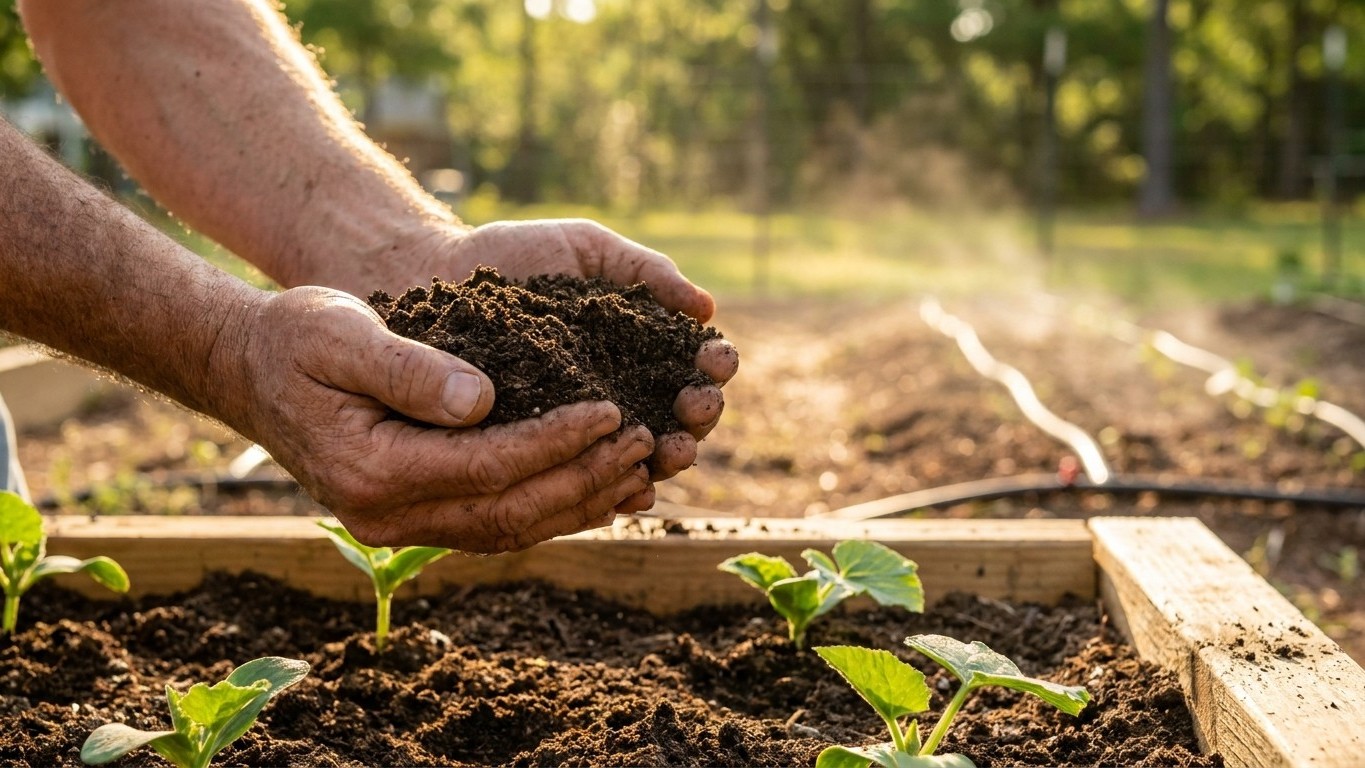

Alaska doesn’t give summer squash much room for error. Around Anchorage, the soil rarely holds enough warmth to set out plants before mid-May, and the growing window slams shut by late September. Roughly 143 frost-free days is what the calendar allows. Success here comes from manufacturing heat the ground won’t provide on its own, not from picking a “hardy” variety and hoping.
When the soil is warm enough in Alaska
The question every Alaska gardener asks is “when,” and the honest answer starts with a range, not a single date. NOAA’s 1991-2020 Climate Normals put the last spring frost at the Anchorage reference station (USW00026451) somewhere between May 3 and May 12, based on the 30-70% probability band for a 32°F freeze. That’s a real, sourced window, not a guess rounded to a tidy date.
But frost date and planting date aren’t the same thing, and treating them as interchangeable is where a lot of squash starts fail. A frost date only tells you when the air stops reliably dropping to freezing. Summer squash doesn’t care about air temperature at 2 a.m.; it cares about soil temperature at root depth, and soil lags behind air by weeks in a climate this far north. Cold soil rots seed before it germinates and stalls transplants even if they survive. So the frost window is a floor, not a green light.
Also worth saying once: a frost date is a probability, built from thirty years of history at one station, not a promise for this particular June. Treat May 12 as “usually safe,” not “guaranteed.”
What actually gets soil warm enough in this climate is deliberate intervention. Alaska gardeners lean on a handful of practices to push soil temperature up before the calendar would do it naturally:
- Black plastic mulch laid two to three weeks ahead of transplanting, to absorb solar radiation and warm the top few inches of soil
- Raised beds, which drain faster and heat up quicker than flat ground because they sit above the cold water table
- Row cover or cloches set over transplants for the first weeks outdoors, trapping daytime heat overnight
- Starting seed indoors under lights three to four weeks before the outdoor set-out date, so the plant is already established when it finally goes into the ground
None of this changes the frost date itself. It changes how soon after that date a gardener can reasonably transplant without losing the crop to chilled roots. For exact varieties suited to the Interior versus coastal Alaska, the University of Alaska Fairbanks Cooperative Extension Service keeps trial data specific to the state’s growing regions, which is a better source than any general guide can be.
How long the season lasts here
Subtracting the two NOAA-sourced dates gives the real shape of the season. Using the earliest edge of each window (last frost May 3, first fall frost October 1), the frost-free stretch runs about 151 days. Using the later edges of each range (last frost May 12, first fall frost September 22), it shrinks to roughly 133 days. That spread lines up with the roughly 143-day average NOAA cites for the station, and it’s a fair range to plan around rather than a single number to bank on.
A season in that range changes the math on almost every decision that follows. In warmer growing zones, a 150-plus-day frost-free stretch is long enough to sow squash twice, pulling an early planting in June and a second one in July to stretch the harvest into fall. Alaska’s window doesn’t leave that kind of slack. Whether the season lands closer to 133 days or 151 days, there generally isn’t enough time after the first sowing matures to start a second round and still finish before the September or early October frost closes things out. The first planting is, in practice, the only planting most years.
That reality also settles a debate that comes up in every squash guide: is it worth transplanting, given that squash roots dislike disturbance? In a longer-season climate, many gardeners direct-sow to avoid the risk entirely. In Alaska, the math flips. Losing two or three weeks to direct-sowing from cold soil, when the entire season might only be 133 days, is a bigger risk than the root check involved in transplanting. Starting seed indoors in biodegradable or peat pots, so the root ball goes into the ground with minimal handling, is the compromise most Alaska growers land on.
For gardeners in longer-season territories where a second sowing is realistic, the site’s succession sowing guide covers how to time a follow-up planting. In Alaska, that guide is less about staggering harvests and more about understanding why the option isn’t really on the table here.
Heat and water in Alaska
Here’s where Alaska’s growing conditions diverge sharply from most of the country, and where a generic squash guide gives the wrong advice. NOAA’s Climate Normals put the average number of days at or above 90°F at the Anchorage reference station at 0.0 per year. Not a handful, not a rare spike. Effectively zero.
That number matters because heat is what usually limits summer squash elsewhere. Squash pollen loses viability fast once temperatures push into the high 90s, which is why growers in hot climates worry about poor fruit set and irrigate aggressively to keep the plant’s oversized leaves from losing water faster than a shallow root system can replace it. None of that applies here. With essentially no days above 90°F, Alaska squash isn’t fighting heat stress or pollen failure. It’s fighting the opposite problem.
Cool, damp summers bring their own trouble: powdery mildew, slow fruit ripening, and rot in fruit sitting on wet soil. Summer rainfall at the same reference station averages about 5.8 inches across June, July, and August, distributed unevenly through the season:
| Month | Average rainfall |
|---|---|
| June | 1.02 inches |
| July | 1.82 inches |
| August | 2.93 inches |
June’s dryness lines up with the critical transplant and establishment period, which is a small mercy since cold, wet soil right after transplanting is one of the fastest ways to lose young squash plants. August’s wetter pattern, arriving as the plants are large and leafy, is when mildew risk climbs. Good airflow between plants, watering at soil level instead of overhead, and avoiding overcrowded rows matter more here than any irrigation schedule. These are 1991-2020 normals for one station, not a promise for a particular July; a rain gauge on the actual garden bed is what tells a grower whether that week needs supplemental water or not, especially since soil type (sandy versus clay) changes how long that rain actually sticks around.
Which summer squash suit Alaska
Three things from this climate should drive the choice of squash type, and none of them point toward a specific brand-name variety. The short frost-free window (roughly 133 to 151 days) favors the earliest-maturing types within the summer squash category, since anything bred for a long, slow season risks running out of daylight before frost. The near-total absence of 90°F-plus days means heat-tolerance and shade-at-the-root traits, which matter enormously in hotter states, are close to irrelevant here. And the cool, humid summer pattern, especially August’s wetter stretch, makes resistance to powdery mildew and other fungal disease the more useful trait to prioritize over yield claims or fruit size.
What this page won’t do is hand over a cultivar name. That’s not caution for its own sake. Variety performance is tested locally for a reason: a type that thrives in a Fairbanks trial plot may behave differently on the coast near Juneau, and Alaska’s own hardiness range (1a to 8a under the USDA Plant Hardiness Zone Map, built from 1991-2020 extreme minimum temperatures) spans a wider swing than almost any other state. Anchorage sits at the milder end of that range; the Interior and points north do not, and a variety recommendation calibrated to one is close to useless for the other.
The trial data that actually answers “which variety” lives with the people running the trials. The UAF Cooperative Extension Service tests summer squash types against Alaska’s actual conditions, region by region, and publishes current recommendations tied to specific growing areas rather than the state as a whole. That’s the only recommendation with real weight behind it, because it’s tested on the ground it’s meant for, not extrapolated from a national average that doesn’t include a single day over 90°F.
The broader takeaway holds regardless of which type ends up in the ground: Alaska’s squash challenge isn’t heat management, it’s compressing an entire crop cycle into a season that’s short even by Northern standards, then keeping that crop dry enough, in a wet August, to avoid losing it to mildew before the first fall frost arrives.