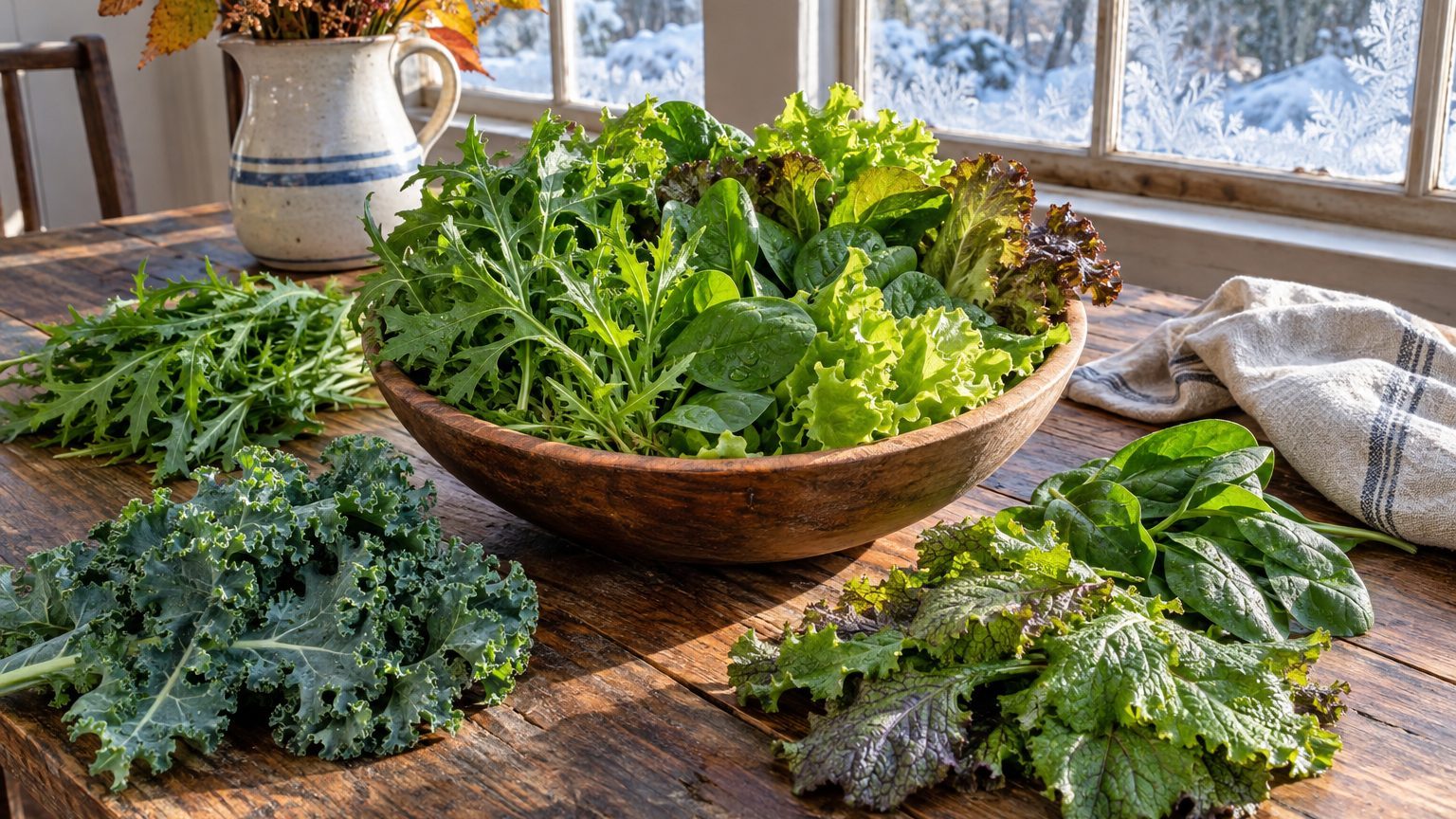

The best winter salads for Alaska are fast, frost-tolerant leaves: spinach, mizuna, arugula, mâche, claytonia and tender young kale. Slow heading types lose the race against the calendar. Anchorage, one of the mildest inhabited corners of the state, gets about 143 frost-free days, and most of Alaska gets fewer. Choose for speed and cold tolerance first, flavor second, and plan on fall harvests or covered beds rather than January pickings from open ground.
The short answer for Alaska
Start with the numbers for Anchorage, the reference station for this page. In NOAA’s 1991-2020 Climate Normals, the 30-70% band for a 32°F freeze runs May 3 to May 12 in spring and September 22 to October 1 in fall (NOAA NCEI station data). Those are not guaranteed last and first frosts. They mark the stretch of dates over which the odds of a 32°F freeze run between 30 and 70 percent. A freeze can still arrive outside that window, and in a given year it often does.
What does that leave a salad grower? A fall that begins early, a spring that starts late, and a summer that is unusually bright. The long daylight partly makes up for the short season, which is why quick leaf crops can finish in an Alaska summer at all. It also works against you in one case. Spinach and arugula sown into the longest days of the year tend to bolt, so the better plan is to sow them later, for fall, instead of racing the solstice.
Sorted by type, the decision looks like this:
| Type | Examples | Fit for Alaska |
|---|---|---|
| Fast, frost-hardy leaves | Spinach, mizuna, arugula, tatsoi | Best bet. Late sowings can be picked as baby leaves into fall. |
| Cold-built rosettes | Mâche, claytonia | Strong choice for cold frames and covered beds. They tolerate chill better than they grow in it. |
| Hardy brassica leaves | Kale, collards | Reliable. Cut as baby leaves for salad, not grown to full size. |
| Loose-leaf lettuce | Cutting and leaf types | Good in summer and early fall. Less frost-tolerant than the hardy greens above. |
| Slow heading chicories | Radicchio, witloof endive | Risky. They need more season than most of the state offers. |
This page does not have a verified sowing date for each type, so for timing, use When to Sow Winter Salads in Alaska. For the wider picture of how these crops fit into a cold-climate garden, see Winter Salads for Alaska Gardens.
What will not work here
Slow crops come first. A 143-day frost-free season sounds workable until you subtract the weeks at each end when soil is cold and growth is crawling. Heading radicchio and witloof endive want a long, steady run, and in Alaska the fall freeze band of September 22 to October 1 arrives before they finish. You can grow them. You will mostly harvest disappointment.
Open-ground midwinter harvests are the second failure. The mean daily minimum of the coldest month in Anchorage is 11.0°F. That is an average of the lows, so plenty of nights run colder. Hardy greens may survive in the ground under snow or cover, but surviving is not growing. Daylight in midwinter is too short for plants to add new leaf, so what you pick in December is what finished growing in October. An unprotected bed is a pantry, not a garden.
Third, calendars written for milder states mislead. Advice like “sow in late summer for winter salads” assumes autumn weeks that Alaska does not have. Following it can mean seedlings that are barely two leaves tall when the freeze band arrives. Those seedlings do not stand in the cold the way established plants do.
The Anchorage dates also fail when exported. The facts behind this page state plainly that the Interior and the north have far fewer frost-free days than Anchorage. A grower in Fairbanks or farther north who borrows the September 22 to October 1 window will be planting into a season that has already ended. Treat the Anchorage numbers as a best case for the populated parts of the state.
Last, spring sowings of bolt-prone greens. Spinach started in June, in the longest days, runs to seed before it makes a useful salad. Sow it early in spring for a first picking, then again in late summer. Skip the middle.
What changes across Alaska
There is no single answer for Alaska. The USDA Plant Hardiness Zone Map (2023, built on 1991-2020 normals) runs from zone 1a to zone 8a across the state. That is seven full zones, the kind of spread you would normally find across half the country. The system rests on one variable only, the average annual extreme minimum temperature, so it says how cold the worst night gets, not how long the growing season lasts or how bright the summer is.
That is why this page cites Anchorage when it gives dates, with a coldest-month mean daily minimum of 11.0°F. Other parts of Alaska differ, sometimes sharply. Look up your own zone on the USDA map yourself instead of assuming one from a neighbor’s advice or from this page.
For a reader in the north or the Interior, the shift is toward speed and protection. Choose the fastest crops from the table (mizuna, tatsoi, baby spinach), expect a shorter window than the Anchorage dates imply, and plan on a cover for both ends of the season. The slow and risky entries, the chicories especially, drop off the list entirely.
Altitude does something similar, and so does terrain. Cold air drains downhill and pools in low spots, so a hollow can freeze while a slope nearby does not. A garden on a hillside may get a few more forgiving nights than one at the valley bottom, though only your own records will tell you by how much. Coastal and milder locations may stretch the season, but this page does not have verified figures for them, so it will not guess.
Where to check this for your own county
A county recommendation beats a state one, and this page is the state one. Alaska is organized into boroughs and census areas rather than counties, so look for your local district office. The University of Alaska Fairbanks Cooperative Extension Service is the state’s land-grant extension service and the right starting point.
When you get there, look for two things. The first is a local planting calendar. Dates tuned to your area account for local frost patterns and the length of the season, which no statewide page can do. The second is a list of varieties that have been trialed where you live. A trial tells you which cultivars actually finished, held up in cold, and resisted bolting under local conditions, and that is far better evidence than a seed catalog description.
If you cannot find a published calendar for your area, call or email the nearest office. Extension staff field these questions constantly, and they often know which plantings failed locally last year. This page has no county-level calendar to offer, and it will not borrow one from another state. Calendars from other states’ extension services are written for other climates and other species, so they are no substitute.
Checking this against your own garden
Your own observations outrank every date on this page. Three are worth tracking.
- Soil warmth by feel. Push your bare hand into the bed in spring. If it still feels cold and heavy, wait before sowing. In fall, the same test tells you when the soil is cooling too fast for seedlings to establish. Compare a south-facing bed with a shaded one and you have mapped your microclimate for free.
- The first flush of male flowers. Willow catkins loosening and shedding pollen is a long-used local signal that spring has really turned. It is no replacement for a calendar, but if it comes ten days earlier along your fence line than in the open yard, you have learned which spot warms first.
- The first true leaves. Seedlings show cotyledons first, then true leaves. If your test sowing takes weeks to reach that stage, your bed is cold or shaded, and your late sowings need more cover or an earlier start.
Write down the date for each, year after year. After three seasons your notes will be a better calendar than anything printed.
Common questions
Can I harvest salad greens outdoors in Alaska in midwinter?
Generally not from open ground. The coldest month in Anchorage has a mean daily minimum of 11.0°F, and midwinter light is too weak for plants to grow. Hardy greens can hold what they already grew, and covers help, but fresh growth stops.
Which type of winter salad is the safest choice?
Fast, frost-hardy leaves such as spinach, mizuna and arugula, plus kale cut as baby leaves. Mâche and claytonia suit cold frames and covered beds. Slow chicories are the riskiest.
Do the Anchorage frost dates apply to the rest of Alaska?
No. The Anchorage window is May 3 to May 12 in spring and September 22 to October 1 in fall, based on the 30-70% band for a 32°F freeze. The Interior and the north have far fewer frost-free days, so treat the Anchorage dates as a best case.
What does the 143-day figure mean?
It is the approximate number of frost-free days in Anchorage. It describes the typical stretch between freezes, not a promise for any single year, and it is longer than what most of the state sees.