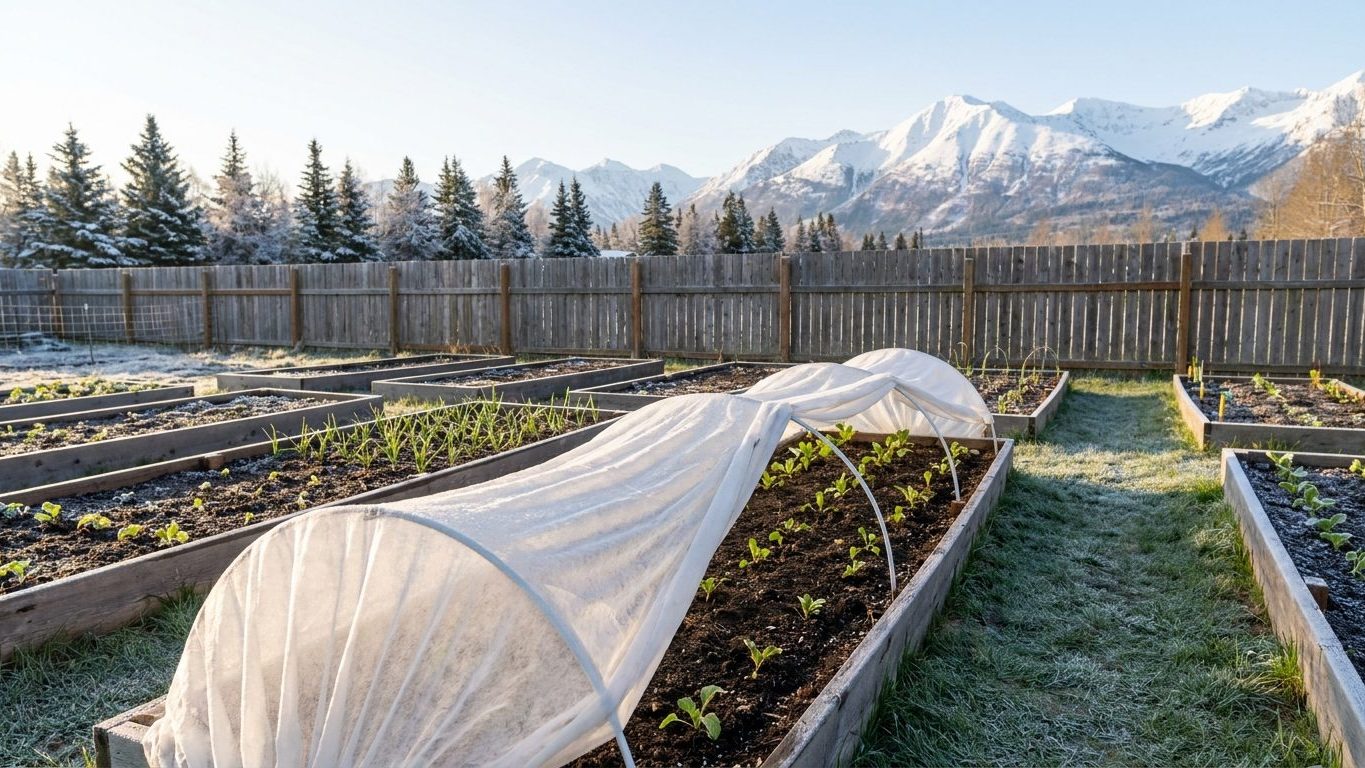

Cover tender plants in Alberta on any night the forecast low nears 0 °C (32 °F). Keep the covers within reach from roughly two weeks before May 21 until roughly two weeks after it, then again from late August on. May 21 and September 16 are Calgary averages, and averages are midpoints. In half of all years the frost lands on the wrong side of them.
The short answer for Alberta
The dates come from Environment and Climate Change Canada’s 1981-2010 climate normals for the Calgary International Airport station. On average, the last spring frost falls on May 21 and the first fall frost on September 16. Each one is a mean date, not a probability band and certainly not a safe date. In one year out of two, the spring frost arrives later than May 21. In one year out of two, the fall frost arrives earlier than September 16.
Between those two dates sits a frost-free stretch of a little under four months. That is the whole growing season for anything you plant outdoors without protection. It is also why covers matter more here than in most of the lower 48, where the same fabric might be a bonus rather than a lifeline. The Extending the Growing Season in Alberta guide covers the full toolkit. This page deals only with timing.
In practice, timing splits by crop. Tender plants (tomatoes, squash, cucumbers, beans, basil) die or stall hard with frost. Cool-season crops (peas, spinach, kale, lettuce) shrug off a light one. So you cover according to what is in the bed, not according to the calendar alone.
| Crop group | Spring | Fall |
|---|---|---|
| Tender (tomato, squash, cucumber, bean) | Plant around or after May 21 with covers ready. Cover on any night near 0 °C (32 °F). | Cover from late August. Pull covers off in the morning. |
| Cool-season (pea, spinach, kale, lettuce) | Sow early. Cover only for hard freezes. | Often fine past the first light frost. Cover for hard freezes. |
Watch the forecast rather than the date. A clear, still night with a dry air mass is the classic frost setup, because heat escapes straight upward. Cloud cover and wind usually spare you. Cover in late afternoon while the soil still holds the day’s warmth, and the fabric traps some of it overnight.
One more caution on the numbers. Canadian normals run 1981-2010, while the US figures elsewhere on this site run 1991-2020. The two sets are not measured on the same scale, so avoid lining Calgary’s dates up against a Montana or Washington town.
What will not work here
Planting tomatoes on May 21 and assuming you are done with frost fails about half the time. The date is a midpoint. Treat it as the middle of a window that runs weeks either side, and keep a cover within arm’s reach until well past it.
The slowest varieties fail for a different reason. With a little under four months between the two mean frost dates, a long-maturing tomato or a big winter squash can run out of season before the fruit ripens. A cover buys days, perhaps a couple of weeks at the margins. It does not add the months a long-season plant wants. The sensible move is to choose faster varieties and use covers to protect them, not to rescue a plant whose maturity date was never going to fit. Which fabrics, tunnels and cloches earn their keep is covered in Which Season Extenders Work in Alberta.
Thin fabric also fails against a hard freeze. Lightweight row cover handles a light frost, but it will not carry a tender plant through a night that drops well below freezing. Winter is a bigger test. The mean daily minimum of Calgary’s coldest month is -13.2 °C (8.2 °F), and no season-extension fabric turns a bed into a winter shelter for tender perennials. Mulch and plant selection do that job.
Plastic left on in sun is a quieter way to lose plants. A closed tunnel on a bright spring afternoon heats quickly, and tomato and squash seedlings can cook under it even when the morning started near freezing. Vent or pull the cover once the day warms. Plant tags are another trap. Many are printed with USDA zones, and Canada’s system does not convert to them. Natural Resources Canada says Canadian zone 4a overlaps nine USDA zones, from 3a to 7a. A tag that says “zone 5” tells an Alberta gardener very little.
A last failure is borrowing one station for the whole province. Calgary’s dates describe Calgary’s airport. They are a starting point, not a promise for a garden two hours north or a few hundred feet higher.
What changes across Alberta
Calgary sits in Canadian hardiness zone 4a, according to Natural Resources Canada’s 1991-2020 normals. That is the zone of the reference city, not of the province. Alberta stretches across a large range of latitude and elevation, so there is no single answer for it. This page has the Calgary figure and does not have the full spread, so it will not guess at one.
Latitude explains part of the shift. Calgary sits at 51.11 degrees north. A reader well north of that has a shorter frost-free window and a faster swing in day length, and day length, not warmth, tells an onion when to stop making leaves and start making a bulb. Gardeners near the edge of the territory should look up their own latitude instead of leaning on Calgary’s.
Northern and upland gardens run weeks behind the Calgary station. If that is you, shift the whole calendar. Hold tender plants back longer in spring than May 21 suggests. Have covers on the beds earlier in late summer than September 16 suggests. Favor the fastest varieties you can find, because you start with less season to spare.
Your own zone is a lookup, not a guess from this page. Natural Resources Canada’s Plant Hardiness Zone by Municipality tool lets you search by municipality. The zone is a climate summary built from seven variables, so use it for plant selection and perennials, not as a frost-date calculator.
Where to check this for your own county
A recommendation written for your county beats one written for the province, and this page is the provincial one. Worse, it leans on a single airport station. For anything you are about to plant, the better source is the provincial agriculture department, Alberta Agriculture and Irrigation.
Two things are worth looking for there. The first is a local planting calendar, ideally one tied to your region and not a province-wide average. The second is the list of varieties trialled near you, because a variety that ripened reliably in one part of Alberta can stall in another with a different frost window. If the site does not have a calendar for your area, that is a good question to put to a local agricultural office or a garden club that has kept records for years.
One caution about the numbers you find. Frost dates published by different sources may come from different years and different stations. Check which station and which normals period a calendar uses before you set it next to the Calgary dates here. A calendar built on 1991-2020 data and one built on 1981-2010 data are not directly comparable.
Checking this against your own garden
Your own beds outrank every date on this page. Three observations are free, need no instrument, and tell you more than the airport station can.
The first is soil warmth by feel. Push your fingers a couple of inches into the bed on a spring morning. If the soil feels cold and damp, seeds of tender crops will sit and rot. A bed against a south-facing wall will feel warmer than one in the open, and that gap tells you how much earlier you can safely plant there.
The second is the first flush of male flowers on squash and cucumbers. Male blooms open before female ones, so their arrival marks real growth, not just survival. If they come late, your garden is running behind, and your fall cover dates should move up accordingly.
The third is the first true leaves on seedlings. The first pair to emerge are seed leaves. The leaves that follow, with the plant’s recognizable shape, mean the plant is rooted and growing. Compare a seedling in a sheltered spot with one in an exposed corner. If one gets its true leaves a week sooner, you have mapped your warm and cold zones without buying a thermometer.
Write the dates down each year. A few seasons of notes about when frost last touched the beds and when it first returned will tell you more about your lot than any published average.
Common questions
Is May 21 a safe date to plant tender crops outside in Alberta?
No. May 21 is the Calgary mean last spring frost, which means the frost falls later than that in one year out of two. Plant with covers ready and check the forecast.
Do I need to cover plants for every fall frost?
Not for every plant. Tender crops need covering for the first frost. Cool-season crops such as spinach, kale and peas tolerate light frost, so save the covers for hard freezes.
Can I use USDA zone information for an Alberta garden?
Not reliably. Canada uses its own hardiness system, built on seven climate variables, and Natural Resources Canada says zone 4a overlaps nine USDA zones, from 3a to 7a. Look up your Canadian zone and use Canadian guidance.
When should I put covers on and take them off?
Put them on in late afternoon, while the soil still holds the day’s warmth. Take them off the next morning once the frost has melted and the air has warmed, so plants do not overheat under fabric or plastic in the sun.