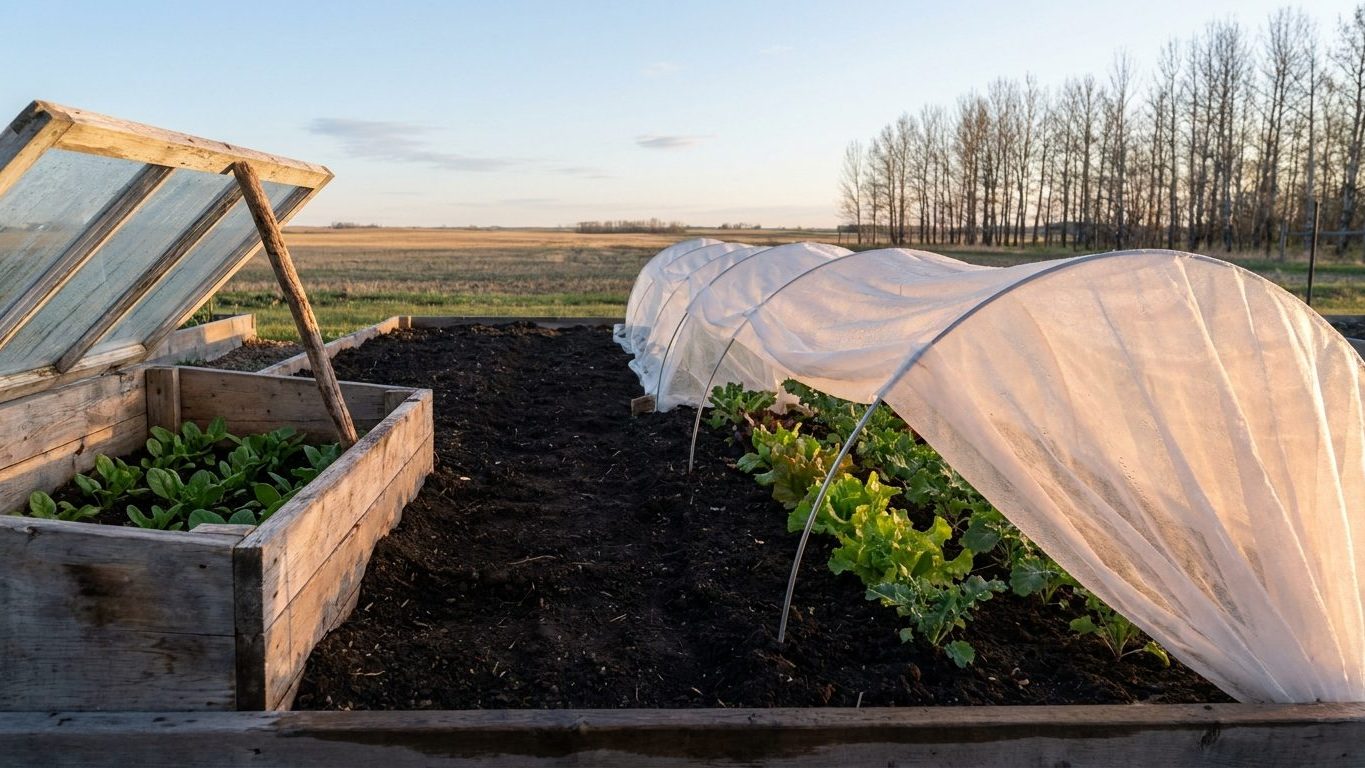

In Alberta, the extenders that earn their keep are the cheap ones: floating row cover, low tunnels over beds, and a cold frame for hardy greens. Greenhouses and tall plastic tunnels pay off mainly for heat lovers like tomatoes. The numbers explain why. At the Calgary airport station, the mean last spring frost is May 21 and the mean first fall frost is September 16, so every extra week is hard-won.
The short answer for Alberta
Why cover beats the calendar
Start with fabric. Lightweight floating row cover, laid straight on a bed or draped over hoops, holds off a light frost on the nights that matter. It lets you set out hardy crops ahead of the average date and keep them going past the fall one. A cold frame does the same job for lettuce, spinach and other cold-tolerant greens, with a lid you can open on warm afternoons.
Those dates come from Environment and Climate Change Canada’s 1981-2010 climate normals for the Calgary International Airport station. They are averages, not guarantees. In one spring out of two, the last frost lands after May 21. In one fall out of two, the first frost arrives before September 16. By simple arithmetic, the two mean dates sit roughly 17 weeks apart, and that is the frost-free stretch you are trying to stretch.
An extender does not move those dates. It changes how much frost a crop can sit through, so you plant inside the risky edges of the window instead of waiting for it to end. Timing the cover matters as much as the cover itself, and When to Cover Your Garden in Alberta covers that side. The wider picture is in Extending the Growing Season in Alberta.
Matching the extender to the job
| Extender | Best use | Main limit in Alberta |
|---|---|---|
| Floating row cover | Frost nights in spring and fall, hardy vegetables | Light fabric lifts in wind unless pinned down |
| Low tunnel (hoops plus fabric or plastic) | Whole beds of greens, brassicas, early carrots | Needs venting on sunny days |
| Cold frame | Seedling hardening, late greens | Holds crops in deep winter, does not grow them |
| Individual plant protectors | Tomatoes and peppers set out early | Protects one plant at a time, and a hard frost can still win |
| Greenhouse or tall tunnel | Heat lovers that need a longer warm stretch | Highest cost, and it must withstand wind and hail |
What will not work here
Trusting the average date
Setting tomatoes out bare on May 21 is a coin flip, because that date is the midpoint of the frost window. Half of all springs bring a frost later. Even a thin sheet of fabric can lose to a hard late freeze, so a spring cover has to match what the forecast is actually threatening.
Slow crops are the second casualty. With roughly 17 weeks between the two mean frost dates, anything that wants a long, hot season (melons, sweet potatoes, long-maturity peppers) is fighting the calendar. A cover adds some warmth but cannot add the heat days a short season lacks. In this climate, days to maturity on the seed packet matter more than any extender.
Wind, heat and deep winter
Calgary-area gardeners deal with wind, and with chinooks, the warm winds that can swing temperatures fast in either direction. Loose fabric blows off and plastic can act like a sail, so hoops need anchoring, and edges need soil, boards or sandbags. Close a clear plastic tunnel on a sunny spring day without venting it, and seedlings can cook by noon while nights still drop below freezing.
Winter is where hopes of year-round harvest run into hard numbers. The mean daily minimum of the coldest month is -13.2 °C (8.2 °F), and that is an average night, not the worst one. Cold snaps go lower. Add latitude: the Calgary station sits at 51.11 degrees north, so midwinter days are short, and plants in an unheated frame mostly pause rather than grow. A frame can store mature hardy crops for a while. It will not start new ones in January.
A single layer will not carry tender perennials through either. If a plant is marginal in Canadian hardiness zone 4a, a bit of fabric changes little.
What changes across Alberta
Calgary’s Canadian hardiness zone is 4a, according to Natural Resources Canada’s 1991-2020 data. That is the zone of the reference city, not of the whole province. Alberta is a long province with prairie, foothills, mountains and northern forest, and no single answer fits all of it. This page does not have the full spread of zones across Alberta, so it will not invent one.
One caution on the zone itself. The Canadian system is built on seven climate variables, while the USDA system uses one, and NRCan states that there are no simple conversions between them. Canadian zone 4a overlaps nine different USDA zones, from 3a to 7a. So do not read it as a USDA number, and do not compare it with US zones you may see elsewhere.
For a reader north of Calgary, or in upland and higher-elevation districts, the frost dates here run weeks off. The safer shifts are to hold planting back, lean on faster varieties, and treat a low tunnel as standard equipment rather than a bonus. The latitude figure belongs to Calgary only, so near the northern or southern edge of the province, look up your own. Day length, not warmth, controls when onions stop making leaves and start making bulbs, and it changes as you move north.
To see which zone your own municipality falls in, use Natural Resources Canada’s Canada’s Plant Hardiness Site and read it for your town, not a neighbouring city.
Where to check this for your own county
The provincial source is Alberta Agriculture and Irrigation. Look there for two things: a planting calendar written for your part of the province, and any vegetable varieties trialled near you. A variety that thrives in a Calgary-area trial plot says more about your garden than a catalogue promise.
A county or local recommendation beats a provincial one every time, and this page is the provincial one, built on a single Calgary station. The frost figures are also the 1981-2010 Canadian normals, while the hardiness zone uses a newer 1991-2020 period. Two reference periods on one page is a reason to hold the dates loosely.
When local advice and this page disagree, go with the local advice. Local growers have already watched your frost pockets, your wind and your hail season. A call to your municipal office or a nearby garden club is also a legitimate way to find out when people around you start planting.
Checking this against your own garden
Your own observations outrank every date above. Three are worth watching, and none needs equipment.
- Soil warmth by feel. Push your hand a few inches into the bed in the morning. If it still feels cold and clammy, warm-season seed will sit and rot, whatever the calendar says. A bed that warms sooner than your neighbour’s tells you it has sun and shelter.
- The first male flowers on squash. They open before the female ones. When they appear, the plant has found enough warmth to commit, which shows how quickly your site heats up.
- The first true leaves. Seedlings first show two seed leaves, then the true leaves. If true leaves come slowly or the plants stall, the spot is too cold, windy or shaded, and a cover will help there.
Over a season or two, a few scribbled dates beside these three signs become a local calendar more reliable than any normal from the airport.
Common questions
Can I plant tomatoes before May 21 if I use row cover?
You can, but you are taking a risk. May 21 is the mean last frost at the Calgary station, so frost comes later in about half of years. Row cover helps against a light frost, not a hard one. Watch the forecast, keep the fabric ready, and treat an early planting as a gamble.
Will a cold frame let me harvest all winter?
It will hold mature, cold-hardy crops for a while, but it will not grow much in the depths of winter. Days are short at around 51 degrees north, and the mean coldest-month minimum is -13.2 °C. Plan the frame for late fall and early spring.
Is Alberta’s zone 4a the same as USDA zone 4a?
No. The Canadian zone uses seven climate variables, and NRCan says there is no simple conversion. Canadian 4a overlaps nine USDA zones, from 3a to 7a.
Do the Calgary frost dates apply across Alberta?
They do not. They come from the Calgary International Airport station. Northern and upland districts run weeks behind, so check local sources for your area.