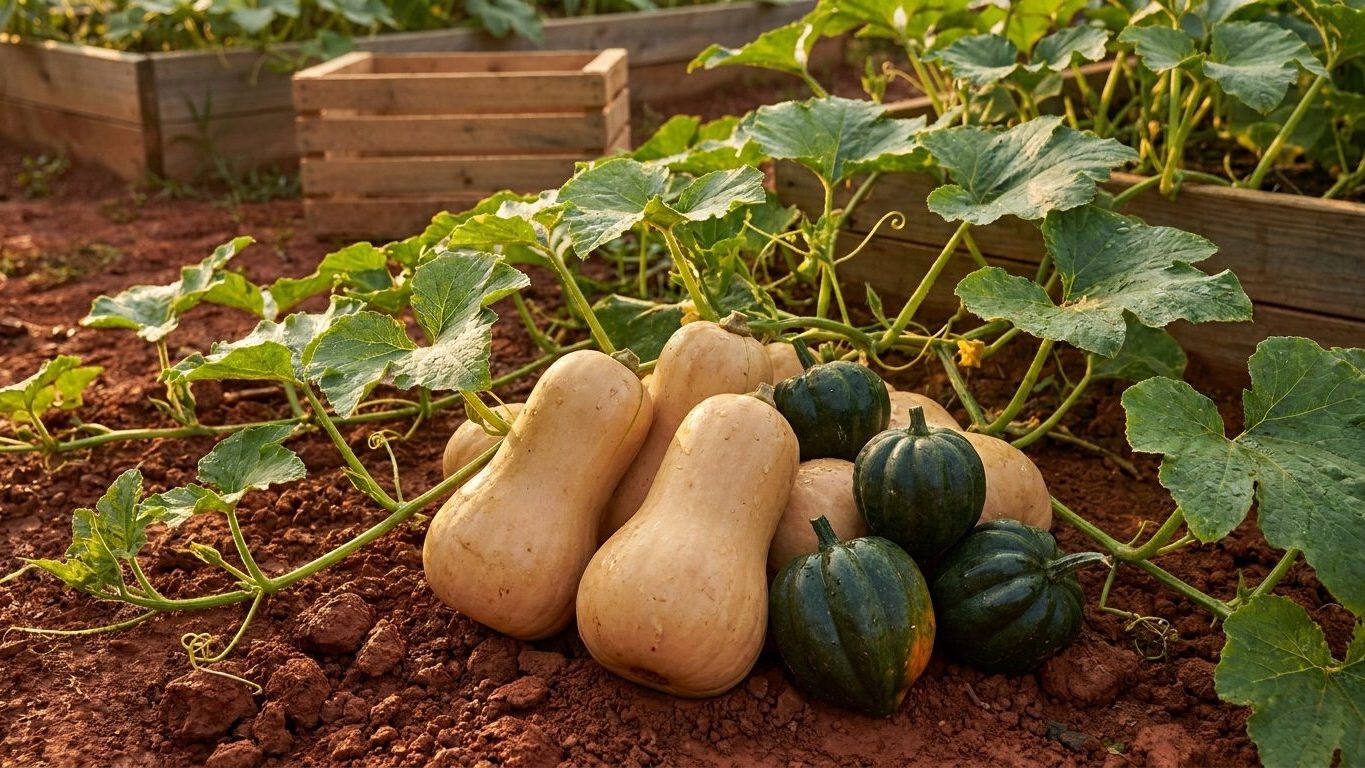

Short-season, cool-tolerant winter squash are the ones that reliably finish in most of Alberta: acorn, delicata, and short-season buttercup or kabocha types. Long-season butternut, hubbard, and big storage pumpkins need more warm days than the province’s climate normals typically deliver, and they’re the varieties most likely to leave you with a vine full of green squash in October.
The short answer for Alberta
Start with the two numbers that decide everything else. At the Calgary Int’l A reference station, the mean last spring frost falls on May 21 and the mean first fall frost on September 16, a frost-free window of roughly 118 days. Layer on top of that a second figure that matters just as much: an average of 0.0 days a year above 90°F. Winter squash doesn’t just need calendar days, it needs heat units to convert sugars and finish the rind. Alberta’s growing window is barely long enough for the fastest varieties, and it comes with essentially no hot-summer push to speed things along.
That combination points the decision toward type, not brand. Seed packet “days to maturity” numbers are usually measured somewhere with real summer heat, so a squash rated at 85 days in a hot-summer trial garden can easily need 100+ effective days here. The safer approach is to pick from the short end of each category and to start transplants indoors rather than direct-seeding on the frost date.
| Squash type | Typical days to maturity | Heat requirement | Fit for Alberta |
|---|---|---|---|
| Acorn | 75-80 | Low | Good, direct-seed or transplant |
| Delicata | 80-100 | Moderate | Workable with transplants |
| Short-season buttercup/kabocha | 85-95 | Moderate | Workable, choose bred-for-north cultivars |
| Butternut | 100-120 | High | Risky most years |
| Hubbard | 100-115 | High | Poor fit |
| Large storage pumpkin | 100-120 | High | Poor fit |
Treat May 21 as a midpoint, not a green light. Environment and Climate Change Canada’s own normals mean that in roughly half of all years, frost arrives after that date, so a gardener who plants outdoors exactly on May 21 is gambling on the better half of the odds. Starting seedlings indoors three to four weeks ahead and transplanting once soil has genuinely warmed buys back some of the margin that the short season takes away.
What will not work here
The clearest failure mode is a long-season variety planted on faith. A butternut squash bred for a 110-day, hot-summer garden gets, at best, about 118 frost-free days here, and those days include zero afternoons above 90°F to push sugar development along. The rind may look mature and the color may turn, but the flesh stays watery and the squash won’t store past a few weeks. Hubbard squash runs into the same wall, often worse, since many hubbard cultivars are bred for even longer seasons than butternut.
Large storage pumpkins fail for a related but distinct reason: they need sustained heat late in the season to finish, and Alberta’s first fall frost arrives, on average, September 16, before the heat has ever really shown up to begin with. A pumpkin that’s still vining and setting new fruit in early September in a hot-summer state is simply out of runway here.
Direct-seeding itself is a second failure mode, independent of variety. Squash seed germinates poorly in cool soil, and if a gardener waits for the mean frost date and then direct-seeds, the plant loses two to three weeks compared with a transplant started indoors in April. In a 118-day window, three weeks is close to a fifth of the entire season.
Rainfall doesn’t fail Alberta gardeners the way it might in a drier province, summer rainfall averages about 8.5 inches across June, July and August, with even the driest month, August, still bringing 2.24 inches. Combined with zero days of 90°F-plus heat, evaporation demand stays low. The practical risk this creates is the opposite of drought stress: on heavy clay soil, that moisture sits longer than it would in a hot, high-evaporation climate, and a large-vined variety that needs wide, well-drained spacing can sit in cool, damp soil long enough to invite rot at the crown before it ever sizes up. Choosing a compact-vine, short-season type reduces that exposure simply by finishing faster.
What changes across Alberta
Alberta is not one climate, and the hardiness zone figure makes that explicit. The reference city sits at Canadian zone 4a, but that’s a single point drawn from a system that combines seven climate variables, not the one variable USDA zones use. Natural Resources Canada itself notes there’s no simple conversion between the two systems, and a Canadian 4a rating can overlap anywhere from USDA zone 3a to 7a depending on which of those seven variables is driving the score in a given location. That spread alone should signal that a squash recommendation built around one reference station won’t hold everywhere in the province.
In practice, that means a garden in the Peace Country or at higher elevation in the foothills is very likely working with a shorter effective season than the Calgary-area figures used here, with a later effective last frost and an earlier first fall frost squeezing the window from both ends. A gardener in that kind of location gets more value from the shortest-season acorn types, and more benefit from starting seedlings indoors even earlier relative to the mean date.
Southern Alberta’s chinook-influenced areas can run milder in early spring, which sometimes stretches the practical planting window a little wider than the provincial reference suggests, but chinooks are unpredictable enough, with their sharp swings back to cold, that they shouldn’t be treated as a guaranteed extension of the season.
This page can’t tell an individual reader which zone their own yard falls into, that requires checking the actual map for their specific location, not reading it off a provincial average. Natural Resources Canada’s plant hardiness site lets a reader enter their location directly and see where they land within that 3a-to-7a spread.
Where to check this for your own county
Alberta’s provincial agriculture ministry is the right next stop for anything more local than this page can offer: alberta.ca/agriculture-and-irrigation. This page has worked from a single reference station’s climate normals, useful for a province-wide picture, but not a substitute for regional data.
Two things are worth looking for once there. First, any planting calendar or frost-date guidance broken down by region rather than by the province as a whole; Alberta’s agricultural zones vary enough that a calendar built for the Peace Country will differ meaningfully from one built for the southern irrigation districts. Second, any variety trial results specific to the reader’s own growing region, provincial and regional extension programs sometimes publish which winter squash cultivars actually finished and stored well in local trial plots, which is a far more direct answer than working backward from days-to-maturity numbers on a seed packet.
A local recommendation beats a provincial one every time, for the same reason a provincial one beats a page written for the whole country. This page has answered the question at the scale of Alberta’s reference climate station. A reader’s own agricultural region, and eventually their own county or municipal district, will always have a tighter, more accurate answer, that’s simply where the more precise data lives.
Checking this against your own garden
None of the dates on this page outrank what’s actually happening in a specific plot of soil. Three simple observations tell a gardener more than any provincial normal.
Soil warmth by feel is the first and most direct check. Squash seed wants soil that feels genuinely warm to the touch, not just frost-free, a bed that’s still cool and damp in late May, even after the mean frost date has passed, is telling the gardener to wait, regardless of what the calendar says.
The first flush of male flowers is the second signal. Squash plants typically produce male flowers before female ones, and a strong early flush usually means the plant has settled in and found conditions to its liking. A plant that sits without flowering well past when neighboring gardens are blooming is often sitting in a cooler or shadier microclimate than the reference station reflects.
The first true leaves, appearing after the initial seed leaves, mark the point where the plant has moved from surviving on stored seed energy to actually drawing on the soil and the season. A slow or stunted set of true leaves is often the clearest early warning that a variety was too ambitious for the number of warm days actually on offer this year, useful information for what to plant differently next season, even if it’s too late to fix this one.