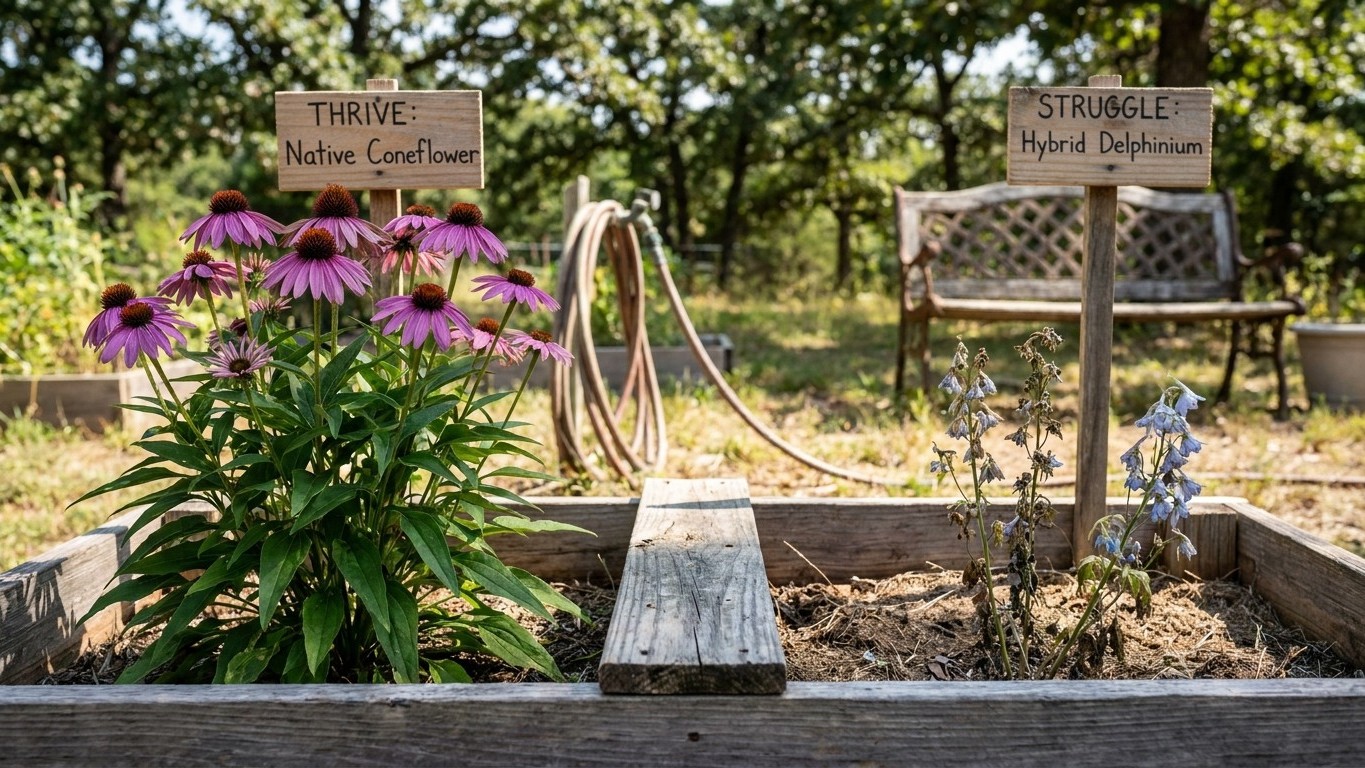

Some flowers will sail through your Arkansas summer and then die anyway that winter, and the fix is picking ones built for both halves of the year, not just the pretty one. Heat and humidity kill more plants here than cold does, so a border that lasts needs tough, waxy-leaved growers like coneflower, black-eyed Susan, salvia, or lantana rather than delicate cool-season bloomers. Before you buy anything, check the hardiness range printed on the plant tag against where your yard actually sits, not just the word “perennial.
What thrives in Arkansas

A flower earns its place in an Arkansas border by surviving three things at once: a wet, muggy summer, a dry spell that can show up with no warning in August, and a winter that swings between mild stretches and hard freezes. NOAA’s 1991-2020 climate normals put Little Rock at 69.2 days a year with a high of 90F or more, which is the real driver of water demand and the reason cool-season annuals like pansies and snapdragons fade fast once June arrives. A flower that thrives here has to shrug off both the heat load and the humidity that comes with it, which is what makes fungal disease, not frost, the bigger killer of the wrong plant in the wrong spot.
Heat and humidity first, cold second
The plant families that handle this combination well share a few traits: tough, often hairy or waxy foliage that resists mildew, root systems that reach for moisture without needing constant watering, and a bloom habit that keeps producing even when nights stay warm. Daylilies, coneflowers, black-eyed Susans, zinnias, salvias and lantana all fit this profile, and all are sold widely at Arkansas nurseries for that reason. Ornamental grasses and sedums add the drought tolerance side of the equation, since both store water and keep producing structure through a dry patch that would flatten a thirstier plant.
Cold hardiness still matters, just less dramatically than in states further north. At a 30.9F average minimum for the coldest month, per NOAA NCEI, Arkansas rarely sees the kind of prolonged deep freeze that kills a marginally hardy perennial outright. The bigger risk is a plant that greens up too early during a mild February stretch and then gets nipped by a late frost. That’s the trait to check on a plant tag before buying: not just the minimum zone, but whether the species breaks dormancy early.
Native plants worth the space
Plants native to the wider central and southern United States have already solved the Arkansas problem: they evolved with this exact combination of humid heat, clay or sandy soil, and a winter that is more freeze-thaw than deep freeze. That history shows up as lower water bills and fewer disease problems once a native is established, usually after its first full year in the ground. It also shows up in the number of pollinators a border attracts, since native bees, butterflies and moths are matched to native bloom shapes and timing in ways that ornamental cultivars often are not.
Good natives for Arkansas borders
- Purple coneflower (Echinacea purpurea): upright, drought-tolerant, blooms most of the summer
- Black-eyed Susan (Rudbeckia hirta): fast to establish, reseeds freely, tolerates poor soil
- Butterfly milkweed (Asclepias tuberosa): the main host plant for monarch caterpillars in this region
- Joe Pye weed (Eutrochium purpureum): tall, moisture-loving, good for a damp back corner
- Wild bergamot (Monarda fistulosa): aromatic foliage, heavy bee traffic when in bloom
None of these need coddling once their roots are down. The trade-off is patience in year one: a native perennial often puts more energy into roots than top growth for the first season, which is why a newly planted coneflower can look thin compared to a container-grown hybrid from the garden center. By year two, that root system is exactly what lets it skip supplemental watering through a dry Arkansas August. Mixing two or three natives into an otherwise ornamental border also spreads bloom time further into fall, since several, including the asters and goldenrods in the same native palette, don’t peak until September or October.
Perennials that come back

At Little Rock’s zone 7b, and across the state’s broader 6b to 8a range per the USDA hardiness map, a solid list of perennials comes back reliably year after year without winter protection: daylilies, garden phlox, peonies, hostas, coreopsis, salvia, and most of the native list above. These are the backbone plants for a border you don’t want to replant every spring.
Reading the zone on a plant tag
The confusion starts with plants that are perennial somewhere, just not here. Lantana, pentas, and mandevilla are all perennial in zones 9 through 11, which covers the Gulf Coast and Florida, but they’re grown strictly as annuals in Arkansas because they can’t survive a winter with a 30.9F average minimum, let alone the occasional hard freeze that comes with it. Read the hardiness range on the tag, not just the word “perennial,” and compare the lower number to your own zone. If the tag says “hardy zones 8-11” and you garden in the 6b pocket of the northern Ozarks, treat it as an annual and budget for replacing it every spring.
The reverse problem shows up too: a handful of species sold as houseplants or short-lived annuals elsewhere are fully hardy perennials in Arkansas, because the state’s mild winter minimum lets their roots overwinter in the ground. This is where a gardener who moved from a colder state often overspends, buying a plant as an annual out of habit when it would have come back on its own. Comparing notes with a genuinely cold-winter state makes the difference obvious: the perennial list built for Flowers That Actually Thrive in Minnesota skews heavily toward extreme cold tolerance, since a Minnesota winter kills far more than Arkansas’s does.
Putting a border together
A border that looks intentional rather than scattered comes down to four decisions made before anything goes in the ground: height, bloom timing, color repetition, and spacing.
Layering and bloom succession
Put the tallest plants, Joe Pye weed, tall garden phlox, ornamental grasses, at the back or center of an island bed, medium perennials like coneflower and salvia in the middle band, and low, spreading plants like coreopsis or creeping phlox at the front edge. Stagger bloom times so something is flowering from spring through the first fall frost, which NOAA’s 1991-2020 normals put at November 7 to November 20 for the Little Rock area, with other parts of the state seeing frost earlier or later depending on elevation.
| Season | Example plants | Typical height |
|---|---|---|
| Early spring | Daffodils, creeping phlox | 4-10 in |
| Late spring | Peony, salvia | 18-36 in |
| Summer | Coneflower, black-eyed Susan, zinnia | 24-40 in |
| Fall | Aster, goldenrod, ornamental grass | 24-60 in |
Repeat two or three colors through the length of the border instead of scattering one of everything. A single clump of purple coneflower next to a single yellow daylily reads as clutter. The same two colors repeated every four or five feet reads as a designed planting, even in a bed built entirely from budget perennials.
Leave room at planting for what a perennial becomes in year three, not what it looks like in a one-gallon pot. This is the single most common mistake in a first-time border: everything is spaced for the size it arrives at, and by the second summer, phlox and daylilies are crowding each other into powdery mildew territory. Check the mature spread on the tag and plant to that number, even though the bed will look sparse for the first season.
Local help
The University of Arkansas System Division of Agriculture runs the state’s Cooperative Extension Service, and its Master Gardener program trains volunteers county by county who can walk a border and tell you what’s failing and why. Their plant lists and county offices are the best source for anything more specific than a statewide range, and they’re the ones to ask about a local frost date that differs from Little Rock’s. Find your county office through the extension service, or start with the broader collection of Arkansas guides for planting calendars by region.
Common questions
What flowers grow well in Arkansas all summer without dying in the heat?
Zinnias, lantana, salvia, coneflower and black-eyed Susan all keep blooming through Arkansas’s hottest stretch, which NOAA’s Little Rock normals put at 69.2 days a year above 90F. Give them full sun and let the soil dry between waterings once established, since soggy roots in high heat cause more losses than the heat itself.
Can I plant tropical-looking flowers like hibiscus or mandevilla and have them come back?
Tropical hibiscus and mandevilla are perennial only in warmer zones than Arkansas’s 6b to 8a range, so most gardeners here grow them as annuals or bring potted specimens indoors before the first fall frost. Check the mature hardiness zone on the tag against your county before assuming it will overwinter outdoors.
Why did my perennials from a catalog rated for my zone still die over winter?
A catalog’s zone rating is a general guide, not a guarantee, and factors like drainage, mulch timing, and a plant breaking dormancy too early during a warm spell all matter more than the zone number alone. A plant sitting in heavy clay that stays wet through winter can rot even when the cold itself would not have killed it.
Do I need to water native plants once they’re established?
Established natives rarely need supplemental watering in an average Arkansas summer, since their root systems are built for the state’s freeze-thaw winters and dry spells. A newly planted native still needs regular water through its first full year while its root system develops, so don’t assume “native” means “no maintenance” from day one.
Related guides
- Flowers That Actually Thrive in Missouri, and the Ones That Struggle
- Flowers That Actually Thrive in Tennessee, and the Ones That Struggle
- Flowers That Actually Thrive in Delaware, and the Ones That Struggle