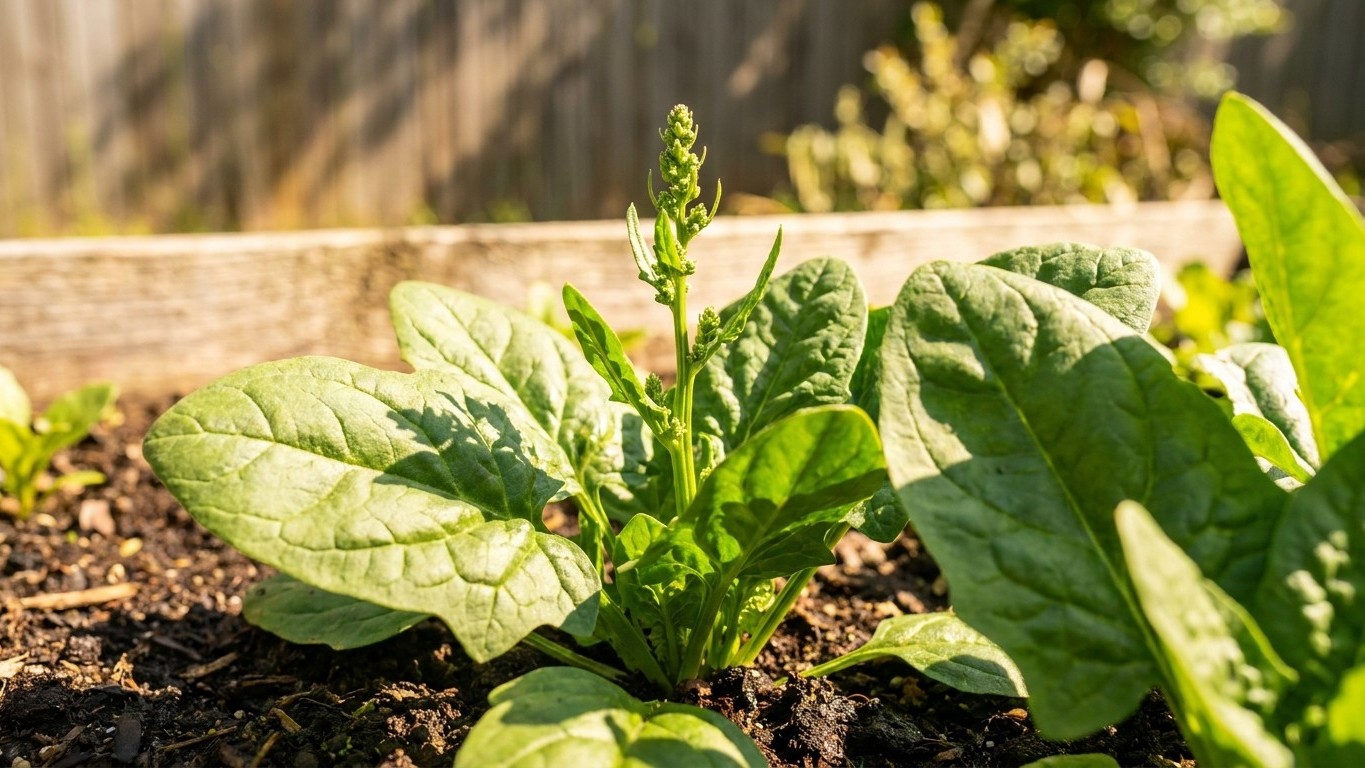

In Arkansas, cut spinach in two short windows: spring, from seed sown in late winter, and fall, from seed sown once the soil cools. Harvest leaves while plants are young and before they send up a flower stalk. Then store them cold. Spinach is highly perishable and will not hold good quality beyond two weeks, even at 32°F. Most home refrigerators run warmer than that, which shortens the time further.
The short answer
The longest day in Little Rock runs 14 h 20 of daylight. That number matters more than it looks, because long days alone are enough to make spinach flower. Utah State University Extension puts it plainly: spinach bolts during long days and warm temperatures. A cool summer does not buy extra weeks here, because the daylight is already past the point where the plant wants to go to seed. In Arkansas the limit is both day length and heat, and they stack. The heat side is considerable: the reference station averages 69.2 days a year at 90°F or higher. Spinach grows best where temperatures do not exceed 75°F, and 75°F is also the point where bitterness becomes the problem. One number, two consequences. If you want the full mechanics of flowering, Will Spinach Bolt Early in Arkansas? goes through them. For the broader crop calendar, start with Growing Spinach in Arkansas.
When to cut
Cut early and often. A young leaf cut from the outside of the plant is better eating than a big one left to toughen, and the plant keeps producing from the center. The final cut is the whole plant, taken when you see the center rising or when daytime highs start running past 75°F, whichever comes first. A bolting spinach plant is not dangerous, only bitter and not worth the plate. Pulling it a few days early costs you little. Waiting a few days late costs you the crop.
How long it keeps
The UC Davis Postharvest Technology Center lists the optimum storage temperature at 32°F with 95 to 98 percent relative humidity. Its wording is worth quoting exactly: spinach “will not maintain good quality for more than 2 weeks.” That is a ceiling, not a plan. Wilting, yellowing and decay increase after 10 to 14 days of storage, and the decline comes faster at 41 to 50°F, which is roughly what a refrigerator door holds. So the door is the wrong place. Put the bag, loosely closed with a little moisture inside, at the back of the bottom shelf, where the air is coldest. Plan to eat it within the first several days and treat anything past that as a bonus. The UC Davis spinach fact sheet has the full numbers.
How long the spring window really is
The spring crop in Arkansas is a sprint. Work through it in order and the shape becomes clear.
- Start with the last frost. NOAA’s 1991-2020 Climate Normals, using the Little Rock station and the 30 to 70 percent freeze probability band, put the last spring frost between March 12 and March 28.
- Count back two to three weeks. Spinach is sown that far ahead of the last frost. That puts seed in the ground from about February 19 at the early end to about March 14 at the late end. The sowing window is therefore about three and a half weeks wide.
- Find the ceiling. Growth stops being good above 75°F. That is a temperature, not a date, and none of the figures on this page says when Arkansas crosses it in spring. Check your own forecast and keep a thermometer handy.
- Count what is left. The usable harvest runs from the first cuttable leaves to the first stretch of days above 75°F. The source publishes no days to maturity for spinach, so any exact number of harvest weeks would be invented.
What the arithmetic does show is the proportion. The window for getting seed in is itself only a few weeks, and the harvest that follows is bounded on the back end by a heat load that adds up to 69.2 days of 90°F or hotter across the year. Those hot days are packed into summer, but they are why the spring season feels short. Think in weeks, not months.
Using the window well
Because the sowing window is wide and the harvest window is narrow, small staggered sowings make more sense than one big one. Sow a short row near the front of the window and another a week or so later, and the cuttings overlap instead of all arriving at once. Anything sown at the late end has the least time before heat arrives, so those rows are the ones to cut young.
Variety is the other lever, though less of one than gardeners hope. Utah State University Extension names four spinach varieties: Bloomsdale, Melody, Teton and Olympia. It publishes no data about any of them, so this page can only list the names and note that the data is not published. Anyone describing one as bolt-resistant or heat-proof for Arkansas is working from somewhere other than this source. Day length and heat decide the end of the season whichever one you pick. For the bugs that tend to show up in the same weeks, see What Eats Spinach in Arkansas, and When.
The autumn crop, and when the soil lets you sow
The fall crop works differently from spring, because the days are shortening, not lengthening. The day-length trigger has already passed by the time you sow. Two other things stand in the way.
Warm soil blocks germination
Utah State University Extension reports that seed germination is reduced when the soil is above 80°F. In Arkansas that is the real gate, not cold. In a hot region the window opens when the soil falls, and not on a date someone prints on a seed packet. The figures here carry no soil-temperature calendar, so use a soil thermometer an inch or two down in the morning, when it reads coolest, and wait for it to settle below 80°F. Gardeners often sow in August because the packet says to, and then wonder why the row comes up patchy. Watering the bed the day before sowing can help, but the thermometer reading is the one that counts.
Frost ends the season
The other end of the calendar is the first fall frost. NOAA’s 1991-2020 normals, with the same 30 to 70 percent band at the Little Rock station, put it between November 7 and November 20. The source’s rule for the fall crop is to plant 50 to 75 days before the date you want to harvest. Counting back from those frost dates gives a range. Seventy-five days before November 7 is about August 24. Fifty days before November 20 is about October 1. So by the arithmetic, sowing falls roughly between late August and the first of October if the target is a harvest ending at the frost dates.
The soil decides where in that range you land. In late August the beds are very likely still above 80°F, which is why the later part of the range is usually the practical one. A sowing after about October 1 runs past even the later frost date at the 50-day end. The source publishes no days to maturity for spinach, and this page does not carry figures for how much cold the plants take, so treat the frost date as the calendar’s marker for the end of the season and not as a precise kill point. If you want a firmer plan, pick the harvest date you actually want, count back 50 to 75 days, and sow on the first morning the soil reads below 80°F inside that span.
Common questions
How long does cut spinach last in the fridge?
At 32°F and 95 to 98 percent humidity, UC Davis says it will not keep good quality beyond two weeks. Quality declines after 10 to 14 days, and faster at 41 to 50°F. Eat it early and keep it at the back of the bottom shelf, not in the door.
Should I cut the whole plant or just outer leaves?
Outer leaves first, while the plant is young and growing. Take the whole plant when it begins to bolt or when highs run past 75°F. A stalk rising from the center is the signal that the leaves are about to turn bitter.
Which variety should I plant?
Utah State University Extension names Bloomsdale, Melody, Teton and Olympia. It gives no data about any of them, and that data is not published on this page either. The calendar, the 75°F ceiling and the soil temperature matter more than the name on the packet.
Why is my spinach bitter?
Heat is the usual cause. Seventy-five degrees is both the limit for good growth and the bitterness threshold, so leaves cut after a warm spell often taste harsher than those from cool weeks. Cutting earlier in the season, or sowing in the fall once the soil cools, is the practical fix.