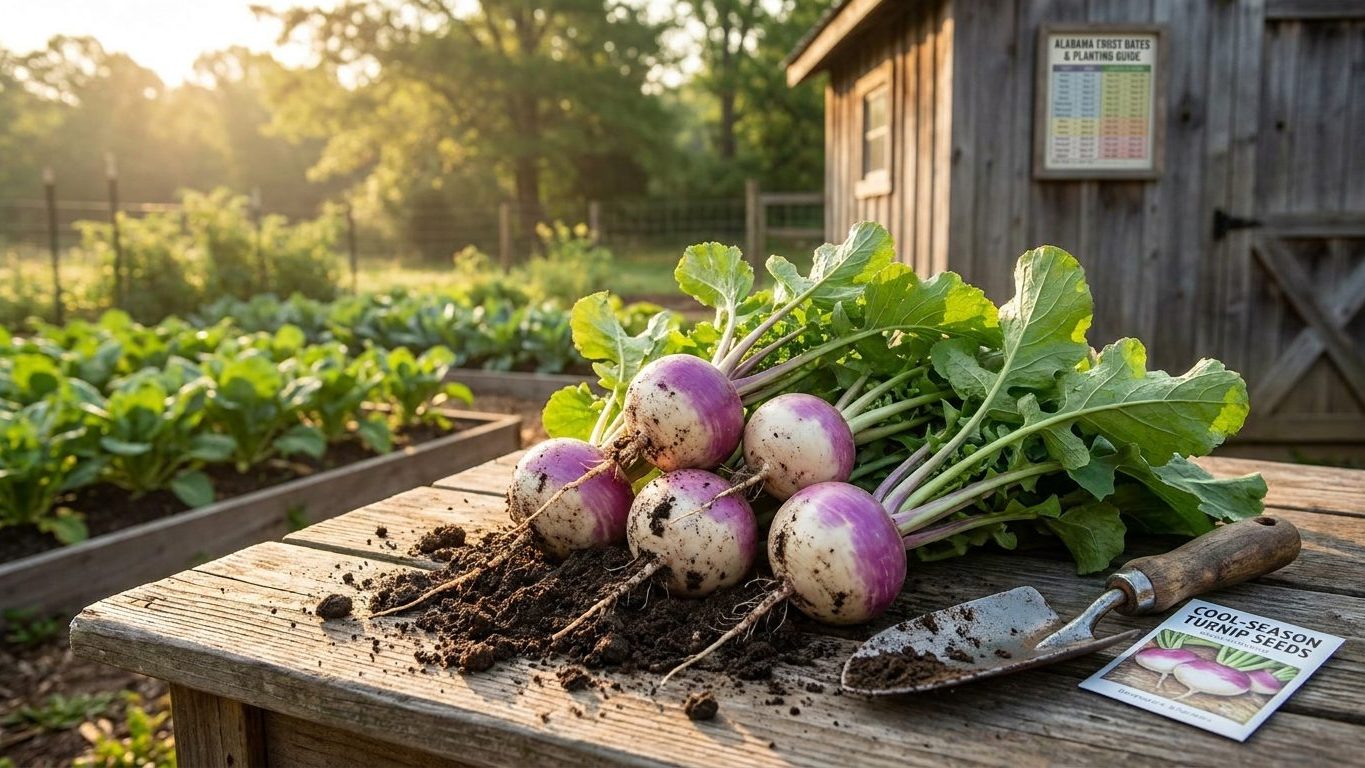

Arkansas gardeners get two turnip windows: late winter into early spring, and a fall sowing timed to finish before hard freezes. The dates below come from Little Rock, so read them as central Arkansas numbers. Fall is the stronger window in most gardens, because spring turnips race against rising heat while fall turnips size up in cooling soil. Count back from frost rather than trusting a calendar page.
The short answer for Arkansas
Sow turnips in late winter to early spring, starting around the March 12 to March 28 window for the last spring freeze, and sow again in fall so the roots finish before the November 7 to November 20 window for the first fall freeze. Both ranges are for Little Rock, and both come from the NOAA NCEI 1991-2020 Climate Normals.
What are those dates a probability of? They mark the band where the odds of a 32F freeze run between 30 and 70 percent. They are not a promise and not an average last-frost day. In any given year, a freeze can land before the band or after it. A date inside the band means a freeze is still a real possibility, nothing more.
Turnips shrug off light frost, so the 32F dates are the ones to use. A spring sowing can go in as the soil becomes workable, right around that March window, without waiting for it to close. In fall, work backward from the November band. Read the days to maturity on your seed packet, subtract that from the early part of the freeze band, and sow on or before that date. A fast turnip gives you more room. Rutabaga is slower and needs an earlier start (see The Best Turnips and Rutabaga for Arkansas for how types compare).
| Threshold | Spring date | Fall date | Use it for |
|---|---|---|---|
| 32F freeze, 30-70% probability band | March 12 to March 28 | November 7 to November 20 | Turnips, rutabaga, other hardy crops |
| 36F light frost (NWS Little Rock) | April 3 | October 31 | Tender plants, not turnips |
The second row is a trap for turnip growers. Tender crops such as tomatoes need the tighter April 3 and October 31 dates. Applying those to turnips would shorten your season by weeks for no reason.
What will not work here
Sowing in summer fails first. Arkansas gets a long, humid, hot stretch between the spring and fall windows, and turnips planted into it bolt or turn woody and sharp-tasting, if they come up at all. A July sowing is the classic mistake, made by people who see “fall crop” and plant too early. Wait until the heat breaks.
Spring rutabaga is the second failure. The frost-free season here runs from the March band to the November band, which sounds generous, but the cool part of it is split into two short pieces. Rutabaga needs a long stretch of cool weather to size up. Sown in spring, it meets summer heat before it fills out. Fall is the only sensible lane for it, sown early enough that roots grow well before the November freeze band.
Weekly watering also fails. Turnips want steady moisture, and a deep soak once a week can leave the top few inches dry while seedlings are small. Uneven moisture cracks roots and makes them bitter. Since Arkansas fall weather can turn dry for weeks, a seedling bed needs a light check every day or two until true leaves appear, then less often.
Close spacing is the quiet killer in a humid climate. Packed rows that look efficient hold moisture around leaves, and foliage diseases follow. Thin to the spacing on the seed packet, even if it hurts to pull healthy seedlings.
Winter is the other half of the story. The mean daily minimum of the coldest month is 30.9F, so average winter nights dip just below freezing, not far below. That is why a fall turnip often survives into December and why a late sowing is not a total loss. It is also why you should not read a mild winter as permission to sow in January and expect roots. Growth stops in the cold, and what you gain is a stand of small plants, not a harvest.
The last failure is borrowing dates from a different place. These numbers belong to Little Rock. Applying them to a hill in the Ozarks, or to a low pocket near the Delta, is a gamble.
What changes across Arkansas
The USDA Plant Hardiness Zone Map (2023, built on 1991-2020 normals) places Arkansas in zones 6b to 8a. That is four half-zone steps: 6b, 7a, 7b and 8a. No single answer fits all of them, and the dates in this article are a middle reading, not a statewide rule. The zone system rests on one variable, the average annual extreme minimum temperature, so it describes winter cold, not when frost arrives in October.
Gardeners in the cooler north and at higher elevation should shift the whole calendar. Spring sowing moves later, since soil warms more slowly and the last freeze lingers longer. Fall sowing moves earlier, since the first freeze arrives sooner. A cold-zone gardener has less room on both ends and little margin for slow varieties. The Little Rock fall band is a ceiling for the north, not a target.
Gardeners in the warmer south have the opposite situation. Fall sowing can run later, and the harvest window stretches deeper into winter. Spring sowing gets squeezed from the other direction, because heat arrives sooner. In the warmest areas the spring crop is the weaker of the two.
Do not take my word, or anyone’s, for which zone your yard sits in. Look it up on the USDA Plant Hardiness Zone Map by ZIP code. Then use the zone as a direction. A colder zone than Little Rock means sow earlier in fall and later in spring. A warmer one means the reverse. The size of the shift is a county question, which the next section covers. For the broader picture, see Growing Turnips and Rutabaga in Arkansas.
Where to check this for your own county
Your state extension service is the next stop. The University of Arkansas Cooperative Extension Service runs a network of county offices, and those offices know your local conditions in ways a state-level article cannot.
Look for two things there. First, a local planting calendar or vegetable planting guide for your county or region, which will list fall and spring sowing dates for greens and root crops. Second, any vegetable variety trial results from your area. A variety that did well in a trial in your county has proved itself in your soil and weather, which is worth more than a catalog description. If a county office or agent can answer by phone or email, ask them directly which turnip and rutabaga varieties have held up locally.
A county recommendation beats a state one, plainly. This page is the state one. It tells you the shape of the season and the reasoning behind the dates, using Little Rock as its reference. It cannot see your elevation, your soil, or the cold pocket at the bottom of your lot. If the extension calendar and this page disagree, go with the extension calendar and treat the difference as useful information about your area.
Bring your hardiness zone with you, and your ZIP code. It speeds up the conversation.
Checking this against your own garden
Your own observations outrank every date here. Three are worth watching, and none needs equipment.
Soil warmth by feel. In spring, push your hand a few inches into the bed. If it feels cold and sticky, wait. If it crumbles and feels cool rather than icy, seeds will germinate. A bed that stays cold while a neighbor’s is ready tells you that yours is shaded or poorly drained.
The first true leaves. After the seed leaves, the first true leaves show how the planting is going. If they appear fast and evenly, your timing and moisture are right. If they are slow or patchy, the soil was too cold, too dry, or too crusted. Note the date for next year.
Frost on your own ground. Walk out at dawn after a cold night. Frost in one corner but not another maps your cold pockets, and those spots will freeze earlier in fall and thaw later in spring than the state dates suggest. Plant fall roots in the warmer spot, and put spring seed in the first place to dry out.
Keep a few lines in a notebook each year. After two or three seasons, your notes will be a more accurate calendar than anything published for the state.
Some gardeners also time this by the Moon: when to plant turnips by the moon, as almanac tradition rather than fact.
Common questions
Can I sow turnips in Arkansas in summer?
It is a poor bet. Summer heat pushes turnips to bolt and makes roots tough and strong-flavored. Wait for the fall window and count back from the November 7 to November 20 freeze band.
Do I need to wait for the last frost to sow spring turnips?
No. Turnips tolerate light frost, so sowing can begin around the March 12 to March 28 band when the soil is workable. Those dates are for Little Rock, and a colder zone should start later.
Which frost dates should I use for turnips, 32F or 36F?
Use the 32F dates. The 36F dates (April 3 and October 31 from NWS Little Rock) are for tender plants like tomatoes and would cut your turnip season short.
Do these dates apply to the whole state?
No. They come from the Little Rock station, and Arkansas spans USDA zones 6b to 8a. Northern and higher areas should sow later in spring and earlier in fall, and your county extension office can give you the local version.