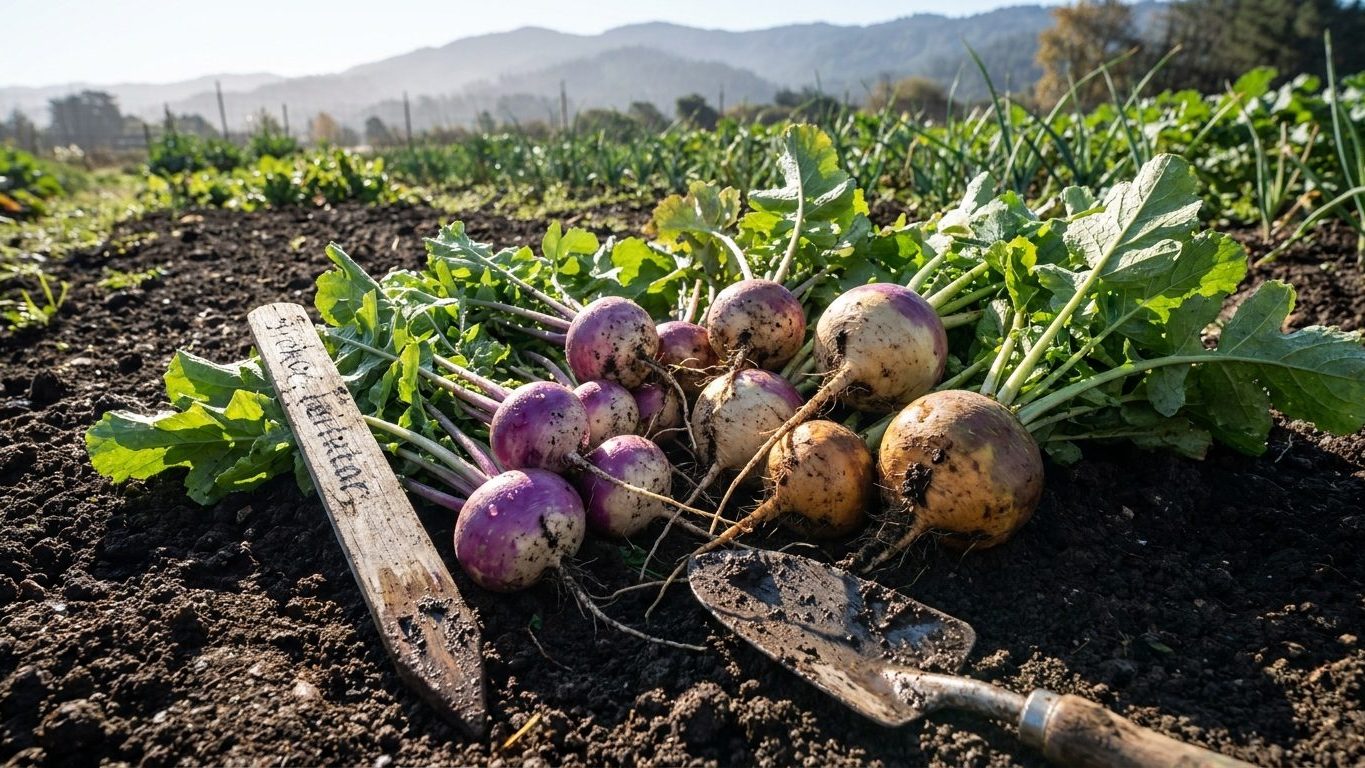

For most Arkansas gardens, the best turnips are fast-maturing types sown for fall, and rutabaga is a fall-only gamble that needs an early start. Greens turnips are the safest bet, globe-type root turnips come second, and rutabaga comes last. Three things drive that ranking: a mild winter, a long hot summer, and a fall freeze that arrives late.
The short answer for Arkansas
Choose by type, not by catalog photo. Quick greens turnips (the kind sold for their leaves, such as Seven Top) are the most forgiving here. A standard globe turnip like Purple Top White Globe is the dependable all-rounder. Rutabaga, which wants the longest stretch of cool weather, rewards only the gardener who sows it first in the fall window.
The reasoning starts with the frost dates. At the Little Rock reference station, the NOAA 1991-2020 Climate Normals put the last spring freeze between March 12 and March 28, and the first fall freeze between November 7 and November 20. Those are dates when the chance of a 32F freeze sits in the 30-70% band. They are probabilities, not promises, and a late freeze can still land after the early end of that spring range.
At the 36F light-frost threshold, NWS Little Rock gives April 3 and October 31. Tender plants like tomatoes need those tighter dates. Turnips and rutabaga do not, since both tolerate a light frost and a hard freeze does little to a turnip root.
The coldest-month figure explains why. The mean daily minimum of the coldest month is 30.9F, so January nights average just below freezing. Cold is rarely what ends a turnip crop in Arkansas. Heat is. That is why the sowing window matters more than the cultivar, and why the dates sit on a separate page: When to Sow Turnips in Arkansas.
| Type | Best season here | Main risk | Verdict |
|---|---|---|---|
| Greens turnips | Fall, with a spring try | Bolting and bitterness in warm weather | Safest choice |
| Globe root turnips | Fall first, spring second | Woody, pungent roots if heat arrives | Reliable in fall |
| Rutabaga | Fall only | Needs the longest cool stretch | Worth it with an early sowing |
For the broader crop picture, see Growing Turnips and Rutabaga in Arkansas.
What will not work here
A spring crop of rutabaga is the clearest failure. Rutabaga is the slowest root in this group, and a spring sowing in Arkansas is racing a summer that arrives early. The last spring freeze can come as late as March 28 at the 30-70% band, and by the time a spring rutabaga would be sizing up, the heat has taken over. The roots end up small, tough and sharp-tasting, if they form at all.
Slow, late-maturing turnips fail the same way. A variety bred for a long cool season gets caught by warm weather before the root fills out. Fast types finish before the heat arrives. That is the whole argument for a greens turnip or a quick globe in spring.
Fall sowing too early is the second trap. Arkansas has a long run between the last spring freeze and the first fall freeze, which tempts gardeners to sow in the heat of late summer. Seedlings that germinate into hot weather struggle, and the soil at that point holds summer’s warmth. Turnips sown into hot ground tend to bolt or turn bitter, and rutabaga sown into it never sweetens up. The first fall freeze range of November 7 to November 20 is a generous deadline, but it is a deadline for finishing, not a reason to start in August.
Humidity adds a different problem. Arkansas summers and early falls are humid, and dense plantings hold moisture around the leaves. Close spacing, the kind that works in drier states, invites leaf spots and rot here. Thinning seedlings promptly and giving greens room for air to move is not fussiness. It is a real fix for this climate.
Watering once a week and calling it done is the third mistake. Turnips need steady moisture to size up evenly, and a sandy bed or a dry fall stretch can swing between soggy and parched. Uneven watering causes splitting and tough roots. A thick mulch and watering by the soil’s feel, not the calendar, beats a fixed schedule.
One thing that will not hurt you is winter. With January nights averaging 30.9F in Little Rock, hard cold is not the threat to a fall turnip patch. Gardeners who worry about cold and ignore heat are guarding the wrong door.
What changes across Arkansas
Arkansas is not one garden. The USDA Plant Hardiness Zone Map (2023, built on 1991-2020 normals) places the state in zones 6b to 8a. That spans four half-zone steps, 6b, 7a, 7b and 8a, so there is no single answer for the whole state. The USDA system rests on one variable only, the average annual extreme minimum temperature, which tells you about winter survival and not about summer heat or season length.
The frost dates in this article come from the Little Rock reference station. Other parts of the state differ, and the gap can be wide enough to move a sowing date by weeks.
If you garden in the north or at altitude
In the colder end of the range, the first fall freeze comes earlier than November 7 to November 20, and a fall crop has less runway. That pushes the choice toward faster types and makes rutabaga a bigger gamble. If you want to try it, sow earlier than the Little Rock logic suggests and keep the bed evenly watered while the weather is still warm. Higher ground also opens spring later, but summer there is gentler on a spring turnip, which gives the quick types a little more room.
If you garden in the south or the warmer lowlands
Toward the 8a end, the fall window runs later into the year, and a turnip patch can stand into winter. The tradeoff is that spring closes sooner and summer heat is harder on anything sown late. Greens types do the best work here, and rutabaga wants the earliest fall start the season allows.
To see where you land, look up your location on the USDA Plant Hardiness Zone Map. Do not guess from a neighbor’s garden or from the nearest big city, since zones shift over short distances in hilly country.
Where to check this for your own county
A county recommendation beats a state one, and this page is the state one. It tells you what is likely across Arkansas and why. It cannot tell you what a trial plot in your county produced last fall.
The place to go is the University of Arkansas Cooperative Extension Service. Every county has an office, and the agents there work with local soil and local weather every season. This page does not have a county-level calendar to quote, and it would be wrong to invent one.
When you reach them, look for two things:
- The local planting calendar for turnips and other cool-season greens, which will name sowing windows for your part of the state.
- The varieties trialled in your county, meaning cultivars that were actually grown there and not just recommended in general.
Ask about rutabaga specifically if you plan to grow it. Because it is the marginal crop here, local experience counts for more than any state list. An agent can tell you whether gardeners near you succeed with it, and whether an earlier start is worth the extra watering.
Soil testing is also worth raising. Extension offices can explain how to submit a sample, and a pH or fertility problem often explains a poor root crop better than the variety does.
Checking this against your own garden
Your own observations outrank every date on this page. Three are worth watching, and none needs a gadget.
Soil warmth by feel. In late summer, push your hand into the bed an inch or two. If the soil still feels warm and dry-hot, it is too early for a fall sowing. When it feels cool and damp, germination gets easier. A bed under tree shade will cool before one against a south wall, and that gap is your microclimate.
The first true leaves. A turnip seedling shows two rounded seed leaves first, then the rough, shaped true leaves. How fast they appear tells you whether your soil and moisture are right. Slow, pale or leggy growth at that stage points to heat, thirst or shade. Quick, sturdy leaves mean you chose the right week.
Where frost lands first. On the first frosty mornings, notice which parts of the yard have white grass and which stay green. Low spots collect cold air and frost earlier, while beds near a house wall or paved area stay milder. Late in fall, that tells you where a rutabaga bed will keep growing longest.
Write what you see down, with the date, and compare year to year. A few seasons of notes will tell you more about your yard than any state-level range.
Common questions
What is the best turnip for an Arkansas garden?
A quick-maturing type sown for fall. Greens turnips are the most forgiving, and a standard globe turnip is the dependable choice if you want roots. Your county extension office can name the cultivars trialled near you.
Can I grow rutabaga in Arkansas?
Yes, but only as a fall crop and only with an early start. It is the slowest of the group, and spring sowings run into summer heat.
Will winter kill my turnips?
Rarely. The mean daily minimum of the coldest month is 30.9F at the Little Rock reference station, and turnips tolerate a light frost. Heat and uneven watering cause far more failures than cold.
Do the frost dates here apply to my county?
Only roughly. The dates come from the Little Rock station, with last spring freeze between March 12 and March 28 and first fall freeze between November 7 and November 20. Both are probabilities for a 32F freeze, and other parts of Arkansas differ.