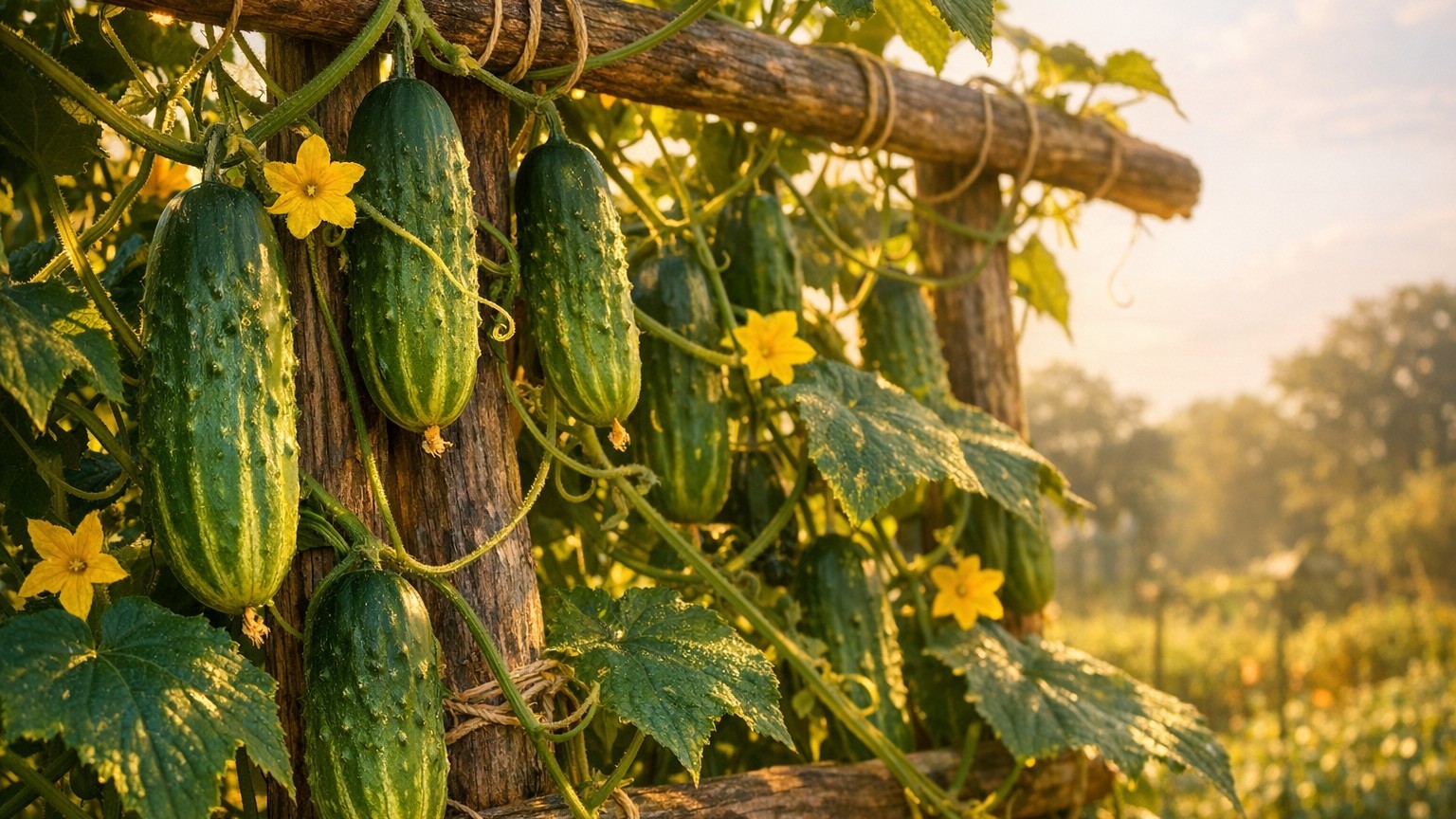

Coastal British Columbia’s growing season runs long but stays cool, so the best cucumber choice here is by type rather than by name: parthenocarpic and burpless types suited to cooler, humid summers, plus fast-maturing pickling types for succession planting. Heat-hungry, long-vine slicing types built for scorching interiors underperform on the coast.
The short answer for British Columbia
Start with what the numbers actually say about this reference climate. At Vancouver Int’l A, the average last spring frost falls March 18 and the average first fall frost lands November 10, which works out to roughly 237 frost-free days in a typical year. That is a genuinely long window, longer than most cucumber varieties need from seed to harvest. But length of season is only half the story, and the other half changes the recommendation.
The station records zero days a year at or above 90°F. No heat spikes at all. Cucumbers are a warm-season crop that size up fastest when nights and days both run warm, and without that heat load, fruit development slows no matter how many frost-free days sit on the calendar. This is the detail that should drive variety choice on the coast: pick types bred to set and ripen fruit reliably in mild, often overcast summers, not types selected for hot, dry inland conditions.
That points toward three categories worth focusing on. Parthenocarpic types, which set fruit without pollination, perform well under the row cover or cold frame that coastal gardeners often use to add heat early in a cool spring. Pickling types tend to mature faster than large slicing types, which matters when the growing season is long on paper but short on actual heat units. Bush types, finally, suit the smaller raised beds and container gardens common in Lower Mainland and Vancouver Island yards, and they don’t ask for the vertical heat-trapping trellis space a vining slicer wants.
One caution belongs here before anything else: March 18 is a mean date from Environment and Climate Change Canada, not a guaranteed safe date. In roughly half of all years, the last frost falls later than that. Treat it as the midpoint of a window, not a green light, and hold off direct seeding until the soil itself, not the calendar, says it is ready.
This page will not name a specific cultivar. Seed catalogs change their offerings yearly, and a name printed here could vanish from shelves by next spring. The types above are the durable decision; the exact variety within each type is a question for the province’s own extension service, addressed further down this page.
What will not work here

Three assumptions fail on this coast, each tied directly to a specific number above. The first is choosing a long-vine slicing type bred for hot, dry inland growing. Those varieties are selected to perform under sustained heat, often 90°F and above, and this station records none of that heat at all. Planted here, they grow leaves readily enough but size their fruit slowly and unevenly, and flavor often turns bland or bitter under the stress of insufficient warmth rather than too little water.
The second failure is spacing cucumber vines flat on the ground in a coastal humidity pattern. June alone averages 2.12 inches of rain here, more than either July or August, which means the wettest stretch of early summer arrives right when seedlings are small and vulnerable. Vines sprawled on damp soil, with leaves sitting in still, humid air, are exactly the setup that invites powdery and downy mildew. A trellis or vertical support that lifts foliage into moving air is not a cosmetic choice on this coast; it is the difference between a productive plant and one that collapses under fungal pressure by midsummer.
The third mistake is assuming summer rainfall covers a cucumber’s water needs without checking. Total summer rain across June, July and August averages only about 5.0 inches, and July, the peak growth month, sees just 1.4 inches on average, the driest month of the three. Cucumbers are roughly 95 percent water by weight and demand steady soil moisture to avoid bitter, misshapen fruit. Relying on that thin July rainfall, especially on a fast-draining sandy bed, leaves the plant short exactly when it is filling out fruit.
There is a fourth, smaller trap worth naming: seeding into cold soil because the calendar says spring has arrived. The March 18 mean last frost is an average, not a promise, and cucumber seed germinates poorly and rots easily in soil that has not yet warmed. Waiting past the frost-free date on paper, until the soil itself confirms it, avoids a wasted first sowing.
What changes across British Columbia
Every figure above describes one station, Vancouver Int’l A, and its hardiness zone rating of 9a under the Canadian system. British Columbia is not one climate wearing one number. The province stretches from mild coastal lowlands to high interior plateaus, deep dry valleys, and northern districts hundreds of miles from the ocean’s moderating influence, and a single reference station cannot speak for all of it.
That 9a figure also needs a plain warning attached: it is a Canadian zone, built from seven climate variables, and it does not convert to a USDA zone on any simple scale. Natural Resources Canada says as much itself, noting that a single Canadian zone can overlap several USDA zones at once. Anyone comparing this page to a US-based cucumber guide is comparing two different measuring systems, not two points on the same ruler.
Inside BC’s own borders, the practical shift a gardener needs to make is about timing and heat exposure, not about which zone number applies to them personally. A garden further from the coast, at higher elevation, or further north than the Lower Mainland should expect a later effective last frost and an earlier effective first fall frost than the dates given here, which compresses the real growing window even where the calendar suggests otherwise. The reverse also holds: a warmer, more sheltered valley pocket can push both dates in the other direction and support types that would struggle nearer the coast.
None of that can be resolved from this page. The right response is not to guess which zone or microclimate applies to a given yard, but to check it directly against the province’s own hardiness zone map and against local extension guidance, both of which are built to answer that question at a finer resolution than a single provincial station ever could.
Where to check this for your own county
This page describes conditions at one reference station in one part of a large province. A gardener in the Okanagan, the Kootenays, the Cariboo, or northern BC is working with a different frost calendar, different summer heat, and often different pest and disease pressure than the numbers above describe. A regional recommendation beats a provincial one every time, and this page is the provincial one.
British Columbia’s agriculture ministry runs the province’s extension service, reachable at gov.bc.ca’s industry, agriculture and seafood pages. That is the starting point for anything more specific than what this page can responsibly claim.
Two things are worth hunting for once there. First, a local planting calendar for the reader’s own region, since the frost dates used above apply to the coastal Lower Mainland and will not hold for the Interior or the North. Second, any list of cucumber varieties trialled or recommended for that specific district, which turns the general type-level guidance above (parthenocarpic, pickling, bush) into an actual shortlist of named cultivars suited to local conditions, pest pressure, and typical summer heat.
Provincial agriculture offices and regional Farm Centres also tend to track disease pressure specific to a district; a coastal garden battling downy mildew and an Interior garden battling spider mites under summer heat are fighting different battles, and the type of cucumber that shrugs off one problem may be vulnerable to the other. That level of detail sits with the regional office, not with a page describing one weather station’s averages.
Checking this against your own garden
Every date and average on this page describes a mean at one station. A gardener’s own observations, taken right at the bed, outrank all of it, because they measure the actual soil and air the seed will meet.
The first thing to check is soil warmth by feel, not by date. Push a bare hand a couple of inches into the bed in the morning; cucumber seed wants soil that feels reliably warm, not merely frost-free, and cold, damp soil that still feels chilly by midday is a sign the calendar is running ahead of the garden.
The second is the first flush of male flowers on an already-growing plant. Cucumbers typically produce a run of male blossoms before the female flowers that actually set fruit appear, and watching for that first male flush is an honest signal that the plant has moved from establishing roots to entering its productive stage, regardless of what the calendar predicted.
The third is the timing of the first true leaves after germination, the leaves that look like miniature cucumber foliage rather than the rounded seed leaves that emerge first. Slow, delayed true-leaf growth after a normal germination points to insufficient warmth or light in that particular spot, a signal worth trusting over any provincial average, since it is measuring the reader’s own yard rather than a weather station miles away.