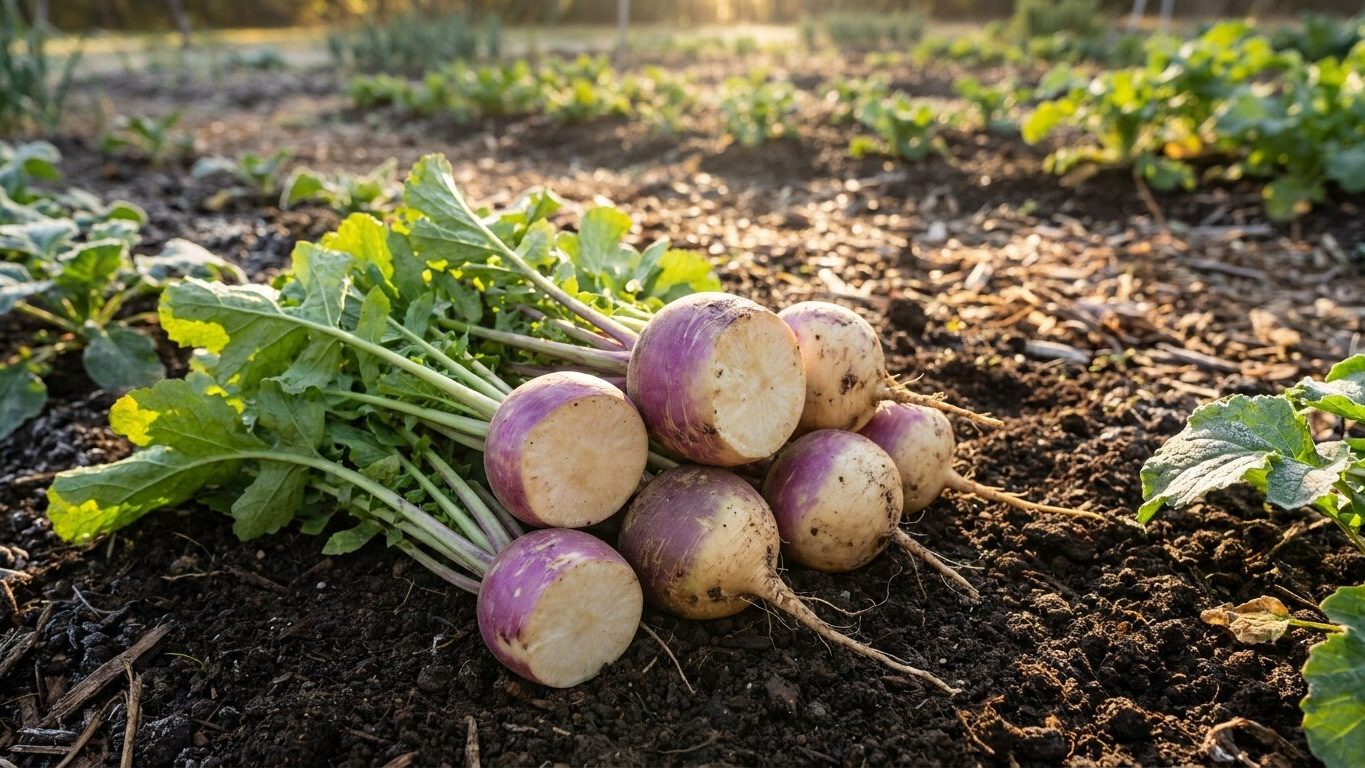

Coastal and Southern California don’t really have a frost date, so timing turnips and rutabaga there comes down to soil temperature and summer heat, not the calendar most seed packets assume. Northern California, the Central Valley, and the Sierra foothills are a different story entirely: real winters, real frost, and a season that behaves the way turnip guides expect. The right answer depends on which California you’re gardening in.
When the soil is warm enough in California
Start with what the record actually says, because it’s not what most gardeners expect. At the reference station for this territory (Los Angeles, USW00023174), NOAA’s 30-year daily records show zero days at or below 32°F, and the frost-free season is listed at a full 365 days. There is no computable last spring frost date for this station because there’s no frost to compute it from. If you garden along the coast or through the Los Angeles basin and southward, the frost question simply doesn’t apply to you.
That’s a fact about one station, not a description of the whole state. Northern California, the Central Valley, and the Sierra foothills freeze in a normal winter, sometimes hard. If you’re gardening in Redding, Sacramento, Bakersfield, or up in the foothills, you’re working with a real last-frost date, and the safest source for that number is your local UC ANR Cooperative Extension office, not a statewide average that would flatten two very different climates into one misleading figure.
Soil warmth matters more than frost here
Where frost isn’t the limiting factor, soil temperature is. Turnips and rutabaga germinate best in cool, moist soil, not soil that’s already baking under early summer sun. In frost-free zones, that means sowing in late winter or early spring while the ground is still cool, then again in early fall once the worst of the heat has broken, rather than fixating on a frost date that never arrives. A frost-free reading is a probability built from 30 years of data, not a guarantee for any single season, so don’t treat it as license to ignore late cold snaps in the Central Valley or foothill gardens.
Both crops are brassicas, sharing pests and diseases with cabbage, kale, and mustard. Flea beetles, cabbage root maggot, and clubroot don’t distinguish between them, which is exactly why a rotation plan matters from the first sowing, not after trouble shows up. If your turnip bed followed cabbage or kale last season, you haven’t rotated anything, and that habit is worth breaking before you plant.
Storage is where carelessness costs the most. A root that looks fine on the outside can still be compromised. Inspect every root at harvest and again before use: a soft patch, a weeping spot, or a moldy crown means that root is done, no matter how solid the rest of it feels. Don’t judge safety by appearance alone.
How long the season lasts here
Here’s where the frost-free record becomes genuinely useful. With both the last spring frost and first fall frost effectively absent at the Los Angeles reference station (zero days at or below 32°F across 30 years, a 365-day frost-free season), the growing window for frost purposes is the entire year. That’s an unusual position to be in as a turnip grower, and it changes the math on succession sowing considerably.
A window that long allows multiple sowings rather than a single shot in spring or fall. Instead of racing to get one crop in before frost shuts things down, coastal and southern California gardeners can stagger plantings through late winter, spring, and again in early autumn, skipping only the hottest stretch of summer when germination suffers and roots turn woody and bitter. That’s a different planning problem than the one frost-bound gardeners face, and it rewards a succession approach more than a one-and-done sowing. Our succession sowing guide walks through spacing those plantings so you’re not harvesting everything at once.
Central Valley and Sierra gardeners are working a shorter, more conventional window bounded by real frost on both ends. Because neither a specific last-spring nor first-fall frost date for those inland regions appears in the verified data here, the honest move is to get those dates from your local extension office rather than guess at them. A short window makes the first sowing the one that counts, and it also raises the question of transplanting versus direct seeding: root crops generally resent transplant disturbance, so in a tight season, direct sowing as early as the soil allows usually beats starting indoors and setting out later.
Heat and water in California
Turnips and rutabaga are fundamentally autumn and winter crops, which means the numbers that matter most here are the cold ones, not a summer heat count. For this territory, the two figures on record are the mean daily minimum of the coldest month, 49.1°F at the Los Angeles reference station, and a USDA hardiness range spanning 5a to 11a across the state as a whole.
That 49.1°F coldest-month minimum is mild. It tells you winters at the reference station don’t deliver the hard chill that pushes roots into full winter dormancy or triggers heavy frost sweetening, the process by which cold converts starches to sugars and improves flavor. Along the coast and through Southern California, expect a milder, less pronounced sweetening effect than gardeners get in a true cold winter. Roots there can often stay in the ground longer without the risk of a hard freeze locking them in, but they won’t develop the same depth of flavor that a proper cold snap produces.
The 5a-11a hardiness range is a reminder that this is one number built from extreme annual minimums, and it spans wildly different gardens. Cite the reference city (Los Angeles) for anything dated, and assume the Sierra and northern interior sit at the cold end of that range, with real winter lows that change the calculus entirely: roots there can be mulched heavily and left in place through a harder winter, or may need lifting and storing if the ground freezes solid, which almost never happens near the coast. This page doesn’t have county-level snow or hard-freeze data for those inland zones, so treat any specific storage timing for them as a question for your local extension office rather than a number to guess at.
No days-above-90°F count or summer rainfall figure is on record for this territory in the verified data behind this page, so it’s worth being direct about that gap rather than inventing a number. What’s certain is that this crop’s real constraints in California are winter mildness and water management, not a summer heat tally.
Which turnips and rutabaga suit California
Choose by type, not by name, because the varieties that actually perform in Fresno differ from what does well in Eureka, and neither this page nor a generic guide can know your specific microclimate. That’s not a dodge, it’s the honest answer: your state’s land-grant extension service runs the trials that tell you which types hold up locally, and UC ANR is that resource for California.
Reasoning from what the record does show still narrows the field usefully. Where the season stretches long and frost-free, as it does near the coast and through the south, earlier-maturing types let you fit in more sowings across that extended window rather than committing your whole season to one long-season type. Where mild winters mean less frost sweetening, flavor development leans more on timing the harvest to cooler weather than on waiting for a hard freeze that may never come. And wherever fog or irrigation keeps humidity up, disease resistance becomes the first thing to check before yield or root size, since damp foliage is an open invitation to the same fungal problems that hit cabbage and kale.
That brassica connection isn’t incidental. Turnips and rutabaga share their pest and disease pressures with the rest of the cabbage family, so any variety choice should sit alongside a rotation plan, not replace one. A resistant type planted into a bed that grew mustard or kale the year before is still gambling with soil-borne problems that resistance alone won’t solve.
Refusing to hand you a cultivar name here is the correct call, not an evasion. A name printed on this page would be a guess dressed up as advice, and the gardener who plants it based on that guess is the one who pays for it come harvest. Your extension office’s trial results are the recommendation that actually means something for your specific ground.