
Coastal and southern California has no frost date to wait for: Los Angeles records no freeze in an average year. Northern California, the Central Valley and the Sierra do freeze, so the state splits in two. Celeriac, kohlrabi, horseradish and Jerusalem artichokes can all grow here, but heat and water limits matter more than cold along the coast, and winter cold matters more inland.
When the soil is warm enough in California
The reference station for this page is Los Angeles, and it has no spring frost date to give. NOAA’s 1991-2020 Climate Normals could not compute a freeze normal at all (the code is -666), and the daily records show zero days at or below 32°F in 30 years. The frost-free season is listed as 365 days. Any frost record is a probability, not a promise, but 30 years without a single freezing day is about as firm as the odds get. Never carry that result north, though. The USDA Plant Hardiness Zone Map (2023) runs from 5a to 11a across California, which is a range wide enough to cover alpine winters and subtropical ones.
Frost is a proxy, not the signal
Where freezes happen, the last frost date only tells you when the cold risk ends. These roots wait for warm soil, and soil warms after the frost risk is over, not at the same moment. A seedbed can be frost-free for weeks and still be too cold for good germination. A cheap soil thermometer, pushed a few inches down in the morning, tells you more than the calendar. Your county’s cooperative extension office can give you the soil temperature each crop wants.
In frost-free California the logic flips. Soil never freezes, so the question is when it gets too hot. Celeriac and kohlrabi are cool-season crops, which pushes their sowing toward fall and winter in the south and toward early spring or late summer inland.
Site the Jerusalem artichoke before anything else
This is the most regretted planting in a vegetable garden, so decide where it goes before you read how to grow it. Jerusalem artichoke is effectively permanent once planted, because every fragment of tuber left in the soil regrows. Give it a corner you will never want back, a bed with a hard edge, or a large buried container, and keep it away from beds you rotate. Digging it out later is a multi-year chore.
One plain fact about the vegetable: it stores inulin rather than starch, and many people get digestive discomfort from it. A small first portion is the sensible way to find out where you stand. Neither cooking nor a cold snap should be counted on to change that.
How long the season lasts here
At the Los Angeles reference station the frost-free season is listed as 365 days. Because neither a first nor a last freeze date exists in the data, there is nothing to subtract, and this page will not invent a pair of dates to make the arithmetic look tidy. The listed figure is the whole year.
What a window like that allows is a second sowing, and a third. Kohlrabi can go in as one batch in fall and another a few weeks later, so the harvest comes in a trickle rather than a flood. Celeriac, the slow one, can start in the cool months and have a long runway. If a transplant sulks after you disturb its roots, you can sow again instead of writing off the year. The succession sowing guide on this site shows how to stagger the batches.
The catch is that a frost-free year is not a heat-free year. The calendar may be open for 365 days, but the useful window for a cool-season root is the stretch when temperatures suit it. On the coast that stretch is long. In a hot inland valley it shrinks to the shoulder seasons.
Inland and upland California is the opposite case. Where freezes arrive, the window is shorter, the first sowing may be the only one, and transplanting becomes a real decision, because the root check from a pot-bound seedling costs time you cannot buy back. This page has no verified frost dates for those areas, so the right move is to look up the last and first freeze at the weather station nearest your garden, then do the subtraction yourself.
Gardeners comparing California with places where the freeze dates are firm can read Growing Unusual Root Crops in Georgia and Growing Unusual Root Crops in North Carolina. Both show how a real frost-to-frost window changes the plan.
Heat and water in California
The figures for days above 90°F and for summer rainfall are not in the verified facts for this page, so there are no numbers here, and guessing would be worse. Look up the count for the station closest to you. It varies enormously, from cool fog-belt neighborhoods to inland valleys that bake. What the facts do establish is that the constraints in frost-free California are heat, drought and water restrictions, not cold.
Two facts govern this group of crops, and the first is season length. Celeriac is the long one. It needs a long stretch of steady growth and steady moisture, and it sulks when watering is uneven. A mild coast gives it the time but not always the cool, and a hot valley can take the cool away. Mulch keeps the root zone cooler and steadies moisture, and drip irrigation fits within most watering rules better than overhead sprinklers.
The second fact is the winter low. At the Los Angeles reference station, the mean daily minimum of the coldest month is 49.1°F. That is a mean minimum, not a record low, but it tells you the soil is not going to freeze there. Horseradish and Jerusalem artichokes can stay in the ground all year, and mulch is for moisture, not for frost.
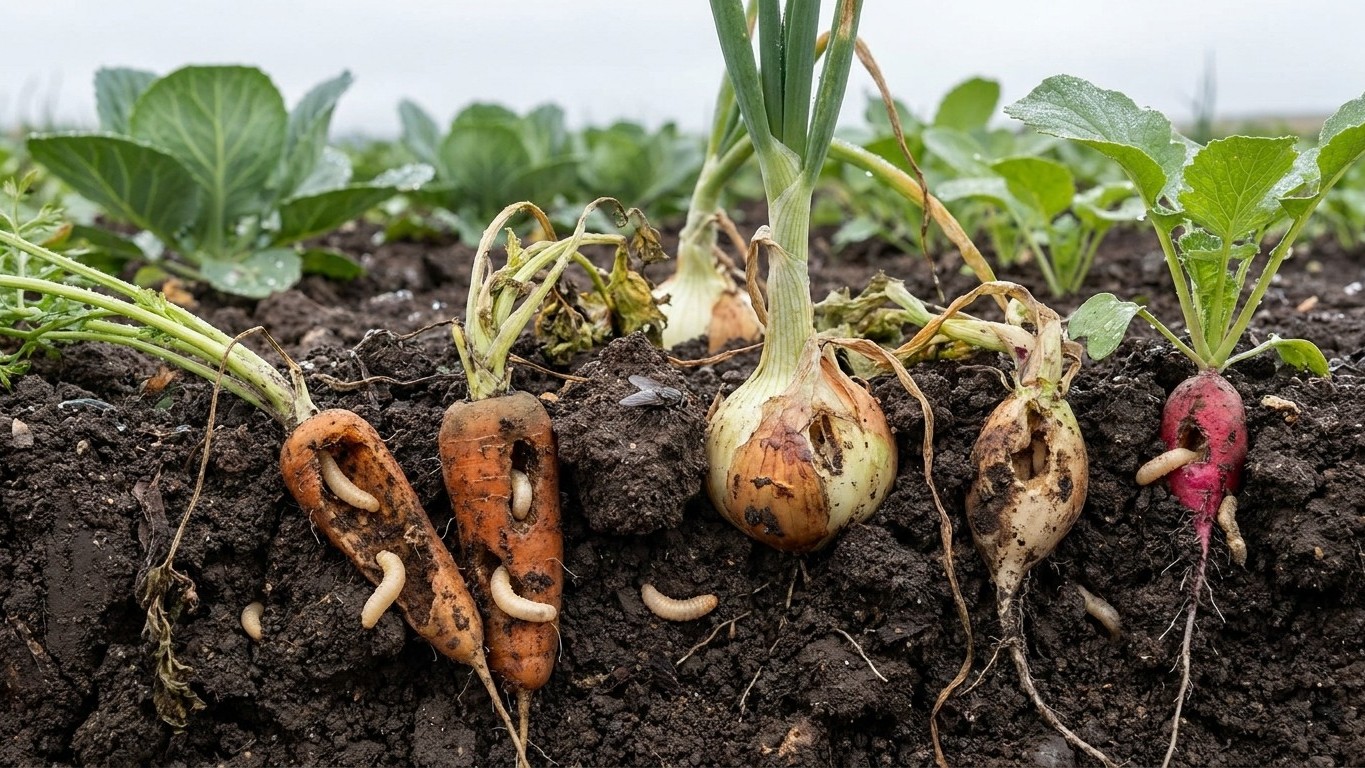
Inland, the decision is a real one. Where the ground freezes, the hardy roots can wait in the soil under a thick mulch, or be lifted and stored before it does. For anything you lift, inspect each root before and during storage. Look for soft patches, weeping spots and a moldy crown. Any one of them ends the question, and a root that looks sound is not proof of a safe one. No keeping time can be promised.
When summers are cool and damp, as they can be along parts of the coast, the trouble is different: slow ripening, mildew on foliage and rot at the crown. Airflow and not crowding the rows matter more there than extra water.
Which these root crops suit California
The choice here is by type, never by cultivar. A short season favors the earliest types, a hot one favors those given airflow and shade at the root, and a humid or foggy one makes disease resistance the first criterion.
| Root type | Where it leans in California | What drives the choice |
|---|---|---|
| Celeriac | Mild coast and cool shoulder seasons inland | Needs a long season and even moisture; heat is the limit |
| Kohlrabi | Almost anywhere in the cool months | Earliest types suit short seasons; fast sowings suit long ones |
| Horseradish | Statewide, as a perennial | Site it where it can stay; hardiness range is wide |
| Jerusalem artichoke | Statewide | Placement matters far more than variety |
Kohlrabi and horseradish belong to the cabbage family, and so do turnip and rutabaga. They share their pests and diseases with cabbage, kale and mustard, so rotating them into a cabbage bed has rotated nothing. The crop rotation guide on this site explains how to space them out.
No cultivar name appears on this page, and the omission is deliberate. A variety that does well in a fog-belt garden can fail in a Central Valley summer, and this page has no local trial data to say which is which. The recommendation that means something comes from trials run in your own region. University of California Agriculture and Natural Resources runs the state’s extension network, and your county office can tell you which varieties have been tested nearby. For the general growing methods, see Celeriac, Kohlrabi, Horseradish and Jerusalem Artichokes.
Common questions
Can I grow these roots year-round in Los Angeles?
The reference station records no freeze in an average year, so cold does not stop you. Heat does, especially for celeriac and kohlrabi, so the practical window is the cooler part of the year.
Do I need to lift horseradish in winter?
Not where the soil does not freeze. Freshly grated root releases compounds that burn the eyes and airways, so grate with good ventilation and keep your eyes away from the bowl.
Can turnips or rutabagas follow cabbage?
They are brassicas, so they share diseases with cabbage, kale and mustard. Following them with each other gives no real rotation.
How can I tell if a stored root is bad?
Check for a soft patch, a weeping spot or a moldy crown, and discard the root if you find one. Looking sound is not evidence of safety, so inspect stored roots regularly and never rely on a fixed keeping time.