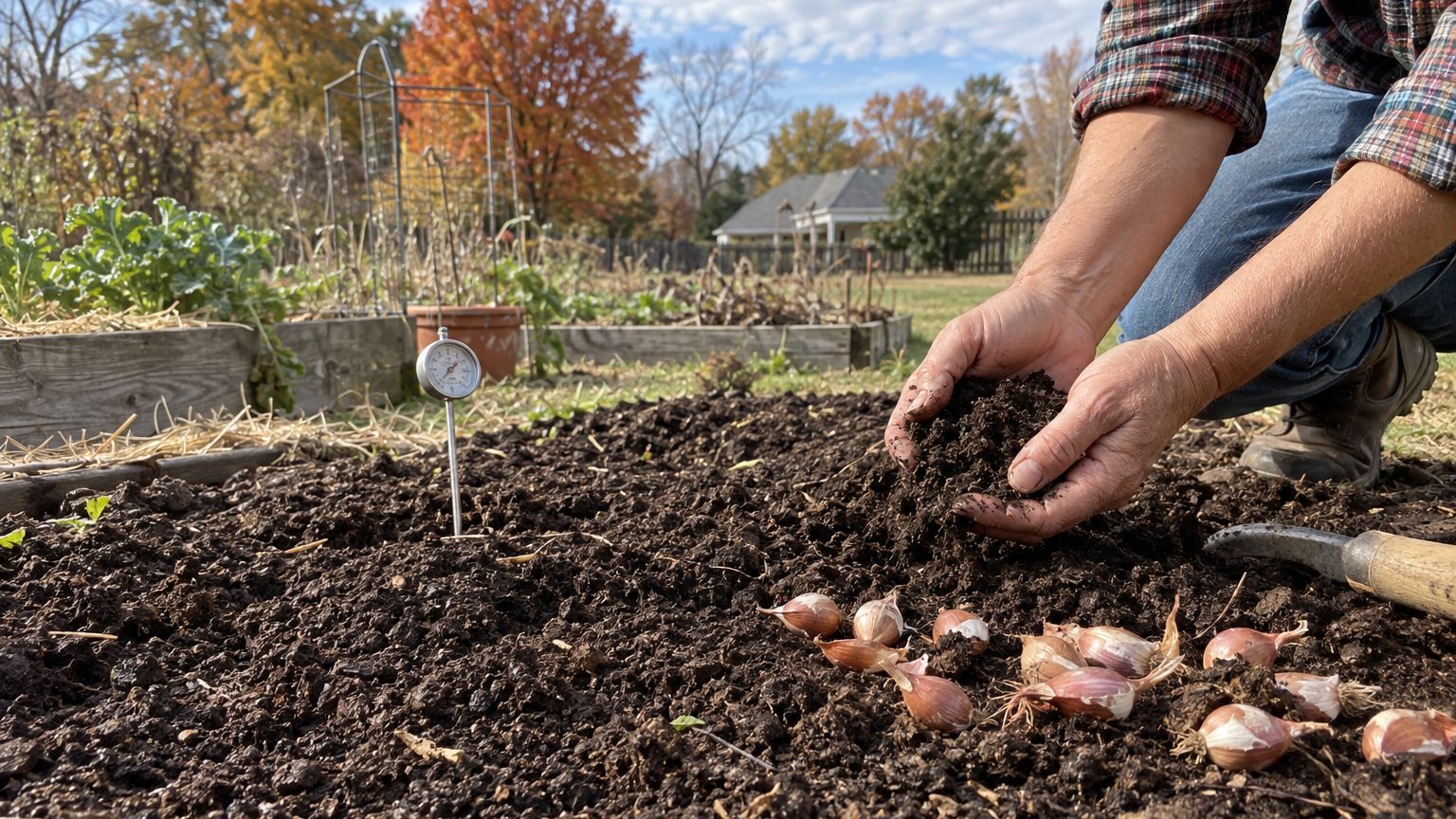

In Colorado, shallots go in either as soon as spring soil can be worked or in autumn where winters are mild enough to spare the bulbs. The state spans zones 3b to 7b on the USDA Plant Hardiness Zone Map (2023), so no single date fits it. This page uses Denver on the plains as its reference point and flags where other parts of the state part ways.
When the soil is warm enough in Colorado
At Denver, the NOAA 1991-2020 Climate Normals put the last spring 32°F freeze between May 1 and May 11 (station USW00003017, the 30-70% probability band). A frost date is a probability, not a promise, so a late cold snap after that window is always possible. Treat the band as a planning range, not a deadline.
The deeper point is that frost is a proxy. Shallots do not care what the air did on a given morning. They care what the soil is doing at planting depth, and soil warms after the frost risk ends, not alongside it. Cold ground holds its chill through April nights and warms slowly under strong sun. A cheap soil thermometer pushed in a few inches tells you more than any calendar. Plant when the bed is workable, crumbly rather than sticky, and the thermometer reading is climbing instead of bouncing back to winter.
Sets, seed and transplants
What you plant changes how closely you follow the frost band. Sets (small bulbs that multiply into a cluster) tolerate cool ground and can go in before the last freeze, because the first green tops shrug off a light frost once rooted. Seed-started shallots, which form single bulbs, and transplants raised indoors are tenderer. Hold those until the freeze band has passed, or protect them with row cover.
Plain trouble sits in the opposite direction too. Sets pushed into cold, waterlogged soil sit and rot instead of rooting. If a late-April storm drops the bed back to mud, wait a week.
What carries over from garlic
Shallots and garlic share a lot of practice: autumn planting logic, curing, storage and allium rotation. The garlic section of this site covers those in depth, so they are not repeated here. Two differences matter for shallots. They are shallower and shorter-rooted, so they suffer more when the top inch of soil swings between wet and dry. And a healthy bulb cluster is harvested earlier in the summer than most garlic, which pushes curing into hot weather.
On curing, inspect rather than assume. A cured bulb has a dry, tight neck, papery skins and a firm base. A soft neck or a moldy base ends the question, and that bulb does not go into storage. Looking sound is not proof of being sound, and no calendar duration for keeping them is a safe promise. For types and varieties trialled in your county, Colorado State University Extension is the place to ask.
For the broader picture of the crop, start with Growing Shallots: One Bulb In, a Handful Out.
How long the season lasts here
The same Denver normals give the first fall 32°F freeze between September 30 and October 12 (same station, same 30-70% band). Subtract the dates and the outer limits of the frost-free window run from 142 days (May 11 to September 30) to 164 days (May 1 to October 12). That is roughly 20 to 23 weeks. It is a single-station figure, and it is a spread, not one number, so plan on the middle of it and expect some years to land at either end.
Mountain towns run far shorter seasons and can frost in July, and the western slope differs again. For a garden at 8,000 feet, this Denver arithmetic does not apply, and a gardener there should treat the first sowing as the only sowing.
What does that Denver window allow? For a crop that wants a long, steady stretch to size up before the tops fall over, 142 to 164 days leaves some room. It allows a second sowing of shallots grown for green tops, spaced a few weeks after the first, so that scallion-style harvests arrive in waves instead of all at once. It does not leave enough slack to start bulb crops late and expect full size. A bulb sown in mid-summer will be small when the fall freeze arrives.
The succession sowing guide on this site explains how to space those waves and what to expect from each. For bulb production, the better use of a long window is a good first sowing, not a second one.
Transplanting is where the length of the window changes the math. In a short season, starting seed indoors and moving seedlings out buys weeks, but each transplant must survive a root check: shallow roots disturbed, wilted tops, a week of sulking. In a long window you can afford that setback. In a short one you often cannot, and direct-planted sets avoid the shock altogether. Colorado sits in the middle, so the choice depends on elevation. On the Front Range plains, transplants are worth trying. Higher up, sets are the safer start.
Compare this with a state that has a much shorter season, as laid out in Growing Shallots in North Dakota, where the first sowing is the only one that counts.
Heat and water in Colorado
This is where Colorado splits the question. The usual framing is autumn against spring, and the winter low decides it. At Denver, the mean daily minimum of the coldest month is 18.4°F (NOAA Climate Normals 1991-2020). That is cold, but it is a mean of nightly lows, not an extreme record. Across the state the zone range, 3b to 7b, shows how far the picture swings with elevation.
I do not have a verified count of days above 90°F or a summer rainfall total for a reference station, so this page does not quote either. The dry-air, hot-afternoon pattern of the Front Range is well known, but a number I cannot source is worth less than none. For local figures, the NOAA Climate Normals for your nearest station and the extension service are the sources to check. What can be said is that low humidity limits some foliar diseases, while summer heat and dry spells put pressure on shallow-rooted shallots, and irrigation does most of the work.
Back to the choice itself. Where the ground freezes hard and stays wet, autumn-planted sets rot or heave, and spring is the safer call. Where winter is milder and the soil drains well, autumn planting gives larger, earlier bulbs, and that is what it is grown for. Colorado has both situations, sometimes within a few miles of each other.
| Factor | Autumn planting | Spring planting |
|---|---|---|
| Best where | Winters milder, soil drains well | Ground freezes hard, soil stays wet |
| Main risk | Rot or frost heaving over winter | Later, smaller bulbs |
| Payoff | Larger, earlier bulbs | Fewer winter losses |
| Mulch role | Holds soil steady through thaws | Conserves summer moisture |
Heaving is the Colorado-specific hazard worth watching. Sunny winter days thaw the surface, cold nights refreeze it, and the repeated cycle can push shallow sets up out of the ground. A layer of straw or shredded leaves laid after the ground has cooled keeps the temperature steadier. Raised beds drain better, which matters if wet clay sits around the bulbs.
Water in summer is the other half. Shallow-rooted shallots need steady moisture while tops are growing, then a dry-down as they mature so the bulbs can cure. In a dry climate, drip or soaker lines do this cleanly. In a cool, damp summer elsewhere, the trouble would be mildew, slow ripening and disease, which is the situation described in Growing Shallots in Pennsylvania.
Which shallots suit Colorado
No variety names appear on this page, and that is deliberate. The varieties that have been trialled at specific elevations in Colorado are the only recommendation worth following, and this page does not have those trial results. A name pulled from a general catalog could be a poor performer at 5,280 feet and a failure at 8,000. A gardener catches that mistake the first season.
Reasoning by type works instead. Start with the season. Denver has a window of 142 to 164 days between freezes, which is workable but not generous. Higher elevations run shorter, so the earliest-maturing types are the right choice there. Shorter-season sets that bulb up quickly beat late types that need every day.
Heat and dry air come next. Types that handle hot afternoons do better with airflow and a little shade at the root zone: mulch over the crown area, wider spacing, and drip irrigation instead of overhead watering. Sets suit this better than transplants because their root systems establish where you put them.
Disease resistance becomes the first criterion only in humid conditions, where mildew and rots thrive. In most of Colorado it ranks below earliness and heat tolerance, though it matters more in irrigated gardens with poor drainage or crowded plantings.
Multiplier types, which produce a cluster from a single set, are the easiest to start with. You can save the best bulbs from one harvest and replant them, which also lets you build a local strain suited to your own yard. Seed-grown types produce single bulbs and give more flexibility in spacing, but they are more demanding in a short season.
For the actual variety list, contact Colorado State University Extension, whose county offices know what has been trialled at your elevation. The Denver frost figures here come from NOAA’s 1991-2020 Climate Normals, so check your own station before relying on them.
Common questions
Can I plant shallots in Colorado before the last frost?
Sets can go in once the soil is workable, since light frost on the tops is tolerable after rooting. Seed-started shallots and transplants should wait until the May 1 to May 11 band at Denver has passed, or be covered when a freeze threatens. That band is a probability, not a guarantee.
Should I plant shallots in autumn or spring in Colorado?
It depends on your winter. Where the ground freezes hard and stays wet, spring is the safer choice. Where the winter is milder and the soil drains well, autumn planting gives larger, earlier bulbs. The Denver mean coldest-month minimum is 18.4°F, but the state’s range is zones 3b to 7b, so local conditions decide.
How do I know shallots are safe to store?
Inspect each bulb. The neck should be dry and tight, the skins papery and the base firm. A soft neck or a moldy base ends the question, and that bulb should be discarded. Looking sound does not prove a bulb is sound, so do not promise yourself a keeping time.
Does the Denver season apply to mountain gardens?
No. The Denver figures describe the plains at 5,280 feet. Mountain towns have much shorter seasons and can frost in July, and the western slope differs again. Higher gardens should treat the first sowing as the only one and lean toward the earliest-maturing types.