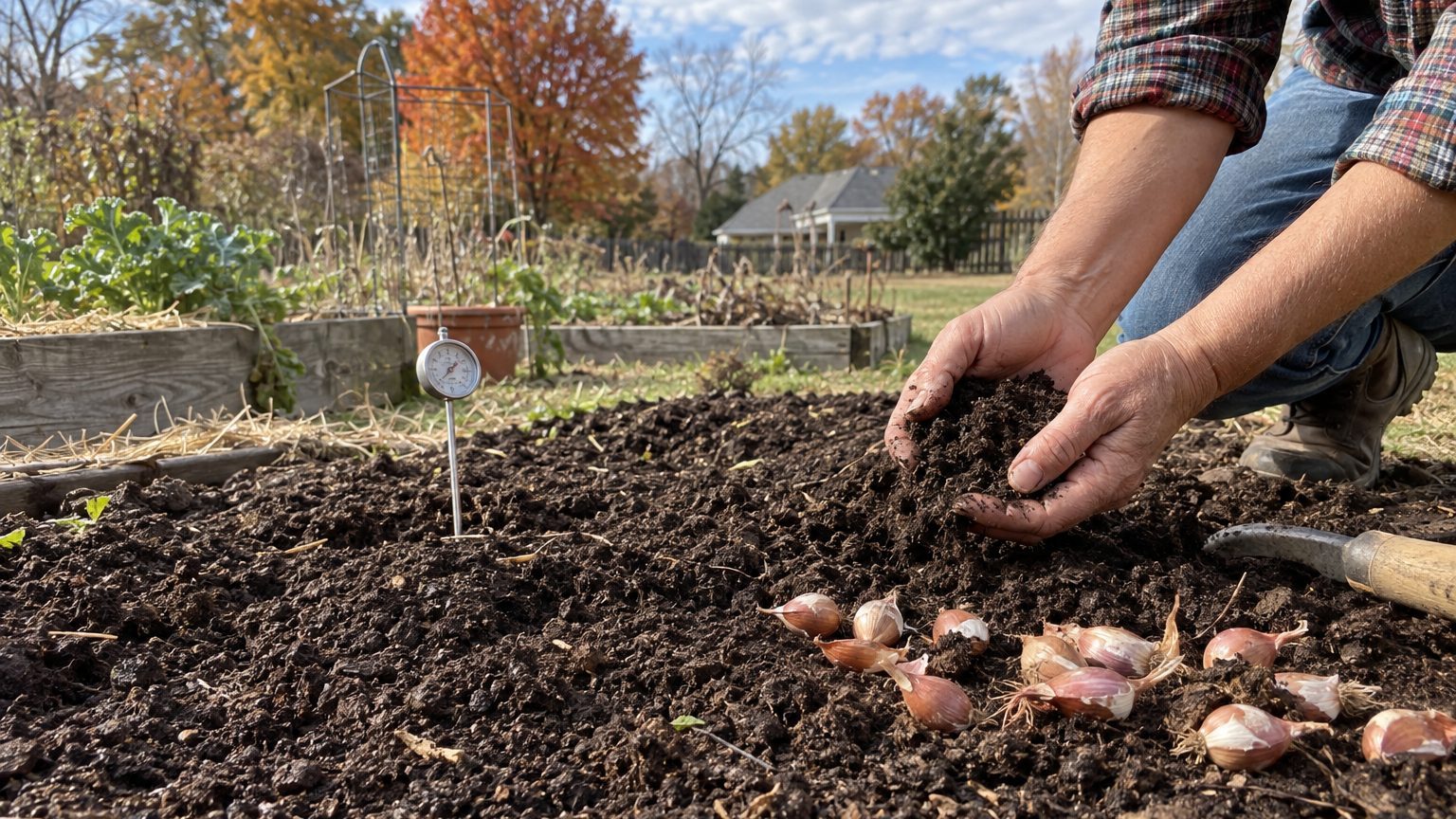

In Pennsylvania, shallots go in either in autumn or as soon as the soil can be worked in spring, and your winter makes the call. Around Philadelphia the last spring freeze falls between March 29 and April 6. The northern tier and the Alleghenies run later. Below: timing, season length, winter and moisture, and how to choose a type.
When the soil is warm enough in Pennsylvania
For Philadelphia, the NOAA NCEI U.S. Climate Normals 1991-2020 put the last spring 32F freeze between March 29 and April 6. That is the 30-70% probability band at the Philadelphia station. It is a probability, not a promise, and you will see a freeze outside it some years. Philadelphia is also the mildest corner of the state. The northern tier and the Alleghenies run two to four weeks later in spring, so a gardener in Potter County and one in Delaware County are working from different calendars.
Frost is a proxy, soil is the signal
The frost date is a stand-in. Shallots wait for workable, warming soil, and soil warms after the frost risk ends, not with it. Ground that spent winter frozen and wet lags behind the air by days or weeks. A practical check is to squeeze a handful. If it crumbles, plant. If it smears into a slick ball, wait. A soil thermometer helps if you own one, but the squeeze test catches the failure that matters, which is sets sitting in cold saturated mud.
Early spring planting pays off because the plant needs time to build leaf before the bulb begins to swell. Every week of delay is a week of foliage you do not get back.
Autumn planting, and what the garlic pages cover
Autumn planting, curing, storage and allium rotation work much the same for shallots and garlic. What differs for shallots is mainly scale and nerve. Sets are smaller, they sit shallower, and many growers treat them as a bit less cold-tolerant than garlic, which is why the winter question below carries so much weight.
Curing deserves a plain warning. Inspect each bulb before you store it. The neck should be dry and tight, the skins papery, the base clean. A soft neck or a moldy base ends the question for that bulb, however good the rest looks. Appearance alone never proves a bulb is sound, and no one can promise how long a given batch will keep.
How long the season lasts here
The same NOAA normals give a first fall freeze between November 5 and November 16 at Philadelphia. Pair the ends of both bands and the frost-free window runs from 213 to 232 days, depending on which dates you match.
| Spring date paired with fall date | Days between |
|---|---|
| April 6 to November 5 (shortest) | 213 |
| March 29 to November 5 | 221 |
| April 6 to November 16 | 224 |
| March 29 to November 16 (longest) | 232 |
Those are Philadelphia figures. What the facts do say is that their spring starts two to four weeks later, which comes straight off the front of the window.
What a long window allows
Seven months or so without a hard freeze is generous for a crop that wants an early start. In the southeast it leaves room for a second sowing, such as a staggered round of sets two or three weeks after the first, which spreads the harvest instead of dumping it all in one week. It also makes starting seed-grown shallots indoors and transplanting a reasonable bet. The seedlings can take the root check and still catch up. The succession sowing guide on this site walks through how to space those rounds.
What a short window changes
Move north or uphill and the first sowing becomes the only one. Losing two to four weeks in spring leaves no slack for a second round, and it changes the math on transplants. A seedling that stalls for two weeks after transplanting has burned time you can’t spare, so direct-planted sets, which skip that stall, make more sense. Gardeners in colder parts of the state should plant the moment the soil allows. For a contrast in how other states handle it, see Growing Shallots in Colorado and Growing Shallots in Illinois.
Heat and water in Pennsylvania
What it does carry is the winter figure, and that is the one that settles autumn against spring.
The winter low decides it
At the Philadelphia reference station, the mean daily minimum of the coldest month is 26.0 F (NOAA NCEI Climate Normals 1991-2020). That is an average of the lows, not the record cold, and it sits only a few degrees under freezing. The USDA Plant Hardiness Zone Map 2023, which is built on the average annual extreme minimum, rates the state anywhere from 5a to 7b. So the territory spans a wide range, and the southeast is at the gentle end of it.
Where winters are milder, autumn-planted sets root before the ground locks up and reward you with larger, earlier bulbs. That is what fall planting is for. Where the ground freezes hard and stays wet, the same sets can rot in saturated soil or heave out of it as it freezes and thaws. In the colder zones of the range, spring planting is the safer call. If you do plant in autumn there, choose your best-drained bed and mulch it.
Heat is the smaller worry, damp is the larger
A cool, damp summer brings its own trouble: mildew on the foliage, slow ripening, and disease that moves through crowded, wet beds. Space plants for airflow, water at the base in the morning, and pull back on irrigation as the tops begin to fall over.
Heat still counts in the warm southeast, where bulbs finish better with a little shade at the root zone from a thin mulch layer. Just don’t build the whole plan around it.
Which shallots suit Pennsylvania
Penn State Extension is the place to ask about varieties that have been grown in the state.
- Short season, northern tier or higher ground: favor the earliest-maturing types, and plant sets rather than transplants so no time is lost to root check.
- Humid summers statewide: make disease resistance your first criterion, ahead of size or flavor. A shallot that holds clean foliage through a wet July is worth more than a bigger one that mildews.
- Warm southeast: types that tolerate airflow-and-shade management do well, and you have the window to try both autumn and spring plantings side by side.
- Cold zones within 5a-7b: choose types with a reputation for winter toughness if you plan to plant in fall, or commit to spring.
Ask the extension office which types have held up locally, then buy sets from a grower who can tell you what they are. For the bigger picture on how one bulb becomes a cluster, see Growing Shallots: One Bulb In, a Handful Out.
Common questions
When should I plant shallots in Pennsylvania?
Plant in spring once the soil is workable and crumbles in your hand, or in autumn where winters are mild enough. At Philadelphia the last spring freeze falls between March 29 and April 6 (NOAA 1991-2020 normals), but treat that as a proxy. In the northern tier and the Alleghenies, expect it two to four weeks later.
Can I plant shallots in fall in Pennsylvania?
In the milder southeast, yes. In colder zones, where the ground freezes hard and stays wet, autumn-planted sets are prone to rot or heave, and spring is the safer call. Pick your well-drained bed if you do try fall.
Is the season long enough for a second sowing?
At Philadelphia the window between freezes runs 213 to 232 days, which leaves room for a second round. Farther north, with spring starting later, plan on one sowing and plant it early.
How do I know shallots are cured and safe to store?
Check each bulb: a dry, tight neck, papery skins, and a clean base. A soft neck or a moldy base means that bulb is out. Looking sound does not make a bulb sound, so keep checking stored bulbs and discard any that soften.