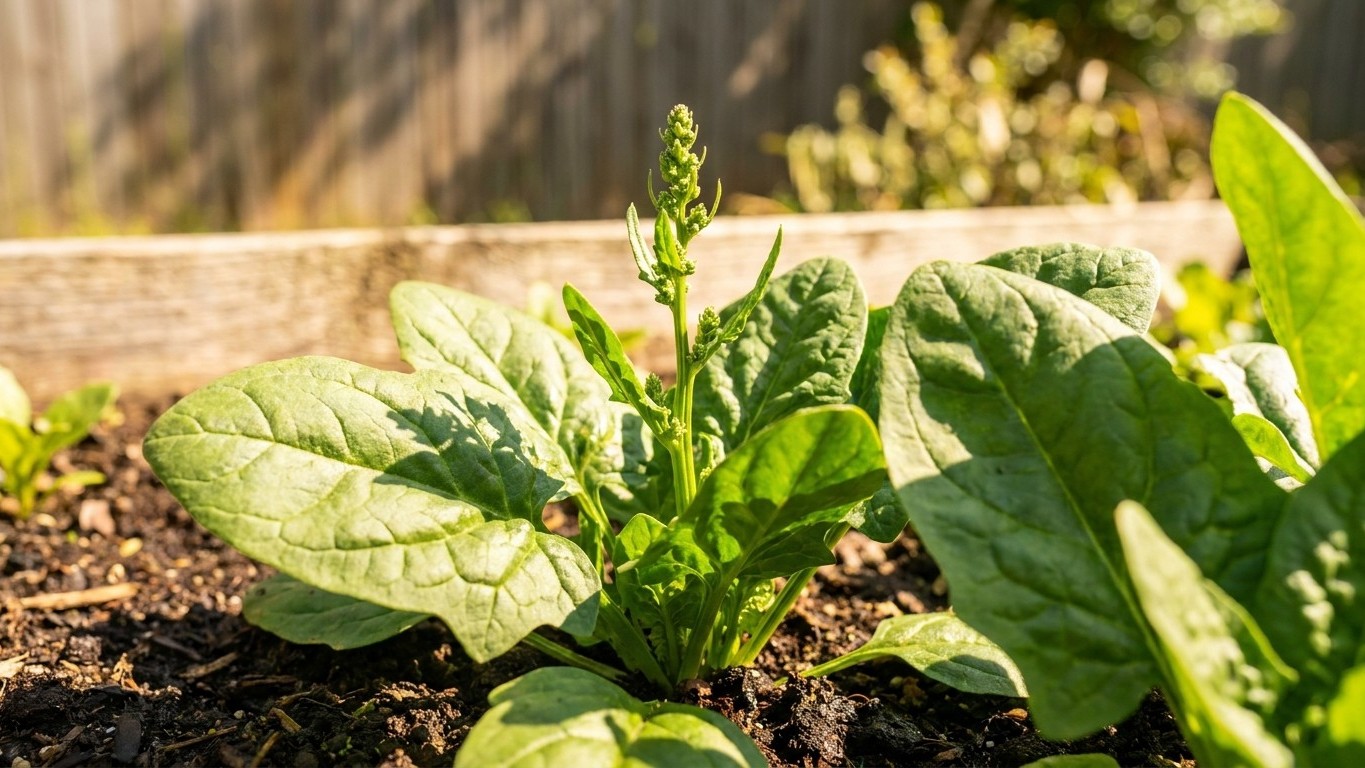

Spinach bolts early almost everywhere along Colorado’s Front Range, and the trigger is daylight, not the mountain air staying cool. By the June solstice, Denver sees roughly 14 hours and 50 minutes of daylight, enough on its own to push spinach into flower. Layer on nearly 40 days a year above 90°F, and the two triggers land in the same narrow stretch of late spring.
The short answer
Two separate forces push spinach toward flowering here, and they don’t wait for each other. The first is day length. Once daylight climbs past a certain point, spinach reads that as a signal to stop making leaves and start making seed. That threshold doesn’t arrive suddenly on the solstice; daylight builds through April and May, so the plant is already sensing longer days weeks before Denver hits its 14-hour-50-minute peak. A cool, cloudy spring doesn’t slow that clock down. The days get long whether the thermometer cooperates or not, and that alone separates spinach from a crop like short-day onions, which use long days to build a harvest rather than end one.
The second force is heat, and in Colorado it shows up fast. Spinach grows best where temperatures stay under 75°F, and that ceiling does double duty: cross it and growth slows, cross it while the plant is already sensing long days and the leaves turn bitter on top of bolting. Denver’s climate record shows an average of 39.6 days a year reaching 90°F or higher, a measure of how much heat load stacks up once the season turns. Those triple-digit-adjacent days don’t spread evenly across summer. They cluster in June, July, and August, right when day length has already pushed spinach toward flowering. So the heat doesn’t create a second, separate problem so much as it pours gasoline on a fire day length already lit.
That means the honest answer to “will it bolt early” is both: day length starts the clock, and Front Range heat finishes the job before most gardeners expect. A gardener in a cooler mountain valley might assume altitude buys protection, but day length there is nearly identical to Denver’s, since it’s a function of latitude, not elevation. What changes at altitude is frost timing, not sunlight. Mountain towns can see a hard freeze into July and again by late summer, which shortens the growing season on both ends without touching the bolting trigger at all. The western slope runs on its own frost calendar too. None of that changes the core fact: wherever you garden in Colorado, long days arrive on schedule, and spinach responds to that schedule regardless of how many mountains sit between you and the plains.
How long the spring window really is
- Start with the last frost. The 30 to 70 percent probability band for a 32°F freeze at the reference Denver-area station runs from May 1 to May 11. That date anchors everything that follows.
- Move the sowing date back two to three weeks. Spinach seed tolerates cold soil, so gardeners sow before the frost-free date rather than after it. Counting back from May 1 to May 11 puts sowing somewhere in the second half of April, with the earliest plantings possible around mid-April in a mild year.
- Track how fast the ceiling arrives. Growth stops being good once temperatures push past 75°F, and on the Front Range that isn’t a late-summer event. Warm spells in the 70s and 80s show up by late May in most years, well before the days above 90°F really start piling up.
- Add the day-length pressure on top. By late May and into June, daylight is already climbing toward that 14-hour-50-minute peak, so the plant is leaning toward flowering at the same time the thermometer starts crossing 75°F.
- Total the usable stretch. Sowing in mid-to-late April and running into a wall of heat and long days by early-to-mid June leaves a spring window of roughly six to eight weeks of good growth, shorter in a warm spring, a bit longer in a cool, cloudy one.
The autumn crop, and when the soil lets you sow
Fall spinach flips the problem. Instead of racing long days, the fall crop races falling soil temperature and an approaching frost, and the source behind these figures, Utah State University Extension, gives a simple rule: sow 50 to 75 days before the date you want to harvest.
Soil still too warm to germinate
Spinach seed germinates poorly once soil temperature climbs above 80°F, and on the Front Range that’s not a rare event in mid-summer. With an average of 39.6 days a year reaching 90°F air temperature, soil under a garden bed in July and much of August routinely sits above that 80°F germination ceiling. That pushes the realistic fall sowing date later than the 75-day count alone would suggest. Gardeners who sow too early into hot soil often get thin, spotty germination rather than the earlier harvest they were hoping for. Waiting for soil to cool, typically as August gives way to early September, produces a more reliable stand even if it trims the growing window on the other end.
The frost that ends the season
The other boundary is the first fall freeze. The 30 to 70 percent probability band for a 32°F freeze at the reference station runs from September 30 to October 12. Counting back 50 to 75 days from a target harvest in that window lands sowing somewhere between mid-July and mid-August, which is exactly the stretch when soil is still too warm to cooperate. The practical fall window in Colorado is a compromise between those two obstacles: sow as soon as soil temperature drops out of the 80s, generally in August, and expect harvest to land closer to the 50-day mark than the 75-day one, since the season’s frost arrives before the longer count would finish.
The source names four spinach varieties commonly grown in home gardens, Bloomsdale, Melody, Teton, and Olympia, but it publishes no days-to-maturity figures or bolt-resistance ratings for any of them. Choosing among them on the basis of speed or heat tolerance isn’t something the data supports; the safer approach is to time sowing around soil temperature and frost dates rather than around a variety name.
Common questions
Does shade slow down spinach bolting in Colorado?
Shade can lower leaf temperature and help keep plants under the 75°F growth ceiling a bit longer, but it doesn’t change day length. Since long days are the primary trigger, shade addresses only half the problem.
Is a fall crop more reliable than a spring one here?
Fall sowing avoids the climbing day length of late spring, which removes one of the two bolting triggers. The tradeoff is the soil-temperature obstacle in July and August, so success depends on timing sowing to when soil has cooled below 80°F, not simply on picking fall over spring.
Does elevation change when spinach bolts?
Elevation changes frost timing, not day length. Mountain towns get essentially the same daylight hours as Denver on the same date, so the bolting trigger arrives on the same schedule even where the growing season is much shorter on both ends.
Can I keep resowing spinach through the summer to get a continuous harvest?
Once day length and heat both cross their thresholds, typically by early-to-mid June on the Front Range, new sowings face the same pressure as the first planting. A continuous summer harvest isn’t realistic here; the practical approach is one spring planting and one fall planting, separated by the hottest, longest-day months.