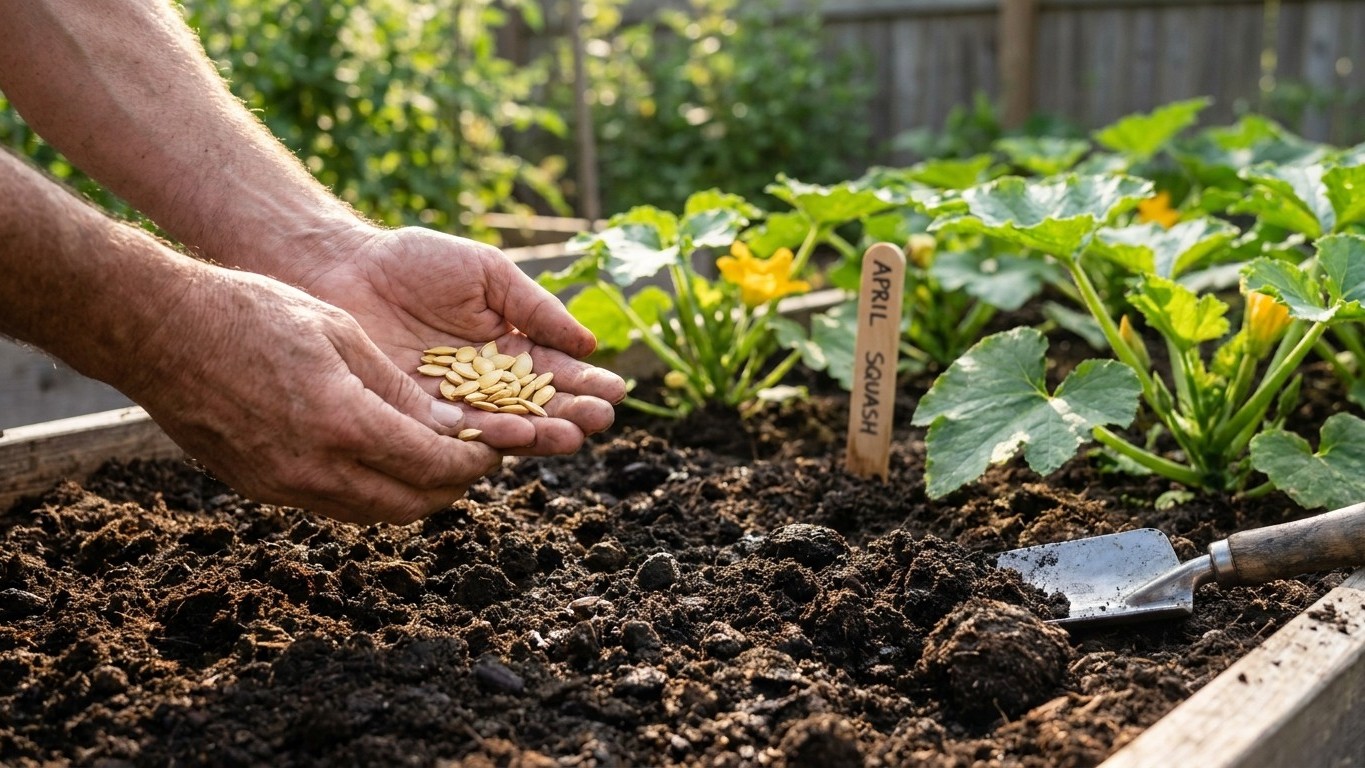

Summer squash goes into Colorado gardens after the soil has warmed and the frost risk has genuinely passed, which on the Front Range plains means waiting until sometime between May 1 and May 11. That window comes straight from the freeze-probability data at the Denver reference station, and it’s a probability, not a guarantee, so the exact day you plant should still bend to what your own yard is telling you.
The short answer for Colorado
Sow summer squash outdoors, whether seed or transplant, in the stretch between May 1 and May 11. That’s the window NOAA’s 1991-2020 Climate Normals mark as the 30-70% probability band for a 32F freeze at station USW00003017, the Denver-area reference point. Read that plainly: before May 1, the odds of another freeze are still above 70%, so planting earlier is a bet against the historical record. After May 11, the odds drop below 30%, though they don’t hit zero. Squash is a warm-season crop with no frost tolerance at all, so this isn’t a date to round down.
On the other end of the season, the same station puts the first fall freeze between September 30 and October 12. That gives the plains roughly 142 to 164 days of frost-free growing, depending on where in each band the actual year falls. Most summer squash varieties, zucchini and yellow crookneck alike, mature in the neighborhood of 45 to 55 days from transplant, so a mid-May start leaves comfortable room for a first harvest by early July and a second flush before the fall frost risk climbs back up.
Two things complicate that clean math, and they’re worth naming here rather than later. First, this frost-date pair describes the Denver plains at 5,280 feet, not the whole state. Second, Colorado’s summer heat, averaging 39.6 days a year at or above 90F, means the constraint on a plains garden is rarely the calendar. It’s whether the plant gets enough water once the season actually turns hot, a problem the next section digs into.
So the short version: treat May 1-11 as your planting window if you’re gardening on the Front Range plains near Denver’s elevation, hold the fall frost date around late September to mid-October as your outer harvest boundary, and understand that both numbers are drawn from one reference station, not a statewide guarantee.
What will not work here
A weekly watering habit is the single most common way summer squash fails in a Colorado garden. The region logs about 5.7 inches of rain across June, July and August combined, and August, right when squash plants are sizing up fruit fastest, averages just 1.58 inches. Split across four weeks, that’s not enough to carry a shallow-rooted, broad-leafed plant through a stretch that also averages nearly 40 days above 90F. Squash leaves are large and lose water fast in dry heat; a plant watered once a week on Colorado’s plains is running a moisture deficit most of that week, and the visible result is wilting afternoons, blossom drop, and fruit that stalls out small and bitter.
The fix isn’t more water all at once, it’s more frequent water in smaller amounts, ideally at the root zone rather than overhead, since Colorado’s low humidity means overhead watering evaporates before it does much good anyway.
Season length breaks the slow varieties
The 142-to-164-day frost-free window at the Denver reference station sounds generous for a crop that matures in under two months. But that number describes the plains specifically. The state’s hardiness zone range runs from 3b clear up to 7b, and the caution attached to both frost dates is explicit: mountain towns run far shorter seasons and can see frost even in July, and the western slope runs on its own pattern entirely. A summer squash variety bred for a long, mild season, marketed as productive over 60-plus days, is a poor match anywhere near the short end of that zone spread. A short growing window doesn’t forgive a slow starter twice; if a late frost eats the first planting, there may not be time left in a compressed high-country season to try again.
Dense spacing is a smaller but real failure point too. Colorado’s air is dry enough that fungal disease is less of a threat than in humid states, so the usual argument for wide spacing (airflow against mildew) matters less here than the argument for root competition and water access. Crowded plants in a low-rainfall summer compete for the same limited soil moisture, and that shows up as reduced fruit set well before any disease does.
What changes across Colorado
Colorado is not one growing season, it’s several stacked on top of each other by elevation. The USDA Plant Hardiness Zone Map puts the state’s range at zone 3b to zone 7b, built on average annual extreme minimum winter temperatures. That’s one of the widest hardiness spans of any state in the country, and it means there is no single “Colorado planting date” that holds true from the Arkansas Valley to a mountain valley town.
A zone 7b pocket, generally at lower elevation, carries a longer frost-free season and enough accumulated summer heat to push squash through two full harvest cycles. A zone 3b pocket, generally in high mountain valleys, can see its growing season squeezed to a fraction of the Denver plains figure, with frost risk lingering into early summer and returning by late August. The frost dates and heat-day averages cited above belong to the Denver-area reference station specifically. They describe the plains at roughly 5,280 feet, not the mountains and not the western slope, which follows a different weather pattern shaped by the Rockies blocking Pacific storm systems.
The practical shift for a reader outside the Front Range plains is straightforward even without pinning down an exact zone: at higher elevation, push the planting window later rather than earlier, expect a shorter harvest span, and lean toward the faster-maturing end of whatever summer squash varieties are available locally. On the western slope, local extension guidance matters more than any statewide date, since that region’s frost pattern isn’t captured in the plains-station numbers at all.
This page can’t tell an individual reader which zone their own yard sits in. The USDA’s map tool can, and it’s the right next stop before locking in a planting date based on elevation alone.
Where to check this for your own county
Colorado State University Extension is the state’s land-grant extension service, and its planting guidance is built for Colorado conditions specifically, county by county, rather than averaged across the state’s entire elevation range. Find it at extension.colostate.edu.
Two things are worth pulling up there before finalizing a planting date. The first is the local planting calendar for the specific county, since a county office in a mountain valley works from a different frost pattern than one on the eastern plains, and that difference matters more than anything a statewide average can capture. The second is the list of summer squash varieties actually trialled or recommended for that county, because variety performance shifts with elevation and heat load in ways a generic seed catalog description won’t reflect.
A county-level recommendation will always beat a state-level one, and this page is deliberately the state-level one. The frost dates and heat averages here come from a single reference station near Denver; they’re a reasonable starting point for the Front Range plains and a poor substitute for local data anywhere else in the state. County extension offices, whether in the San Luis Valley, the Western Slope’s fruit country, or a mountain resort town, adjust their calendars for exactly the elevation and microclimate quirks that a statewide page has to generalize away.
If the county office doesn’t publish a dedicated summer squash calendar, the broader vegetable planting guide on the same extension site will usually carry a frost-date table specific to that county’s weather station, which is the number to plant by, not the Denver-area figure cited above.
Checking this against your own garden
Every date on this page is a regional average built from decades of weather records. The garden in front of you is one specific plot in one specific year, and it will often disagree with the average by a week or more in either direction. Three signs, none requiring anything beyond a hand and a pair of eyes, tell you more than a calendar can.
Soil warmth by feel comes first. Summer squash seed germinates poorly in cold soil, and a garden bed that still feels cool and damp an inch or two down, even after the calendar date has passed, is telling you the local microclimate is running behind the regional average, whether from shade, elevation, or a north-facing slope.
The first flush of male flowers is the second signal. Squash plants typically produce a run of male flowers before the female flowers, the ones with a tiny swollen bulge behind the petals, show up and start setting fruit. Seeing only male flowers for a week or two isn’t a problem; it’s normal sequencing, and it means fruit is coming, just not yet.
The first true leaves, the ones that follow the rounder seed leaves and actually look like squash foliage, mark the point where the plant has shifted from surviving on stored seed energy to feeding itself. A slow appearance of true leaves after a cold snap is a sign that particular week set the plant back, useful information for timing a second planting or judging whether row cover is worth the effort next spring.