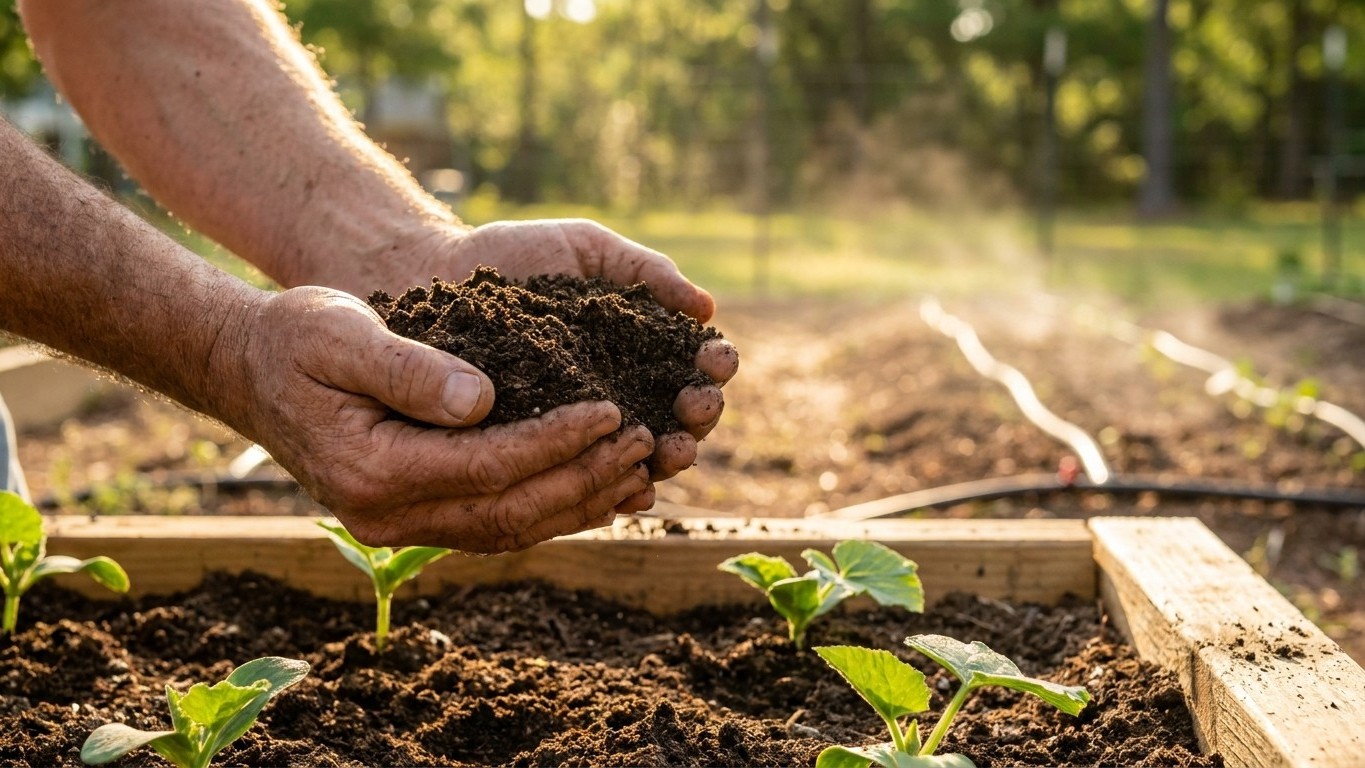

In most of Colorado’s populated corridor, summer squash goes into the ground once the calendar clears the last spring frost window and the soil itself has caught up with the air, typically from mid-May onward along the Front Range, later in the mountains and earlier on parts of the Western Slope. The soil, not the sky, is what decides the date.
When the soil is warm enough in Colorado
NOAA’s 1991-2020 Climate Normals put the last spring frost at Denver’s reference station, USW00003017, somewhere between May 1 and May 11, based on the 30-70% probability band for a 32F freeze. That’s the working frost window for the Front Range plains, and it’s the number most gardeners in the region plan around.
But a frost date only tells you when the air stops freezing. Summer squash doesn’t care about the air. It cares about the soil, and soil at 5,280 feet warms slower than the calendar suggests, especially after a snowy spring or in a shaded, north-facing bed. Squash seed sown into cold soil just sits there, rotting more often than sprouting. The safer read of that May 1 to May 11 window is this: treat it as the earliest the freeze risk drops low enough to matter, then wait another one to two weeks for the soil itself to warm through, particularly if the bed is heavy clay, which holds cold longer than a sandy loam.
That frost window is also a probability, not a promise. A 30-70% chance of a freeze on either side of that range means some years bring a frost before May 1, and some years none after April 20. Nobody can guarantee the sky will behave, so the practical move is to watch the soil directly, not just the date on a chart.
Elevation changes everything
Denver’s frost normals describe the plains at 5,280 feet. Colorado’s mountain towns run a dramatically shorter season, and some can see a frost in July. The Western Slope, with its different air drainage and lower humidity, runs on its own clock entirely. A gardener in Steamboat Springs or Leadville planting by a Denver frost date is planting for the wrong climate. The state’s hardiness zones span 3b to 7b under the USDA Plant Hardiness Zone Map, a range built on one variable, the average annual extreme minimum temperature, and that spread alone tells you how much this state varies from valley floor to mountain pass.
Given that variation, the most reliable local check isn’t a statewide date at all. It’s a soil thermometer pushed a few inches into the bed, paired with a look at the extended forecast, and a call to a local extension office if there’s any doubt about which side of the mountains a particular garden sits on.
How long the season lasts here
Stack the two NOAA windows together and the frost-free season along the Front Range runs from around May 1 to May 11 in spring to September 30 to October 12 in fall, both drawn from the same reference station, USW00003017. Depending on which end of each range a given year lands on, that works out to somewhere between roughly 150 and 155 days without a freeze. Call it five months, give or take a week on either end.
Five months is a genuinely workable season for summer squash, which moves fast once it gets going. That length is what makes a second sowing worth considering rather than a luxury: a planting that goes in during the first half of May, plus a second one seeded in early to mid-summer, can both reach maturity before the fall frost risk climbs back up in late September. A shorter mountain season doesn’t give you that margin. There, the first sowing is usually the only sowing, and the plant has to do all its work in a tighter window with no room for a slow start or a stretch of bad weather early on.
That timing question, when a second planting still has enough season left to finish, is worth working out deliberately rather than guessing. The succession sowing guide on this site walks through how to count backward from a local fall frost date to figure out the last safe date for a follow-up planting, which matters more in a state where the growing window can run anywhere from over five months on the plains to a fraction of that in the high country.
The other decision the season length affects is whether to start seed indoors and transplant, or sow directly into the garden. On a shorter mountain season, a few weeks’ head start from an indoor sowing can matter. On the Front Range’s fuller window, direct sowing after the soil has warmed is usually simpler and avoids the root disturbance transplanting causes, since squash doesn’t always take kindly to having its roots handled.
Heat and water in Colorado
Denver’s reference station logs an average of 39.6 days a year at or above 90F, per NOAA’s 1991-2020 Climate Normals. That’s a real heat load, close to six weeks of high-90s pressure spread across a summer, concentrated mostly in July and early August. Summer squash sets fruit poorly once temperatures push into the high 90s, because the pollen itself doesn’t survive long in that kind of heat, and a flower that isn’t pollinated in time simply drops instead of turning into a fruit. Squash’s oversized leaves make the problem worse: they lose water fast under a hot sun, and the plant’s shallow, spreading root system can’t always keep pace with that demand, especially in the middle of a heat stretch.
Rainfall doesn’t offset much of that. Summer rain across June, July and August averages about 5.7 inches at the same reference station, with July the wettest of the three at 2.14 inches and August the driest at 1.58. Across the whole year the station averages 14.5 inches, so summer isn’t even the wettest stretch of the calendar. That combination, nearly 40 days of 90-degree-plus heat against under 6 inches of rain over three months, is what makes irrigation the deciding factor for squash here rather than an optional extra. A single summer thunderstorm also tends to run off a hard, sun-baked bed rather than soak in, so the rainfall total on paper often overstates what actually reaches the root zone.
What this means at the plant
In practice, that heat and dryness combination points toward a few adjustments: watering deeply and less often so moisture reaches past the shallow root plate, mulching to slow evaporation from the soil surface, and giving plants some afternoon shade during the hottest stretch of July if the bed sits in full, unbroken sun all day. None of that changes the fact that this is dry, hot-day gardening, not the cool, damp-summer gardening some other parts of the country deal with. Where a territory runs cooler and wetter in summer, the risks flip toward powdery mildew and slow ripening instead of heat stress, but that’s not the Front Range’s problem. Here, water management and heat timing are what decide whether a squash crop actually sets fruit or just flowers and stalls.
Worth remembering too: that 39.6-day figure is a count at one reference station, not a blanket description of the whole state. A garden at higher elevation, or on the cooler Western Slope, will see meaningfully fewer 90-degree days, which changes how urgently irrigation and shade need managing there.
Which summer squash suit Colorado
Given a roughly five-month season on the Front Range with a heavy stretch of 90-degree heat in the middle, the types that tend to make sense here are the earliest-maturing kinds, which get a crop established before the worst of the July heat hits pollination, and types that hold up under dry conditions with some airflow around the leaves to reduce the risk of powdery mildew building up in a hot, dusty summer. In the shorter mountain seasons, the earliest types matter even more, since there’s simply less calendar to work with.
What this page won’t do is hand over a specific variety name. That’s not an oversight, it’s the honest answer. Variety performance shifts by elevation, soil, and microclimate in a state that spans hardiness zones 3b to 7b, and a cultivar that thrives on the Denver plains can struggle in a mountain valley two hours away. The only recommendation that actually means something is the one built on local trial data, gathered from real gardens across the state’s different growing regions.
That data lives with Colorado State University Extension, which tracks which squash types and cultivars have performed reliably in trials across the state’s varied climates. A call or visit to a local extension office, matched to the specific county and elevation of a given garden, will do more for choosing the right squash than any general list ever could. Reasoning by type, rather than chasing a name, is the approach that actually holds up once the plant is in Colorado’s soil rather than on a seed catalog page.