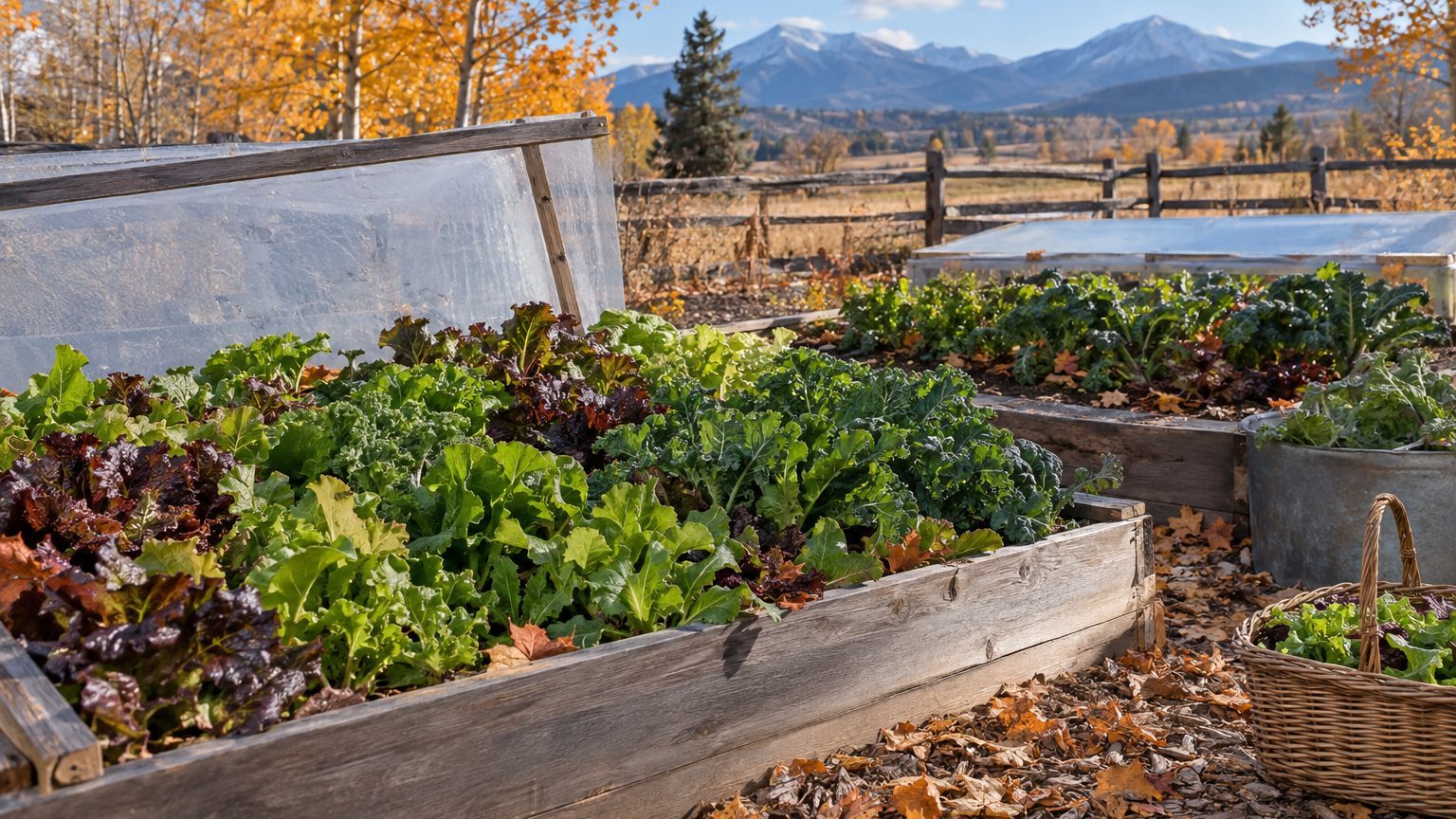

Winter salads in Colorado are decided by cold more than heat. On the Denver plains, hardy greens go in during late summer so they reach useful size before the first fall frost window of September 30 to October 12. After that they need a cover as nights approach the 18.4 F mean daily minimum of the coldest month. Mountain towns and the western slope run on very different calendars.
When the soil is warm enough in Colorado

The last spring frost at Denver falls between May 1 and May 11. That is the 30 to 70 percent probability band for a 32 F freeze at station USW00003017, from the NOAA NCEI 1991-2020 Climate Normals. A freeze in the second week of May is still possible, so treat the dates as a planning range.
Frost dates track air temperature, and seeds respond to the soil. Soil warms more slowly than air and lags behind the end of frost risk, especially in beds that stay shaded or damp. A garden can be frost-free on paper while the top few inches are still too cold for quick germination. Warm soil is what gets seeds up evenly and lets transplants root in without a stall.
How do you check soil in a Colorado bed?
Push a soil thermometer to seed depth in the morning, when the bed is at its coolest, and check it for several days running. One warm afternoon proves little. Soil that crumbles in your hand instead of smearing into a ribbon is ready to work. Working wet clay on the plains leaves clods that dry into bricks.
For winter salads the soil question comes up twice. In spring it tells you when the bed can take an early crop of quick greens. That crop clears out by midsummer and frees the bed for the real sowing, which happens when summer is fading. At that point the problem reverses. Late-summer soil can run too hot for lettuce seed to sprout well, so water the bed and shade it for a few days before sowing to cool it down.
These dates belong to the Denver reference station at 5,280 feet. Mountain towns run far shorter seasons and can frost in July. The western slope differs again, with its own low-elevation warmth and its own cold pockets. A gardener in Grand Junction, Steamboat Springs or Pueblo should lean on local records, and the county office of Colorado State University Extension can supply them. The USDA Plant Hardiness Zone Map 2023 puts Colorado anywhere from zone 3b to 7b, which says plainly how much the state varies.
How long the season lasts here
The reference station has about 150 days between the mean last spring frost (May 1 to May 11) and the mean first fall frost (September 30 to October 12). That is roughly five months. It is a respectable window for a high, dry state, though less generous than it sounds once you add the cool nights of April and late October.
A window of that length allows a second sowing. On the Front Range the bed can carry a spring crop of quick greens, then be cleared and re-sown in late summer for fall and winter harvest. The two crops use different types of plant. Spring greens race against rising heat, and the late-summer sowing needs hardy types that can finish growing before the light fades. The succession sowing guide in this winter salads series lays out how to stagger sowings across a window like this one.
Transplanting also pays off at this length. Starting seedlings in a cool shaded spot in midsummer and moving them out once the worst heat passes buys a couple of weeks. The catch is the roots. Leafy greens dislike disturbance, so choose cell trays deep enough that roots can fill the cell without circling, and handle the root ball gently.
A shorter window changes the arithmetic. Where frost can arrive in September or even earlier, as in many mountain valleys, the first sowing is the only one. Direct sowing then makes more sense than transplanting, because there is no slack to absorb a check at the roots. Greens go in as soon as the soil is workable and the bed is committed for the year, or sown later under a cold frame that holds heat through the first hard freezes.
Gardeners in other climates run into the opposite problem, with windows long enough to sow three times. Compare how it plays out in Winter Salads for Pennsylvania Gardens and Winter Salads for North Dakota Gardens.
Heat and water in Colorado

Denver summers bring hot afternoons and dry air, and the plains get little rain through July and August, so the bed lives on irrigation. That shapes the late-summer sowing. Lettuce and other tender leaves bolt and turn bitter when roots bake, and seed sown into a dry crust may never come up. Mulch the sides of the row, water lightly and often until seedlings emerge, and put shade cloth over the bed for the first couple of weeks.
Dry air does have an upside. Mildew and leaf spot, which wreck salad beds in humid regions, are less of a problem here. The risk shifts to covered beds, where trapped moisture under plastic or fabric can start the same diseases. Vent covers on mild days.
The heat only gets the crop started. Everything after that is settled by the cold. Denver’s coldest month has a mean daily minimum of 18.4 F, and that single figure sorts the greens into three groups. The winter cold decides which ones stand uncovered, which need a cover to stay in edible condition, and which cannot manage at all.
Which winter salads need a cover in Colorado?
The hardiest leaf crops, such as spinach, kale and mâche, can stand uncovered through most winter nights on the plains. They may look wilted and flat in the morning and recover by afternoon. Tender salad leaves, including most head and loose-leaf lettuces and arugula, can take a light freeze but need a row cover, low tunnel or cold frame once nights fall into the low 20s F. Warm-season greens such as basil collapse at the first frost and cannot be carried through winter by any cover short of a heated space.
The first frost, September 30 to October 12 at the reference station, sets how late a sowing can still reach useful size. Growth slows steeply as days shorten in late fall, and by midwinter most plants only hold what they already have. A sowing that goes in too late sits as tiny seedlings all winter and starts growing again in late winter, much too late to be called a winter crop. Count backward from the frost window, and plan the last sowing to reach harvest size before growth stops.
Winter sun and wind dry out covered greens quicker than you might expect. Check the soil under covers every week or two and water on a mild morning, so that the leaves can dry before night.
Which winter salads suit Colorado
The choice here is by type. A short season favors the quickest crops, such as baby-leaf mixes, mustards and tatsoi, because they reach harvest before the light drops. Mountain gardeners, whose first frost may come in early September, should lean even harder on these fast types. Where the window is long, as on the Denver plains, slower and hardier crops like spinach, kale and mâche become realistic. They are the ones to count on for harvest from November through February.
A hot and dry late summer favors types that tolerate heat at germination and can be given airflow and shade at the root. Bolt-resistant lettuces and leaf types that grow low and compact do better than large heads, and wide spacing keeps leaves dry and cool. Because humidity is low on the plains, disease resistance ranks below heat tolerance and cold hardiness. It moves up the list for covered beds, where a damp microclimate is easy to create.
Variety names are where gardeners most often go wrong, and the right source is local. Cultivars that thrive at 5,280 feet in Denver may fail at 8,000 feet in a mountain valley or on a western slope orchard bench. The trials that matter are run by the land-grant university, and Colorado State University Extension and its county offices publish what has performed in each part of the state. Take your variety list from them, because the same cultivar can behave differently with every few hundred feet of elevation.
For the general principles behind these choices, see Winter Salads: What Grows When Lettuce Will Not. Everything in this series assumes beds and containers at home. Salad greens are grown from seed and cut at the garden, never gathered from ditches or streams.
Common questions
When should I sow winter salads on the Colorado Front Range?
Count back from the first fall frost window of September 30 to October 12 at the Denver reference station. Hardy greens need enough time to reach useful size before growth slows. Late summer is the usual starting point, with the exact date depending on your elevation and the type you grow.
Do winter salads need a cover in Colorado?
Spinach, kale and mâche often stand uncovered. Tender lettuces and arugula do better under a row cover, low tunnel or cold frame once nights turn well below freezing. The coldest month averages a daily minimum of 18.4 F at Denver, so plan on covers for anything that is not truly hardy.
Can I grow winter salads in the mountains?
Yes, though the season is much shorter and mountain towns can frost in July. Choose the fastest types, direct sow instead of transplanting, and use a cold frame or similar structure to extend the harvest. Your county extension office can tell you what has worked at your elevation.
Which varieties should I buy?
Ask Colorado State University Extension for the varieties trialled in your part of the state. Local trials account for elevation, dry air and the short mountain season in ways a seed packet cannot.