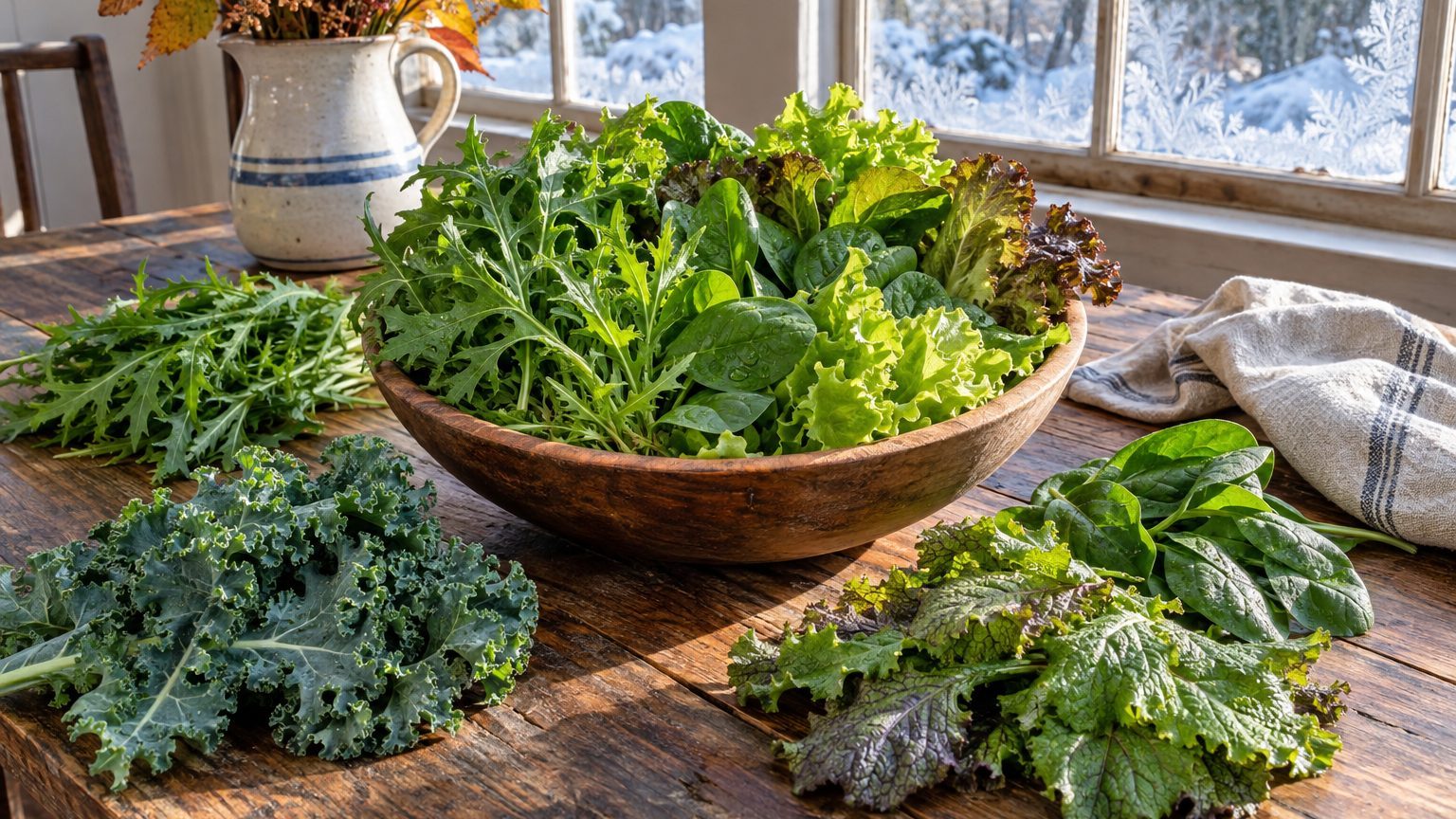

For Colorado, the best winter salads are the cold-tolerant leaf crops: spinach, mâche, claytonia and kale, with arugula, mizuna and tatsoi as fast fillers. Heading lettuces and anything slow to mature are the weak bets. The numbers below come from Denver, at 5,280 feet on the plains. Mountain and western slope gardens run on different clocks, so treat this page as a state-level starting point.
The short answer for Colorado
Choose hardy leaf crops over heading crops, and sort them by how fast they grow. The slow, cold-loving group (spinach, mâche, claytonia) goes in first and stands through the cold months. Kale is the sturdy middle. The quick growers (arugula, mizuna, tatsoi) are your late-sowing insurance. That sorting comes straight from how short the Denver growing window is.
NOAA’s 1991-2020 Climate Normals for the Denver reference station put the last spring frost between May 1 and May 11 and the first fall frost between September 30 and October 12. Both ranges are the band where the chance of a 32°F freeze sits between 30 and 70 percent. They are odds, not promises. A freeze can land before or after either window, and that is why a winter salad plan can’t hang on a single date.
Then there is the cold itself. The mean daily minimum of Denver’s coldest month is 18.4°F. That is an average overnight low, not the record low, so some nights run colder. Plants that shrug off a 28°F night will still struggle through a month of nights like that without any protection. In practice, that pushes most Colorado gardeners toward a cold frame, low tunnel or row cover for the deep-winter harvest.
Here is how the types line up for a Denver-area garden:
- Spinach, mâche, claytonia: sown in early fall, these are the most dependable winter greens. They do their growing in the cool weeks before the deep cold and then hold, giving small harvests through winter, best under cover.
- Kale: tough enough to stay standing outdoors, and good as baby leaves in salads. It is the one crop on this list you can reasonably leave uncovered in most Front Range winters, though the leaves will look battered.
- Arugula, mizuna, tatsoi: fast growers that suit sowings made close to the fall frost window. They stall in the deepest cold, so give them a cover and expect modest winter growth.
For specific sowing weeks, see When to Sow Winter Salads in Colorado. For the wider picture of how winter salads work in this state, start with Winter Salads for Colorado Gardens.
What will not work here
Slow crops sown late. With the first fall frost arriving between September 30 and October 12, a salad crop has to be nearly at harvest size by the time that band opens. Days shorten fast through October and growth slows to a crawl. Whatever hasn’t reached size by then mostly sits and waits. Full-size head lettuce, slow-heading chicories and anything that wants months to mature fall into this trap.
Tender lettuce left bare. An 18.4°F average minimum in the coldest month is a hard ceiling for soft, thin-leaved lettuces. A single hard freeze may be survivable. A winter of them is not, and the leaves turn to mush or brown out at the edges. If you love butterhead and other tender lettuces, they belong under a cover with some ventilation, or in spring and fall rather than midwinter.
Watering once a week and calling it done. Colorado’s air is dry and its wind is steady, even in January. Soil under a cover dries out faster than most people expect, and a frozen, thirsty root zone is a common reason hardy greens fail in a sunny dry stretch. Check soil moisture a few inches down on mild days instead of following a fixed schedule. The same goes for fall sowing: seeds started in warm, dry late-summer soil need daily dampening and a little shade to germinate, particularly lettuce and spinach, which resist sprouting in hot ground.
Sealed covers on sunny days. This one surprises people. A closed low tunnel or cold frame can heat up quickly under strong high-altitude sun, even when the air outside is freezing, and cook the seedlings inside. Vent on bright days, close at dusk. A cover that is never opened does more harm than none at all.
Finally, anything built on Denver’s calendar and carried to the mountains. Denver’s frost windows are a poor guide for mountain towns, where seasons run far shorter and frost can show up in July. An outdoor winter salad bed with no structure is not realistic there. This page does not have station-level frost data for mountain or western slope towns, so it won’t pretend to give dates for them.
What changes across Colorado
The USDA Plant Hardiness Zone Map (2023, built on 1991-2020 normals) puts Colorado anywhere from zone 3b to zone 7b. That is a very wide range for one state, and it means there is no single answer. The system rests on one variable only, the average annual extreme minimum temperature, so it tells you about survival in the coldest snap, not about how long your growing season is or how hot your summer runs.
Denver is the reference city for this page, and the dates and the 18.4°F figure all belong to it. A gardener on the plains near the Front Range will find them close to their own conditions. Elsewhere, the numbers move. Higher ground means a shorter frost-free stretch, colder minimums and a much narrower fall window for sowing. Winter salads there lean on structure: a cold frame, a hoop house or a greenhouse, with the hardiest crops (mâche, claytonia, spinach) doing most of the work.
The western slope differs again. It is not simply “warmer Colorado” or “colder Colorado,” and it does not follow Denver’s pattern in either direction. Local terrain, valley cold pooling and elevation all shift the picture, so a recommendation that works on the plains can be wrong a few valleys over.
If you are north of the Front Range or at altitude, shift your thinking earlier and more protected. Sow sooner relative to the first fall frost, assume cover from the start, and favor the hardiest types. This page cannot say which zone your yard falls in. Look up your location on the USDA Plant Hardiness Zone Map and read the zone for your own spot, not the state’s overall spread.
Where to check this for your own county
Colorado’s land-grant extension service is Colorado State University Extension, and it is the right next stop. County offices know their local frost patterns, soils and water, and they hear every spring and fall what actually worked in their area.
Look for two things there. First, a local planting calendar for your county, or the nearest one that matches your elevation. A calendar built for your valley will beat any statewide date, including every date on this page. Second, any information on varieties trialled in your county: which spinach, kale or hardy lettuces held up through local winters and which ones didn’t. This page does not have county trial results, so that detail has to come from them.
The plain truth is that a county recommendation beats a state one. This page is the state one. It gives you a sensible starting point and tells you which types are worth trying, but it averages over terrain that spans everything from the plains to high mountain valleys. If the extension office’s advice and this page disagree, trust the extension office.
Many county offices also run Master Gardener help lines or answer garden questions by phone or email. If you can’t find a winter salad calendar online, asking directly is a perfectly good way to get one.
Checking this against your own garden
Your own observations outrank every date here. Three are worth watching, and none needs equipment.
Soil warmth by feel. Push your hand a few inches into the bed in the morning. If it feels clearly warm, late-summer soil is still too hot for spinach and lettuce to germinate well, so wait or shade it. If it feels cool and crumbly, sow. A bed against a south-facing wall will stay warm longer and thaw sooner than one in open shade, and that gap is your microclimate showing itself.
The first flush of male flowers. On squash and cucumbers, the male blooms open first. When they appear, you know your garden has crossed into real summer growth. Note the date each year. A garden that gets there earlier than a neighbor’s is warmer or more sheltered, and it will likely let you start fall sowings on a different schedule too.
The first true leaves. Seedlings first show two rounded seed leaves, then the first true leaves, which look like the mature plant. Fall sowings that reach that stage before the first hard freeze are in good shape. Ones that haven’t will probably stall until spring. If your seedlings are routinely behind, your site is cooler, shadier or windier than Denver’s average, and you should sow earlier or add cover sooner.
Common questions
Can I grow winter salad greens outdoors in Colorado without any cover?
Kale and some spinach can survive uncovered on the plains, but expect slow growth and damaged leaves. With Denver’s coldest-month average minimum at 18.4°F, most salad greens give better harvests under a cold frame or row cover. In mountain towns, cover is close to mandatory.
Which winter salad crop is the most dependable for Colorado?
Spinach, mâche and claytonia are the strongest group for cold-season salads, since they handle cool weather better than faster greens. Kale is the toughest for open-air growing. Which one does best for you depends on your elevation, so check county trial information through extension.
Are the frost dates on this page exact?
No. For the Denver reference station, they mark the band where the chance of a 32°F freeze is between 30 and 70 percent: May 1 to May 11 in spring, and September 30 to October 12 in fall. A freeze can come earlier or later, and other parts of Colorado differ.
Does my hardiness zone tell me when to sow?
Not by itself. The USDA zone system uses one measure, the average annual extreme minimum temperature, so it describes how cold your coldest snap gets. Sowing dates depend on frost timing, which varies across Colorado’s 3b to 7b spread. Pair your zone with your county extension calendar.