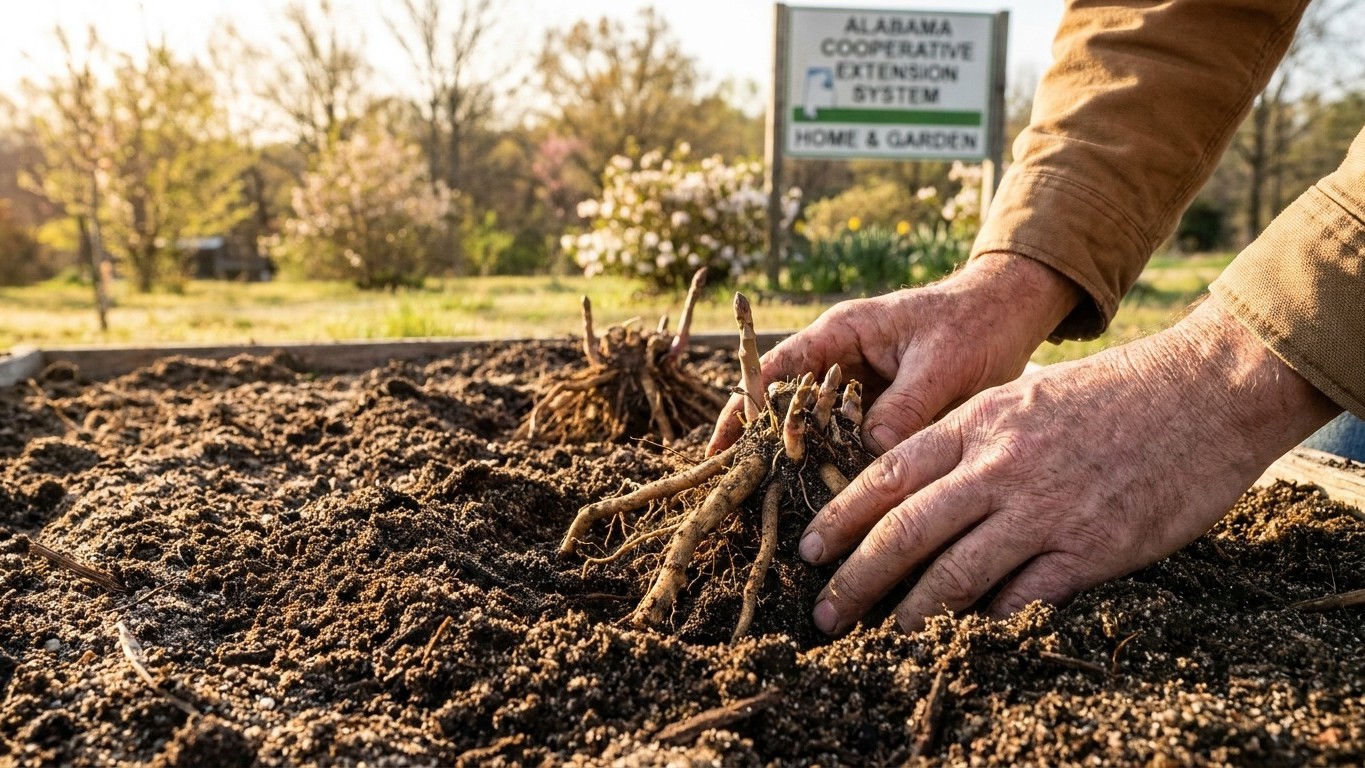

Plant Asparagus Crowns in Connecticut in early spring, once the ground has thawed and can be worked, timed to the region’s last-frost window rather than a fixed calendar date. For the state’s coastal reference station, that mean last-frost window runs from April 2 to April 12; inland and northwest Connecticut push later. The crowns go into an 8-inch furrow, and the bed being built will keep producing for a decade or more once it’s established, which makes the site and soil decision weigh heavier than the exact planting week.
The short answer
an Asparagus Bed is a decision made once and lived with for ten to fifteen years, since Utah State University Extension’s guidance is plain that the plant isn’t harvested until its third year and then keeps producing for a decade beyond that. The only soil condition the source names is drainage: asparagus wants ground that sheds water, full stop. No pH number, no fertility target, and no winter chilling requirement is published for this crop, just drainage.
Connecticut’s answer to that question, at least on paper, leans favorable. The soil USDA lists as representative of the state is the Windsor series, and it’s about as far from soggy as soil gets: 82 percent sand, only 2 percent clay, and a drainage class the survey records as excessively drained. Water doesn’t linger in ground built that way; it moves through fast. For a crop that spends fifteen years in one spot, that trait matters more than almost any other single number in a soil report.
That doesn’t mean every yard in the state sits on sand. The Windsor series is what USDA lists as representative of Connecticut, a benchmark rather than a survey of every garden bed in it. Rivers cut floodplains of heavier silt, hillsides carry ledge and till, and any lot a builder has graded or filled can behave nothing like the mapped series nearby. The only way to know what’s actually under a given yard is a soil test, or a look at the county soil survey for that specific parcel.
If the ground doesn’t drain
If a test, or just a shovel honestly, turns up ground that holds water after a hard rain, a bed for a crop that stays put for fifteen years is not the place to gamble. Raised beds or a mounded row solve most drainage problems for asparagus, and working several inches of compost or coarse sand into the planting trench helps water move through rather than sit around the crown. Skipping that step on heavy ground doesn’t just cost a season; it can rot the crowns before they ever produce a spear worth cutting.
The source is silent on soil pH and on any winter chilling requirement for asparagus, so no target number for either is offered here. What’s published is drainage, and on that single measure, the soil this state is known for leans favorable rather than the reverse.
Will the summer here water it for you?
Utah State University Extension’s watering schedule for a new asparagus bed is specific: 1 to 2 inches of water every other week for the first two years, then a lighter rhythm of the same 1 to 2 inches every three weeks once the crowns are established. Connecticut’s summer rainfall, on paper, covers a good share of that math, but the numbers only line up on a calendar, not necessarily in the ground.
- What the sky delivers. The 1991-2020 normals for the reference station put summer rainfall at about 11.1 inches across June, July and August combined: 3.77 inches in June, 3.32 in July, 3.98 in August. July, the driest of the three, is also usually one of the hottest months of the growing season, right when a young bed’s roots are working hardest to get established.
- What a young bed asks for. At 1 to 2 inches every other week, a bed in its first two seasons wants somewhere around 6 to 7 applications across a 13-week summer, roughly 6 to 13 inches of water depending on which end of that range a given week actually needs.
- Where the gap shows up. July’s 3.32 inches, spread across four or five weeks, rarely arrives as two tidy inch-and-a-half doses two weeks apart. Connecticut rain tends to come as thunderstorms, a heavy pulse followed by a dry stretch, and on the sandy, excessively drained soil the state is known for, water that does fall moves through the root zone quickly rather than sitting in reserve for the next dry stretch.
- What that means for the hose. A gardener on sandy, fast-draining ground should plan to supplement in most summers, particularly through July, rather than assume the sky is handling it. A rain gauge staked next to the bed is the only way to know, week to week, whether that particular July delivered its average or fell short of it.
- After year two. Once the bed shifts to the lighter every-three-weeks schedule, the math gets easier: roughly 4 applications of 1 to 2 inches across the same 13-week stretch, a target the state’s summer normals cover more comfortably, even allowing for an uneven July.
When to put the crowns in
Crowns go into the ground in early spring, and the timing anchor for that is the region’s last-frost window rather than a fixed week on the calendar. For the coastal reference station, the mean date of last spring freeze falls around April 2 to April 12, a range built from three decades of freeze-probability data, not a promise about any single year. Around that window, once the soil can be worked and isn’t waterlogged from spring melt, is when the 8-inch furrows go in and the crowns get set.
That April 2 to April 12 figure comes from the coastal reference station, which sits in the mildest part of the state. Inland and northwest Connecticut freeze later in spring and earlier in fall than the coast does, so a gardener working land away from Long Island Sound should expect to plant later than that window, not on it. The safest local check is the same as the one for soil: look at what the ground and the forecast are actually doing on the property in question, rather than importing a coastal date to hill country.
Once the furrow is dug and the crown set at the bottom, the trench isn’t filled in all at once. The backfill goes in gradually across the season, about two inches every other month as the emerging shoots grow, rather than burying the crown under a full 8 inches of soil on planting day. That gradual fill gives the crown room to push up through loose soil instead of fighting through a compacted trench.
Crowns aren’t the only route in. Asparagus can also be started from seed, though that path adds a year to an already patient timeline; seed-grown plants need a season to become transplant-sized crowns before they go into the permanent bed, pushing the first harvest out further than the three-year wait a purchased crown already requires. For most home gardeners, buying dormant one-year crowns and setting them in early spring, timed to that regional frost window, is the faster route to the eventual harvest.
Common questions
Which asparagus variety should I plant in Connecticut?
Utah State University Extension names four: Jersey Giant and Jersey Knight, both all-male, and UC 157 F1 and Purple Passion, both male-and-female. The source doesn’t publish flavor, yield, or a reason to prefer one over another for a given region, sex of the plant is the only distinction on record, so any preference beyond that isn’t backed by this source.
How long before I get asparagus to eat?
No spears get cut in the first two years at all. Harvest starts in year three, and even then it starts light: about four weeks of cutting that first harvest year, six weeks the year after, and eight weeks the year after that. Each season’s cutting ends not on a set date but on a signal from the plant itself, when most of the spears coming up have gone thinner than a pencil.
Does Connecticut soil need amending before planting asparagus?
That depends entirely on what’s under the specific yard in question, not on the state’s representative soil series. If a soil test or a simple dig shows ground that drains well, as the sandy soil this state is known for tends to do, no amendment is dictated by the source beyond good drainage. If the ground holds water, working in compost or coarse sand and raising the bed is the fix, since drainage is the one soil condition asparagus actually requires.
Can I Plant Asparagus Crowns in fall instead of spring?
That’s not published in the source used for this guide. What is published is early spring planting, timed to the region’s last-frost window, along with seed as a slower alternative route. A gardener considering a fall planting should treat that as an open question rather than an option confirmed here.